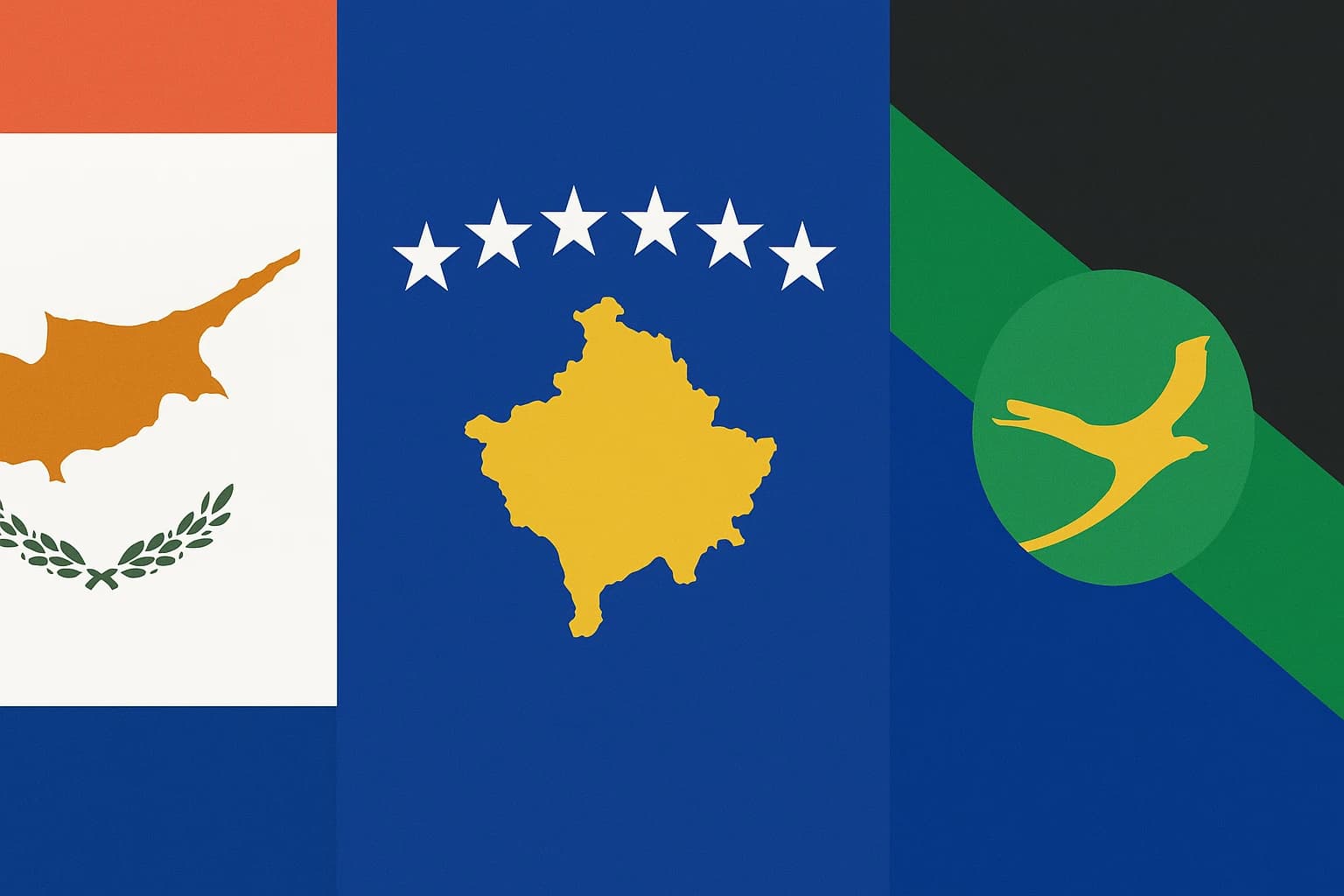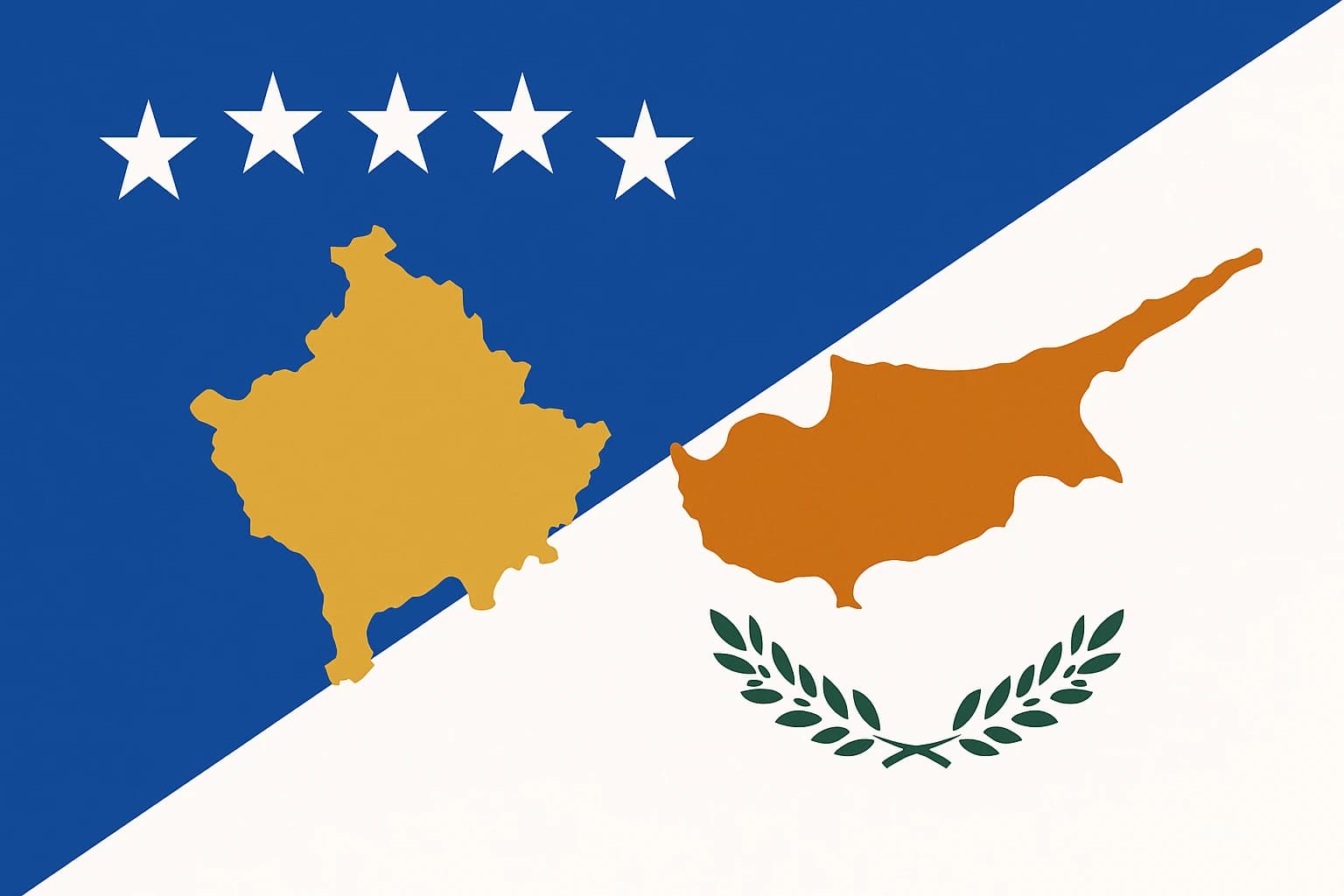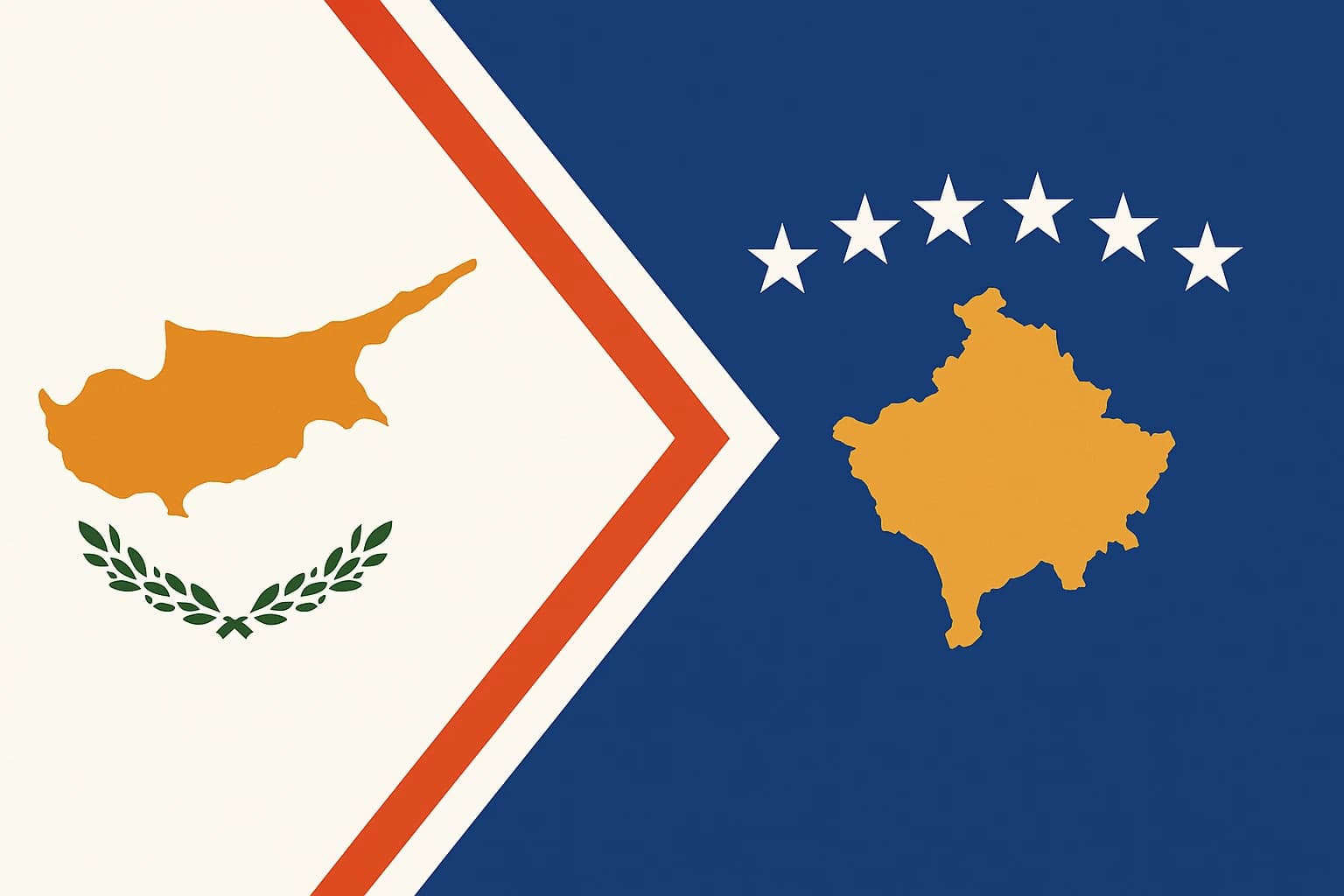
Out of 195 widely recognized sovereign nations, exactly two put a map of their own territory on their national flag: Cyprus and Kosovo.
A flag normally points outward. It compresses a whole country into a rectangle of color and shape and asks other people to read it. A map points inward. It traces the edges of what you claim to own, which makes it an argument about law rather than an argument about identity.
That is why a map-flag is closer to an admission than a boast. It is what a country ends up with when it has run out of symbols its own people can agree on. Nicosia in 1960 and Pristina in 2008 are separated by nearly five decades and by completely different conflicts, and they arrived at the same solution for the same reason.
What flags are for, and why maps break the rules
The core function of a national flag is abstraction. Colors and shapes stand in for values, history, and community rather than for literal geography. Japan's flag is a red circle on white, representing the rising sun. Canada's is a maple leaf. Neither country needs to draw its own outline to say what it is.
The North American Vexillological Association, the leading organization in the study of flags, publishes design guidelines that stress simplicity, meaningful symbolism, and distinctiveness. Good flags tend to work because they offer something a citizen can project meaning onto: a color, an animal, a shape that no faction has managed to claim outright.
A map offers nothing of the kind. It is a territorial claim rendered as a graphic element, and it only makes sense under one condition. A country adopts a map-flag when its communities are so divided that every conventional symbol already belongs to one of them, and the outline of the land is the last image nobody has weaponized.
Two countries reached that condition forty-eight years apart, and both made the same choice.
Cyprus 1960: the outline was all that was left
Cyprus in the late 1950s was a British Crown Colony coming apart. The Greek Cypriot majority, roughly 80% of the population, wanted enosis, union with Greece. The Turkish Cypriot minority feared absorption and pushed for taksim, partition. These were not debating positions. The two communities were killing each other over them.
EOKA, the Greek Cypriot paramilitary organization, ran a bombing and assassination campaign against British targets and Turkish Cypriots. TMT, the Turkish Cypriot resistance group, retaliated. Neighborhoods split along ethnic lines, and by the time independence negotiations began the island had been in open intercommunal violence for years.
Now consider the flag design problem. The Greek Cypriot community claimed the blue and white of the Greek flag.
The Turkish Cypriot community claimed the red and white of the Turkish flag.
Any palette that referenced either nation amounted to a declaration of victory for one side. Blue was Greek. Red was Turkish. Green carried Islamic associations. There was nothing safe left in the paint box.
The answer came through the 1960 Constitution, negotiated via the Zurich and London Agreements: a white background claimed by nobody, a copper-colored silhouette of the island, and two crossed olive branches below it. The copper reference was genuinely pre-partisan, since Cyprus is named for the metal, "Kypros" in Greek. The olive branches belonged to no ethnic tradition on the island.
The map was not a design triumph. It was what remained after every contested symbol had been stripped out.
How the flag's neutrality collapsed
In 1974 a Greek junta-backed coup attempted to force enosis. Turkey responded with a military invasion, and the island was partitioned. The north, roughly a third of the territory, came under Turkish military control. In 1983 the Turkish Republic of Northern Cyprus declared itself an independent state, recognized only by Turkey.
The TRNC then adopted its own flag, a deliberate visual inversion of Turkey's: a red crescent and star on white, bookended by two horizontal red stripes. Meanwhile the copper silhouette on the official Cypriot flag now depicted territory the Republic of Cyprus does not control. A shape chosen because it was the one thing both communities could accept had become a picture of what one of them had lost.
The outline still shows the whole island, including the north, which has been under Turkish military presence for over fifty years. UN peacekeepers patrol the Green Line buffer zone. Reunification talks have collapsed repeatedly, most notably at Crans-Montana in 2017, and nothing since has come close.
Kosovo built the same structure four decades later, with the Cypriot precedent available to anyone who cared to look at it.
Kosovo 2008: a flag designed under supervision
Kosovo declared independence from Serbia on February 17, 2008. Behind that date sit the Kosovo War of 1998 and 1999, NATO's 78-day bombing campaign against Serbia, and nearly a decade of UN administration under UNMIK.
The design problem was, if anything, tighter than Cyprus's. Kosovo was roughly 92% ethnic Albanian, with a significant Serbian minority concentrated in the north and smaller Roma, Bosniak, Turkish, and Gorani communities. Serbia, backed by Russia and China at the UN Security Council, refused to recognize independence at all.
The Albanian double-headed eagle, the centerpiece of Albania's flag, was the obvious candidate for the majority population.
Using it would have signaled irredentism, a desire to merge with Albania, which would have alarmed the Serbian community and the Western governments sponsoring independence in roughly equal measure. The Serbian Orthodox cross was a non-starter for the opposite reason. Every traditional ethnic symbol was disqualified before the competition began.
That competition, run under international supervision, produced the design the Kosovo Assembly adopted: a blue field, a gold map of Kosovo's territory, and six white stars in an arc above it, one for each of the main communities, Albanians, Serbs, Bosniaks, Roma, Turks, and Gorani.
The map was again the only image no faction owned. And the blue is not a coincidence. It matches the EU flag.
That palette was aimed at Brussels and Washington rather than at Kosovo's own citizens, which makes the flag a diplomatic document as much as a national symbol.
What the two flags share beyond design
Neither flag grew out of centuries of shared culture. Both were assembled at a crisis moment, under external pressure, by committees trying to satisfy hostile communities simultaneously. Cyprus's emerged from British-brokered negotiations involving Greece and Turkey. Kosovo's emerged under EU and US supervision with explicit international sign-off. In both cases the result reflects what foreign mediators could accept as much as what citizens chose.
Kosovo's six stars are worth looking at closely. The star nominally representing the Serbian community sits above a map Serbia does not recognize. The design claims to include Kosovar Serbs while asserting a territorial reality Serbia rejects, and that contradiction was baked in from the first day.
Both flags also lack something. No historical reference, no religious symbol, no founding myth. Compare the Israeli Star of David, the Nordic crosses, or the crescent on the Turkish and Pakistani flags.
Those flags invoke a deep shared story. Cyprus and Kosovo are quietly conceding they have no such story they can display without starting an argument. They agree, tenuously, on where they are. Not yet on what they are.
Why flag scholars treat map-flags as a warning sign
Designers and flag scholars consistently rate map-flags as poor designs, and the objection is functional rather than aesthetic. A map only works as a symbol if the map is uncontested, and a country that needs a map-flag is by definition a country whose map is contested.
Other entities have tried it. Colonial-era British territories often included geographic outlines, and several US state flags carry the state's shape. Most of those are considered weak designs, have been replaced, or belong to entities whose sovereignty is not under existential threat.
The obvious objection is that a map is a proud assertion of territorial integrity. Turn it around. For a nation at peace with its borders the map is redundant. Canada does not need to draw Canada on its flag; France does not need to show you the hexagon. The outline becomes necessary only when the borders are the thing under argument, and at that point the flag is insisting rather than stating.
Michael Billig's concept of "banal nationalism," introduced in 1995, describes how national symbols work by going unremarked, ambient, taken for granted. A flag outside a post office should fade into the texture of an ordinary day. A map-flag resists that. It is too literal and too legalistic to disappear, so it reminds you of the dispute every time you pass it. Something like a hospital bracelet: the identification is necessary precisely because something is wrong.
Can a map-flag ever be retired?
Kosovo offers no comfort on that question. Roughly 104 UN member states recognize it, but Russian and Chinese vetoes block UN membership. The north remains tense and semi-partitioned. EU accession candidacy grinds on. The map has not become less contested, and it still surfaces as a flashpoint in the EU-brokered normalization talks between Belgrade and Pristina.
Cyprus is no closer. The Republic's flag still bears the full island. The north is still under Turkish military presence. Reunification talks remain stalled with no resumption scheduled. The map has depicted claimed but uncontrolled territory for over fifty years, and no alternative design is politically viable, because proposing one would mean conceding the dispute.
In theory the conditions for retiring a map-flag are simple. Genuine reunification, or a final-status agreement that settles the territorial question, would make the outline redundant. The borders would be settled enough that a country could stop drawing them and start using a symbol that means something beyond coordinates. Neither Nicosia nor Pristina is anywhere near that point, which is why both maps stay where they are.