Flags carry arguments
Vexillology is the study of flags, and most of what it turns up is political. A flag has to do two contradictory things at once: mark a country off from its neighbors and hold together everyone inside it. The designs that follow all attempt that balance in different ways.
Afghanistan
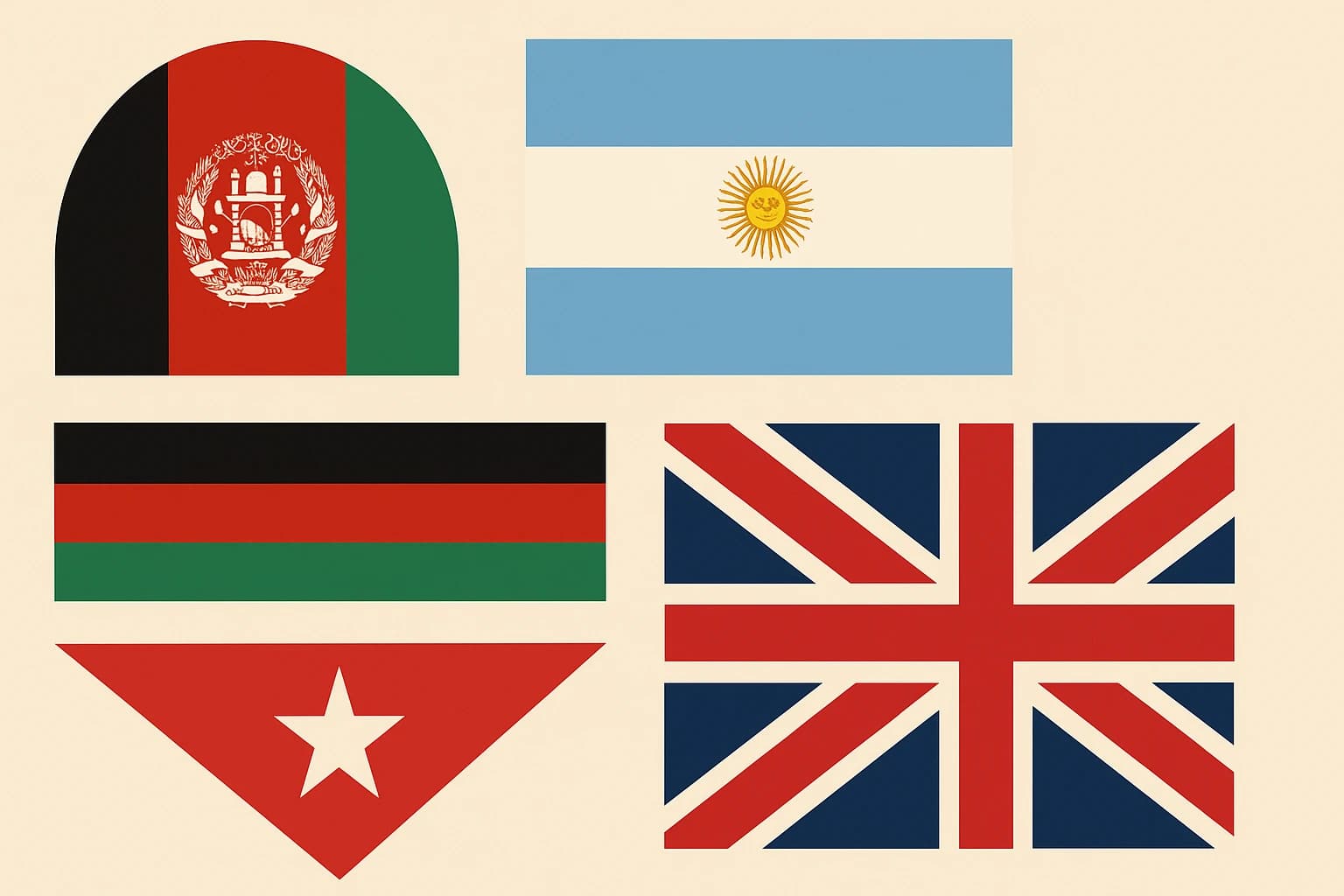
Afghanistan's flag has changed many times. Each redesign followed a political shift, which makes the sequence of flags a fairly reliable record of the country's politics and of a nation trying to work out its own identity under pressure.
Argentina
The sun on Argentina's flag is called the Sun of May, and it marks the start of a new era. The blue and white around it stand for sky and clouds.
Africa
Many African flags share a set of liberation colors, alongside symbols specific to each country's own struggle. The flags of South Africa, Ghana, and Kenya are all built around independence and the fight that preceded it.
The Americas
Flags across the Americas record colonization, independence, and the cultures that survived both. Canada's maple leaf and Brazil's stars work at opposite ends of that range, one a single emblem and the other a scatter of them.
Europe
European flags carry a long record of political change. The French tricolor and Germany's black, red, and gold both belong to specific moments of transformation rather than to any continuous tradition.
The Union Jack works differently again. It is a composite, a union of kingdoms rendered as overlapping crosses.
Asia
Japan's flag is one of the simplest in the world; India's tricolor packs a great deal more symbolism into its three bands. Both sit inside traditional narratives while staying open to newer readings.
Reading them
A flag compresses a lot into very little. Colors and shapes carry the parts of a national story that a country wants visible at a distance, which also means they tell you what has been left out.