The Flag of Moldova
Republic of Moldova
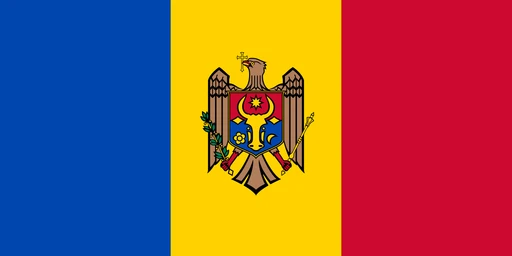
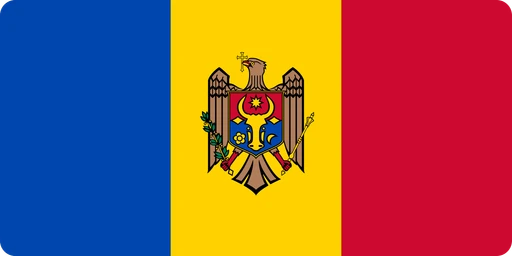
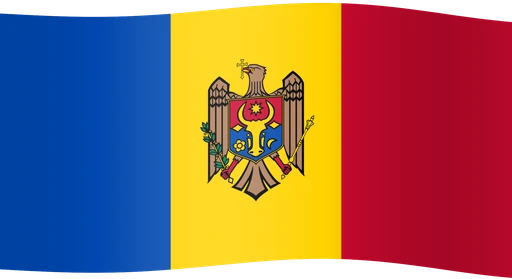
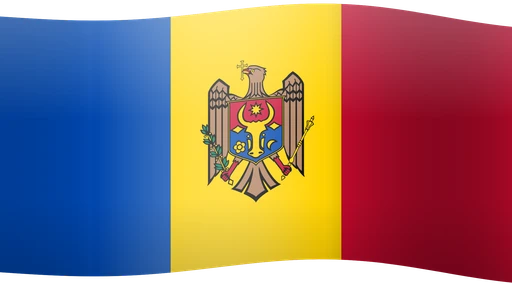
The flag of Moldova is a vertical tricolor of blue, yellow, and red with the national coat of arms in the center of the yellow band. The arms show a golden eagle holding an Orthodox Christian cross in its beak and a scepter and an olive branch in its talons, flanked by a floral ornament. Moldovan law sets out the flag's proportions and the details of the arms.
Moldova's flag is one of the most distinctive in the world: a rare national flag that carries a full coat of arms on both sides, making it one of only a handful of flags globally to feature a reverse, mirrored image. At its heart is a golden eagle clutching an olive branch and a scepter, bearing a shield depicting an aurochs head beneath a star, flanked by a rose and a crescent. This layered emblem compresses centuries of Moldovan, Romanian, and Dacian heritage into a single heraldic image. The tricolor of Prussian blue, yellow, and red binds Moldova to its Romanian linguistic and cultural kinship, while the unique coat of arms insists on a distinct national identity. That tension has defined Moldova's post-Soviet story ever since independence in 1991.
Why the coat of arms matters
Moldova is one of only three countries in the world whose national flag features a coat of arms on both the obverse and the reverse, with the reverse being a mirrored image. The other two are Ecuador and the Central African Republic. It's a detail that might sound minor, but it creates real headaches: manufacturing a double-sided flag with a detailed heraldic emblem is significantly more expensive and technically demanding than printing a simple geometric design. That Moldova insists on it anyway is itself a political statement, a declaration of heraldic pride.
The coat of arms was restored after the Soviet period, which had buried it under communist symbols for half a century. Its reinstatement in 1990 was an act of cultural reclamation, a conscious reaching back to a pre-Soviet identity that Moscow had tried to erase. Without the coat of arms, Moldova's flag would be virtually indistinguishable from Romania's, which uses the same blue, yellow, and red vertical tricolor with no central emblem. That near-identical appearance has caused real confusion at international sporting events and diplomatic functions, where the two flags have been accidentally swapped. The coat of arms, then, isn't decorative. It's the single element that gives Moldova its own visual identity on the world stage.
Among vexillology enthusiasts, Moldova's flag consistently appears on lists of the world's most complex national flags. The eagle, shield, aurochs, star, rose, and crescent are all doing separate work in a very small space.
From the Principality of Moldavia to the Moldavian SSR
The blue-yellow-red tricolor has roots reaching back to the Principality of Moldavia, which used similar colors as early as the late 18th and 19th centuries. These weren't arbitrary choices. As the unification movement with Romania gained momentum in the 1800s, shared colors reflected a shared national consciousness, a visual argument that the Moldavian and Wallachian peoples belonged together.
Then came the Soviets. After the establishment of the Moldavian SSR in 1940, Moscow imposed a succession of flags designed to smother that earlier identity. Early versions featured the standard red field with hammer, sickle, and star. Later iterations added a green horizontal stripe, a nod to Moldova's agricultural landscape, but always subordinated to Soviet iconography. Pre-existing heraldry was deliberately suppressed. The aurochs, the eagle, the centuries-old shield: all vanished from official use.
The pivotal year was 1990. On April 27, over a year before Moldova formally declared independence in August 1991, the Supreme Soviet of the Moldavian SSR adopted the tricolor with the restored coat of arms. It was a bold move, a declaration of sovereignty wrapped in fabric and thread while the USSR still technically existed. After independence, the flag was confirmed, with minor subsequent refinements to the coat of arms's legal description clarifying proportions and color specifications.
One stark reminder of this unresolved history flies just east of the Dniester River. Breakaway Transnistria still uses a flag derived directly from the Soviet-era Moldavian SSR: a red field with a green horizontal stripe, topped by a gold hammer, sickle, and star. It's the only territory in the post-Soviet space to have retained full Soviet-era symbolism on its flag, making it a living artifact of a conflict that remains frozen to this day.
Reading the golden eagle
The eagle at the center of Moldova's coat of arms is a golden (or natural) eagle displayed, its wings spread wide. This motif draws from medieval Moldavian heraldry and connects to the broader Eastern European tradition where eagles signify power and divine protection. In its right talon, the eagle grips an olive branch, the universal emblem of peace. In its left, a golden scepter, signaling sovereignty and the authority to rule.
On the eagle's breast is a shield that works almost as a flag within a flag. Against an azure background, the aurochs head dominates. The aurochs, or zimbru, is the ancient symbol of Moldavian statehood, an extinct wild ox that once roamed the Carpathian forests and became synonymous with the principality's strength. Above the aurochs head sits an eight-pointed star, sometimes called the Star of Bethlehem, sometimes interpreted as a solar symbol predating Christianity. To the right of the aurochs is a five-petaled rose, linked to the historical region and its natural abundance. To the left hangs a crescent, whose meaning is genuinely contested: some scholars point to Ottoman-era influence, others to Christian symbolism, and still others trace it to pre-Christian lunar traditions common across the Balkans.
The azure background of the shield echoes the blue of the tricolor's first band. The aurochs itself crosses borders: it also appears in Romania's coat of arms and in the heraldry of the historical Moldavian principality, so both countries claim the same animal as their own.
Blue, yellow, red: shared colors, contested meanings
The specific shade matters more than you might think. Moldova's blue is Prussian blue, a darker, more muted tone than the brighter cobalt blue on Romania's flag. It's a subtle difference, but it's codified in Moldovan law, a quiet insistence that these are not the same flag, even if they look alike from across a stadium.
Yellow occupies the center band, symbolizing Moldova's fertile plains and grain fields. This is one of Europe's most agriculturally productive regions, and the golden stripe reflects that reality. Red, on the right, carries the traditional meaning found across dozens of national flags: the blood of those who fought for the nation's freedom, echoing the Romanian tricolor tradition from which Moldova's palette descends.
The vertical arrangement of three equal bands follows the French tricolor model that swept across 19th-century European nationalist movements. Plenty of nations adopted this format. What makes Moldova's case unusual is the near-total visual overlap with Romania's flag when the coat of arms is removed. Both flags have been mistakenly flown for each other at international events, causing diplomatic awkwardness and occasional public outcry. Within Moldova itself, there's a long-running debate about whether to keep the Romanian-style tricolor or adopt something more visually distinct. That debate is never really about design. It's about identity: whether Moldovans are a branch of the Romanian nation or a separate people entirely.
Protocol, variants, and the Transnistrian shadow
Moldova's flag flies at the Presidency, Parliament, government buildings, courts, and embassies abroad, with specific protocols governing half-mast display during official mourning periods. What catches many people off guard is the civil flag. Moldova's civil and merchant flag omits the coat of arms entirely, leaving a plain blue-yellow-red tricolor. On the open sea, a Moldovan-flagged vessel is flying what looks exactly like the Romanian flag.
The President of Moldova uses a distinct variant: the coat of arms centered on a plain blue field, a simpler but immediately recognizable marker of the head of state. Armed forces and police units carry their own variants, typically incorporating the coat of arms with additional military insignia.
Then there's Transnistria. The self-declared Pridnestrovian Moldavian Republic flies a flag that is, quite literally, a Soviet relic: a red field with a green horizontal stripe, hammer, sickle, and star in gold. No other post-Soviet entity has retained this level of Soviet-era symbolism on its official banner. The contrast between Chișinău's golden eagle and Tiraspol's hammer and sickle captures an entire geopolitical fracture in two pieces of cloth.
Gagauzia, Moldova's autonomous region in the south, adds another layer. Its flag, three horizontal stripes of blue, white, and red with a wolf's head, reflects yet another distinct identity within Moldova's borders. Walk across this small country and you'll encounter at least three fundamentally different flags, each telling a different story about who the people beneath them believe themselves to be.
Identity politics and the flag
Moldova's flag sits squarely at the center of the country's ongoing identity debate. Pro-Romanian citizens see the tricolor as confirmation of cultural unity with Romania, evidence that the Prut River is an artificial border. Pro-Moldovan identity advocates point to the distinct coat of arms as proof of separate nationhood, a symbol that says: we share roots, but we are our own country.
Since Moldova applied for EU membership in 2022, following Russia's full-scale invasion of Ukraine, the national flag increasingly appears alongside the EU's circle of gold stars in public settings, on government buildings, at rallies, on social media profiles. It's a symbolic alignment with the West that would have been unthinkable a generation ago.
Various political movements have called for a redesign over the years and none have succeeded. Moldovan diaspora communities abroad use the flag as an identity marker, particularly to distinguish themselves from Romanian communities in London, Rome, and Paris, where both populations are significant.
References
[1] Official website of the Parliament of the Republic of Moldova, Law on the State Flag of the Republic of Moldova (Law No. 248, 1990). parlament.md
[2] Official website of the President of the Republic of Moldova, State Symbols section. presidency.md
[3] Flags of the World (FOTW), comprehensive vexillological analysis of Moldova's flag and its variants. fotw.info/flags/md.html
[4] Smith, Whitney. "Flag." Encyclopædia Britannica. General vexillology reference for flag symbolism and protocol.
[5] King, Charles. The Moldovans: Romania, Russia, and the Politics of Culture. Hoover Institution Press, 2000. Essential source on Moldovan national identity and the political dimensions of state symbols.
[6] Treptow, Kurt W. (ed.). A History of Romania. The Center for Romanian Studies, 1996. Historical context for the Moldavian Principality and shared Romanian-Moldovan heritage.
[7] Heraldry of the World, detailed breakdown of Moldova's coat of arms elements and their heraldic sources. ngw.nl/heraldrywiki
[8] TASS and Reuters reporting on Transnistrian flag symbolism and EU accession symbolism (2022-2024), for contemporary context.
Common questions
- Why does the Moldovan flag look like the Romanian flag?
- The Moldovan flag mirrors the Romanian flag because of shared historical and cultural links. Both hail from a common Dacian and Roman heritage, shown in their identical blue, yellow, and red stripes.
- What does the aurochs on the Moldovan flag mean?
- The aurochs stands for bravery and nobility. It comes from medieval heraldry and is one of the oldest Moldovan symbols still in use.
- What does the eagle symbolize on Moldova's coat of arms?
- The eagle in Moldova's coat of arms symbolizes the Christian faith. Holding an Orthodox cross, olive branch, and scepter, it represents peace and sovereignty.
- Why does Moldova's flag look almost identical to Romania's?
- They both use the same blue, yellow, and red vertical stripes because of their shared Romanian language and culture. The main difference is that Moldova's official flag has a coat of arms in the center, while Romania's doesn't. Without that coat of arms, the two flags look so similar they've actually been swapped by accident at international events.
- What's the aurochs on Moldova's flag, and why is it there?
- The aurochs (called zimbru in Romanian) was the symbol of medieval Moldavia, an extinct wild ox that used to live in the Carpathian forests. It represented the region's strength and power back then. You'll find it on Romania's coat of arms too, since both countries share those historical roots, though they both claim it as their own heraldic symbol.
Featured in these articles
- The Coat of Arms Nobody Can Draw: Why Some National Flags Are Legally Perfect and Practically Impossible
- Stripes That Tell the Wrong Story: How the Horizontal Band Became the Default, and What Countries Lost When They Copied It
- The Coat of Arms Trap: Why Belize, Moldova, and Paraguay Put Encyclopedias on Their Flags, and Whether It Works
- Five Flags That Never Come Up in Quizzes
Download this flag
Free in 12 styles, from 32px icons up to 2000px, as SVG, PNG, WebP and JPG.