The Flag of Austria
Republic of Austria
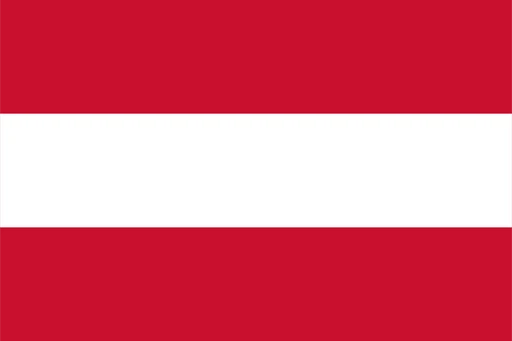
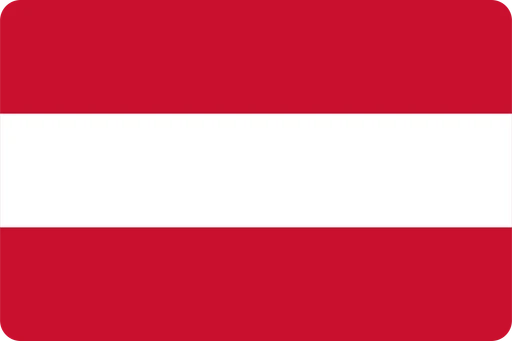
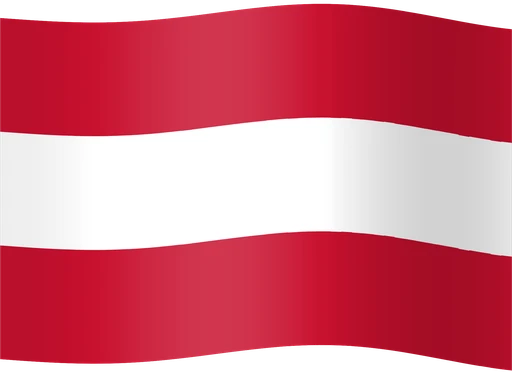
Austria's flag has three horizontal bands of equal width, red at the top and bottom with white between them. It is among the oldest national flags in the world, and the red-white-red triband has stood for Austria through eight centuries of changing states.
Austria's red-white-red triband is one of the oldest national flags in the world, with origins in the late twelfth century. Legend puts its birth on a battlefield at the Siege of Acre in 1191, where Duke Leopold V of the Babenberg dynasty removed his blood-soaked surcoat to find only a white strip where his belt had been. True or not, the colors have stood for Austria for over eight centuries, through the rise and fall of empires, annexation by Nazi Germany, and the country's postwar rebirth as a republic.
The legend behind the colors
The story goes like this. During the Third Crusade, Duke Leopold V of Austria fought so fiercely at the Siege of Acre in 1191 that his white surcoat was drenched in blood, and when he unbuckled his belt the only white left was a narrow band across his midsection. He adopted red-white-red as his personal colors. It is a good origin story and almost certainly not true.
What is documented is that the Babenberg dynasty had adopted red-white-red as heraldic arms by the early thirteenth century. The earliest evidence is a seal from 1230 belonging to Duke Frederick II, known as "the Quarrelsome," the last of the Babenberg line. A 1254 poem by Reinmar von Zweter also refers to the red-white-red identity, which confirms the colors were established early.
Among European national flags only Denmark's Dannebrog can seriously compete for the title of oldest. Denmark's legendary origin dates to 1219, a few decades after Leopold's supposed revelation at Acre, and its documented history runs roughly parallel. The two flags have coexisted for something like eight hundred years.
From ducal banner to national flag
The colors survived the Babenbergs without always being the main event. When the Habsburgs took control of Austria in the late thirteenth century they brought their own dynastic colors, black and gold. For centuries the black-yellow bicolor was the imperial standard, flying over the Holy Roman Empire and later the Austrian Empire, while red-white-red served as a regional identifier for the Austrian hereditary lands.
That tension ran through Austrian history for roughly six hundred years. The Habsburgs ruled a sprawling multiethnic empire and their flag stood for the dynasty rather than any one territory. Red-white-red belonged specifically to Austria, rooted in place rather than in bloodline.
The collapse of the Austro-Hungarian Empire after the First World War changed that. Red-white-red was already flying over the new republic through late 1918, and on October 21, 1919 a law made it official, the first time the old Babenberg colors were formally the flag of an Austrian state.
In March 1938 Nazi Germany annexed Austria in the Anschluss. The flag was suppressed and replaced by the swastika, and Austria ceased to exist as a sovereign nation. On May 1, 1945, one of the first acts of reasserted Austrian sovereignty was to restore the flag, and the 1945 constitution formally reconfirmed it.
Design specifications
Three equal horizontal bands, red on top, white in the center, red on the bottom, in a 2:3 aspect ratio. The civil flag of Austria is about as minimal as a national flag gets.
The shade of red is usually given as Pantone 186 C, a strong warm red without much blue in it. Austrian federal law does not legislate a precise Pantone value, so there is some flexibility in reproduction and slight variation between manufacturers.
The state flag, the Dienstflagge, is a different proposition. It carries the Austrian coat of arms at center: a black eagle holding a hammer in its right talon and a sickle in its left, wearing a mural crown, and bearing a small red-white-red shield on its chest, with broken chains hanging from its feet. The mural crown represents the bourgeoisie and civic life, the sickle agriculture, the hammer industry, and the broken chains, added in 1945, Austria's liberation from Nazi occupation. The country runs the simplest possible flag for everyday use and a densely coded one for the apparatus of state.
The eagle's broken chains
The coat of arms was originally designed in 1919, when the First Republic needed to replace the Habsburg double-headed eagle. The solution was a single-headed republican eagle, and its details were a political compromise among the three major camps of Austrian politics. The hammer represented the Social Democrats and the working class, the sickle the Christian Socials and the rural peasantry, and the mural crown the pan-German nationalists and the civic bourgeoisie.
That eagle did not survive unscathed. During the Austrofascist period from 1934 to 1938 the republican arms were banned and briefly replaced with a double-headed eagle echoing the old imperial style. Under Nazi rule the coat of arms was suppressed entirely. When Austria reemerged in 1945 the republican eagle came back with the broken chains across its feet.
Other red-and-white flags
Red and white are among the most common colors in world flags, so Austria has plenty of company. The most frequent mix-up is with Latvia, which also uses red-white-red horizontal bands. Latvia's red is a much darker maroon or carmine, and its proportions differ, with narrow white and wider red stripes in a 2:1:2 ratio, against Austria's equal bands and brighter red.
Lebanon without its cedar, Peru rotated ninety degrees, and the historical flag of Tahiti all bear a family resemblance. Indonesia and Monaco fly red-over-white bicolors, essentially the top two thirds of Austria's flag, and Poland inverts that to white over red. None of them share Austria's history, and most postdate it by centuries.
In vexillological terms Austria's design is a classic triband, one of the simplest and oldest flag structures there is, and it has lasted longer than almost anything else on a European flagpole.
Protocol and everyday use
Austrian flag law draws a clean line between the civil flag and the state flag. Any citizen may fly the plain red-white-red triband. The version with the eagle is reserved for official government buildings and state functions.
October 26, Austria's National Day, is the biggest occasion for flag display. The date marks the 1955 declaration of permanent neutrality, passed the day after the last Allied occupation troops left the country. The Austrian State Treaty of that same year, which restored full sovereignty, is commemorated annually as well, and flags are a fixture of those ceremonies.
The red-white-red also shows up at international sporting events, particularly alpine skiing and football. Each of Austria's nine federal states, the Länder, flies its own flag, from Tyrol's red eagle to Vienna's white cross on red, with the federal triband above them.
References
[1] Federal Law Gazette (Bundesgesetzblatt) of the Republic of Austria. Federal Constitutional Law, Article 8a: official flag specifications and usage regulations.
[2] Bruckmüller, Ernst. The Austrian Nation: Cultural Consciousness and Socio-Political Processes. Riverside, CA: Ariadne Press, 2003.
[3] Smith, Whitney. Flags Through the Ages and Across the World. New York: McGraw-Hill, 1975.
[4] Flags of the World (FOTW). "Austria." Maintained under the auspices of the International Federation of Vexillological Associations (FIAV). https://www.fotw.info/flags/at.html
[5] Zöllner, Erich. Geschichte Österreichs: Von den Anfängen bis zur Gegenwart. Vienna: Verlag für Geschichte und Politik, 1990.
[6] Austrian Federal Chancellery (Bundeskanzleramt). Official descriptions of state symbols and their usage protocols. https://www.bundeskanzleramt.gv.at
[7] Leonhard, Walter. Das große Buch der Wappenkunst. Munich: Callwey, 1978.
Common questions
- What's the origin story behind Austria's red-white-red flag?
- Legend has Duke Leopold V fighting so hard at the Siege of Acre in 1191 that his white surcoat came away completely soaked in blood except for a white strip under his belt, after which he adopted red-white-red as his colors. It is probably a myth, but the Babenberg dynasty was using these colors by at least 1230, which makes it one of the oldest national flags in the world.
- Is the Austrian flag the oldest flag in the world?
- It is one of the oldest, though Denmark's Dannebrog is a real rival for the title. Both go back to the early 1200s, with origin legends set decades apart, 1191 for Austria and 1219 for Denmark. They have coexisted for roughly 800 years, which makes them the two most enduring national flag designs in Europe.
- How do you tell the Austrian flag apart from the Latvian flag?
- Both are red-white-red horizontal tribands, but two things separate them. Latvia uses a much darker maroon red, while Austria's is brighter and warmer. Latvia's stripes are also unequal, with the red bands wider than the white in a 2:1:2 ratio, whereas Austria's three bands are the same width.
- What do the symbols on Austria's coat of arms mean?
- The eagle holds a hammer for industry and workers and a sickle for agriculture, and wears a mural crown for civic life and the middle class. They were a deliberate compromise between Austria's three major political factions in 1919. The broken chains on the eagle's feet came later, added in 1945 to mark liberation from Nazi occupation.
- Why does Austria's eagle have broken chains on its feet?
- They were added in 1945 when Austria restored its coat of arms after the Second World War. The chains stand for liberation from Nazi Germany, which had annexed the country in 1938 and banned both the flag and the coat of arms. The original 1919 eagle had no chains at all.
Featured in these articles
- Latvia's Flag Began as One Line in a Medieval Chronicle
- The Two-Headed Eagle: How a Byzantine Symbol Survived Empires, Revolutions, and Republics
- The White Flag That Isn't Surrender: How Switzerland, Georgia, and the Holy Roman Empire Turned a Blank Canvas Into Bold Identity
- The Coat of Arms Trap: Why Belize, Moldova, and Paraguay Put Encyclopedias on Their Flags, and Whether It Works
Download this flag
Free in 12 styles, from 32px icons up to 2000px, as SVG, PNG, WebP and JPG.