The Flag of Tibet
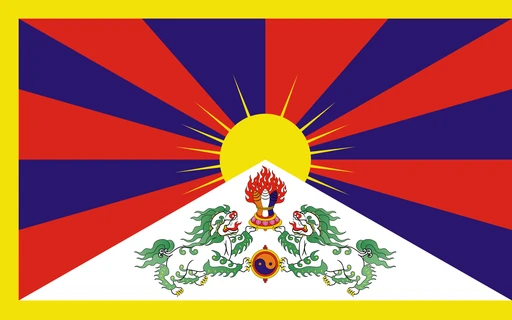
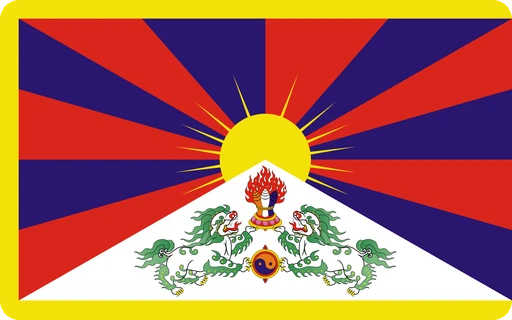
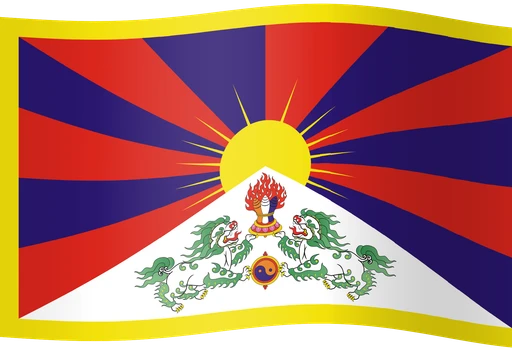
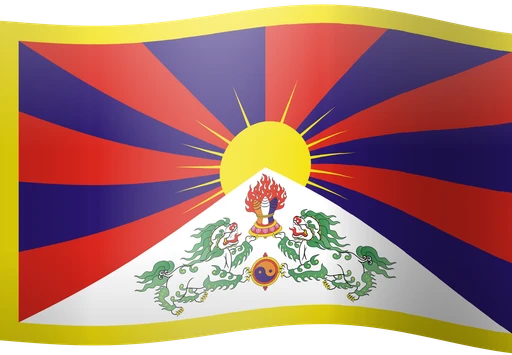
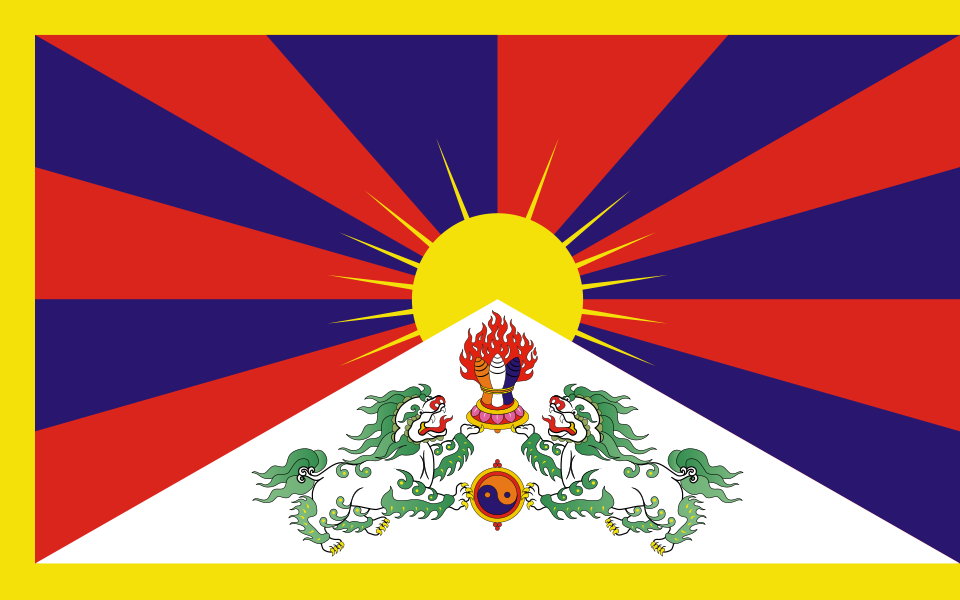
The flag of Tibet shows a white mountain under a yellow sun, with six red bands and six dark blue bands spreading from the sun to the edges. Two snow lions with green manes stand on the mountain. They hold up a flaming jewel of three colours, and a swirling jewel sits between them. A yellow border runs along the top, the bottom and the hoist. The Central Tibetan Administration reads the mountain as Tibet, the red bands as the six original Tibetan tribes, the sun as freedom and well-being, the lions as a unified spiritual and secular life, and the border as the spread of the Buddha's teachings.
The flag of Tibet is hard to mistake for any other. A white mountain fills the lower half. A yellow sun rises behind its peak and throws twelve bands of red and dark blue to the edges. Two snow lions stand on the slopes. An army carried it first, in 1916. China has outlawed it since 1959, and the Tibetan government in exile flies it from India.
One banner for every regiment
Tibetan armies carried flags long before this one. The Central Tibetan Administration, the government in exile in Dharamshala, traces the custom to King Songtsen Gampo in the seventh century, when each regiment had its own banner. Several showed snow lions. The Tethong family still owns a silk battle flag of the Shigatse regiment with a single snow lion on a red field.
In February 1913 the 13th Dalai Lama declared Tibet independent of China. He commissioned one banner for his army and ordered every military unit to adopt it.
When was it first flown? Tsarong Dundul Namgyal wrote a biography of his father, Tsarong Dasang Dadul, who commanded the new army. He says the flag "was first displayed in the late spring of 1916" at a parade near the Norbulingka palace in Lhasa. Flags of the World records a different view from the vexillologist Pierre Lux-Wurm, who dated the sun and its rays to 1912. No adopting decree has been published, so this page gives the year 1916 and no day.
The British consular officer Eric Teichman saw a version soon after. During the fighting between Tibet and Sichuan in 1917 and 1918 he described a yellow banner with a lion, a snow mountain, a sun and a moon flying over the Kalon Lama's residence in Chamdo.
Who drew the lions?
Most accounts give the design to the 13th Dalai Lama himself. His tailor, Gyalten Namgyal, said so. The writer Jamyang Norbu reports that the Dalai Lama wrote a description of the flag in his own hand. That paper stayed with Tsarong Dasang Dadul until 1946, when it went to the newly formed Foreign Office.
One early copy survives. Around 1919 or 1920 Lhasa sent a painted model of the flag to Tethong Gyurme Gyatso, the governor in Derge. It measured about 7 by 10 inches, on white cotton, with the meaning of each symbol written out. Norbu calls it the only known copy of the original design.
A rival story says a Japanese visitor drew the flag. The man usually named is Yasujiro Yajima, who designed the Guards barracks at the Norbulingka. Norbu thinks the rising sun is the grounds for the charge, and he rejects it. He argues that the crowded, colourful design belongs to Tibetan Buddhist art and owes nothing to Japanese taste.
With no credited designer on record beyond these accounts, this page leaves the designer field empty.
What each part stands for
The Central Tibetan Administration publishes a meaning for every element:
- The white mountain is Tibet, the "Land Surrounded by Snow Mountains."
- The six red bands across the dark blue sky are the six original tribes of Tibet. Wikipedia lists them as Se, Mu, Dong, Tong, Dru and Ra.
- The sun stands for freedom and for spiritual and material well-being shared by all beings in Tibet.
- The two snow lions stand for a unified spiritual and secular life.
- The flaming jewel they hold up is the Three Jewels of Buddhism: the Buddha, the Dharma and the Sangha.
- The swirling jewel between them stands for ethical self-discipline.
- The yellow border is the Buddha's teachings spreading through space and time.
The border runs along three sides only. The fly edge is left open.
No official specification of proportions or colours has been published. Wikipedia gives the flag as 5:8, and Flags of the World gives 3:4. The image on this page is 5:8. Its colours come from the public domain drawing it uses: #da251c for the red, #29166f for the blue, #f4e109 for the yellow, with green manes on white lions.
In the flag books by 1923
Chinese state media have claimed the flag did not exist before 1959. A Xinhua commentary said the Dalai Lama's supporters created it in exile. The printed record says otherwise.
In 1923 the British government's flag book, Drawings of the Flags in Use at the Present Time by Various Nations, showed it as the national flag of Tibet. The German navy's Flaggenbuch followed in 1926, and the Italian naval ministry's flag collection in 1934. National Geographic printed it in its flag issue of September 1934. The Central Tibetan Administration quotes the magazine's verdict: "one of the most distinctive of the East." The researcher Nick Gulotta has counted more than 30 different trading cards showing the flag, printed around the world between 1928 and the early 1960s.
The flag went abroad in person in March 1947, at the Asian Relations Conference in New Delhi. The Kashag, the Tibetan cabinet, sent a flag with its delegation. What that meant is disputed. The historian A. Tom Grunfeld notes that the conference was not sponsored by a government, and says the flag carried no diplomatic weight and was removed after the Republic of China protested. A Tibetan delegate disputed that, and photographs show the flag on display beside those of other countries.
Outlawed at home, flown abroad
Chinese troops entered Tibet in 1950. For a few years the flag stayed. In 1951 the Tibetan prime ministers Lukhangwa and Lobsang Tashi refused Chinese demands that only the Chinese flag be displayed. The 14th Dalai Lama has told a story about Mao Zedong from 1955. Mao asked whether Tibet had a national flag. The Dalai Lama hesitated and said yes. "That is no problem," Mao replied. "You may keep your national flag." The Chinese government has not acknowledged the exchange.
The uprising of March 1959 ended that. The Dalai Lama fled to India, and China outlawed the flag. It is still illegal in the Tibet Autonomous Region. Free Tibet reports that Tibetans are arrested for owning it, waving it, or keeping a picture of it on a phone. One of them, a nomad from Amdo named Lhamo Kyab, was held for 11 months and then sentenced to three years in prison. He had planned to fly the flag over a holy mountain near his home.
In exile the flag was set down again in Mussoorie in 1959, worked up from the surviving source material. The Central Tibetan Administration uses it today, and so do Tibet support groups around the world. Crowds carry it every 10 March, the anniversary of the uprising.
There is no emoji for it. Activists asked the Unicode Consortium for one in 2019 and did not get it.
References
[1] "The Tibetan National Flag," Central Tibetan Administration. https://tibet.net/about-tibet/the-tibetan-national-flag/
[2] "CTA's Response to Chinese Government Allegations: Part Four," Central Tibetan Administration. https://tibet.net/important-issues/sino-tibetan-dialogue/ctas-response-to-chinas-allegations/ctas-response-to-chinese-government-allegations-part-four/
[3] Jamyang Norbu, "Freedom Wind, Freedom Song," 12 February 2015. https://www.jamyangnorbu.com/blog/2015/02/12/freedom-wind-freedom-song-1/
[4] Nick Gulotta, "Recognizing the Snow Lion: New examples of international awareness of Tibet's national flag," Tibetan Review, 9 March 2021. https://www.tibetanreview.net/recognizing-the-snow-lion-new-examples-of-international-awareness-of-tibets-national-flag/
[5] "The Tibetan flag," Free Tibet. https://freetibet.org/freedom-for-tibet/culture-religion/tibet-flag/
[6] "Tibet," Flags of the World. https://www.fotw.info/flags/xt.html
[7] "Flag of Tibet," Wikipedia. https://en.wikipedia.org/wiki/Flag_of_Tibet
[8] "File:Flag of Tibet.svg," Wikimedia Commons. https://commons.wikimedia.org/wiki/File:Flag_of_Tibet.svg
Common questions
- What does the flag of Tibet mean?
- The Central Tibetan Administration gives a meaning for each part. The white mountain is Tibet, the land surrounded by snow mountains. The six red bands are the six original Tibetan tribes. The sun stands for freedom and for spiritual and material well-being. The two snow lions stand for a unified spiritual and secular life. The flaming jewel is the Buddha, the Dharma and the Sangha, and the yellow border is the spread of the Buddha's teachings.
- Who designed the flag of Tibet?
- Most accounts credit the 13th Dalai Lama. The Central Tibetan Administration says he commissioned the banner and ordered every military unit to adopt it. His tailor, Gyalten Namgyal, said he designed it himself. A rival story credits a Japanese visitor to Lhasa, Yasujiro Yajima. The Tibetan writer Jamyang Norbu rejects that story, and a description of the symbols in the Dalai Lama's own hand supports the first account.
- When was the flag of Tibet adopted?
- The usual date is 1916. Tsarong Dundul Namgyal, in a biography of his father, the commander-in-chief of the Tibetan army, wrote that the flag was first displayed in the late spring of 1916 at a parade near the Norbulingka palace in Lhasa. No adopting law has been published. Some vexillologists give 1912 for the sun and its rays, so this page records the year only.
- Is the flag of Tibet banned in China?
- Yes. China outlawed the flag in 1959, after the Tibetan uprising, and it is still illegal in the Tibet Autonomous Region. The campaign group Free Tibet reports that Tibetans are arrested for owning, waving or flying it, or for keeping a picture of it on a phone. Chinese authorities call it the "snow lion flag" and describe it as separatist.
- Did the flag of Tibet exist before 1959?
- Yes. A British government flag book of 1923 showed it as a national flag. So did the German navy's Flaggenbuch of 1926 and an Italian naval flag book of 1934. National Geographic printed it in September 1934. Chinese state media have claimed the flag was created in exile after 1959. These printed records, all older than the exile, contradict that claim.
- Is there a Tibetan flag emoji?
- No. Tibet has no flag emoji. Tibetan activists petitioned the Unicode Consortium for one in 2019, and the request did not succeed. Wired magazine covered the campaign that year. It noted that Taiwan has a flag emoji, and that adding Tibet's would invite requests from other unrecognized states.
Download this flag
Free in 12 styles, from 32px icons up to 2000px, as SVG, PNG, WebP and JPG.