The Flag of Timor-Leste
Democratic Republic of Timor-Leste
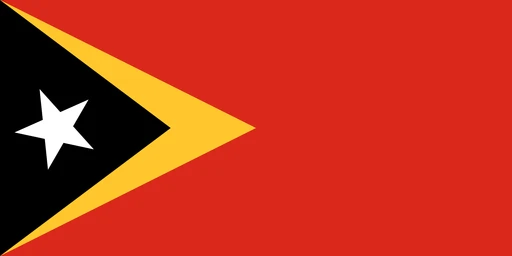
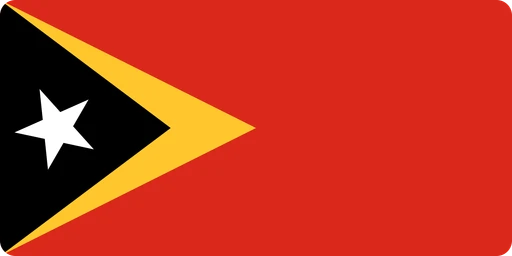
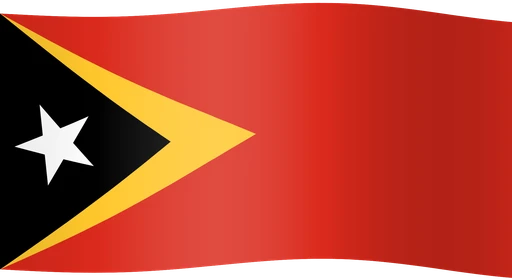
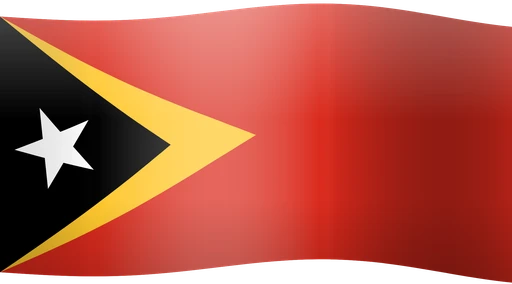
The flag of Timor-Leste, also known as East Timor, is a red field with two triangles at the hoist: a black isosceles triangle laid over a slightly longer yellow one, with a white five-pointed star inside the black. Red is the struggle for national liberation, black the obscurantism that has to be overcome, yellow the traces of colonialism, and the white star peace.
Timor-Leste raised this flag for the first time in 1975, weeks before an invasion took it back down. It went up again in 2002.
Raised, lowered, raised again
The flag was first adopted on 28 November 1975, when Fretilin, the revolutionary front that had led the campaign against Portuguese rule, declared independence after centuries of colonial government. Indonesia invaded that December. The occupation lasted until 1999, and the Indonesian flag flew in its place; the Timorese flag stayed in use mainly among the resistance and in exile.
A UN-sponsored referendum in 1999 returned a vote for independence, and Timor-Leste moved into self-government under UN administration. Independence was formally restored on 20 May 2002, and the flag went back up.
Two triangles and a star
The field is red. At the hoist, a black isosceles triangle sits over a broader yellow one, and a white five-pointed star inside the black triangle points toward the hoist.
Red is the sacrifice made during the fight against foreign rule. Yellow is what colonialism left behind. Black is the darkness the country had to come through. The white star is peace, and hope for what follows.
In use
The flag is displayed across government and public institutions, appears on official documents, and is standard at national events. Protocol governs its handling and display, and it is given equal prominence alongside other national flags at international functions. There are no significant variants. Schools and public buildings fly it regularly, and during independence celebrations it does most of the visual work.
Flags from the same movement
Mozambique and Angola came out of the same era of decolonization, and their flags carry the same themes of struggle and resistance, drawn on in similar visual language. The regional movements for independence left their mark on all of them.
References
[1] United Nations, "UN Members," un.org
[2] CRW Flags, "Flag of Timor-Leste," crwflags.com
[3] Flagspot, "Timor-Leste," flagspot.net
Common questions
- What do the colors on the Timor-Leste flag mean?
- Red is the fight for independence, yellow the colonial past, black the hardships that had to be overcome, and the white star peace and hope.
- Why is there a star on the Timor-Leste flag?
- The white five-pointed star stands for peace and hope, and for the recognition the country sought from the rest of the world.
Featured in these articles
- The Map That Became a Flag: Why Kosovo and Cyprus Broke Vexillology's Most Sacred Rule
- Born from War: How South Sudan Designed a Flag for the World's Newest Country
- The Sun Disc on the Flag of Bangladesh: How a Blood-Red Circle Became the Symbol of a Nation Born in War
- Born from Revolution: How Angola and Eritrea Turned Liberation Movement Logos into National Flags
Download this flag
Free in 12 styles, from 32px icons up to 2000px, as SVG, PNG, WebP and JPG.