The Flag of Ontario
Province of Ontario
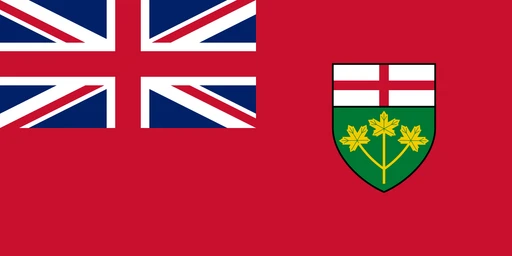
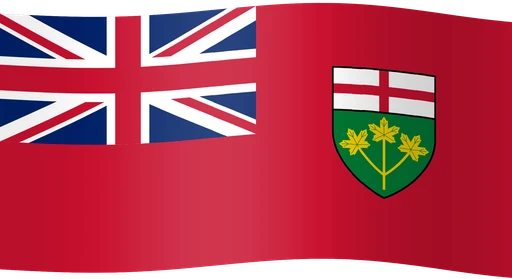
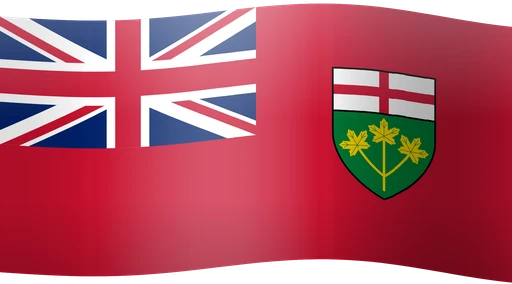
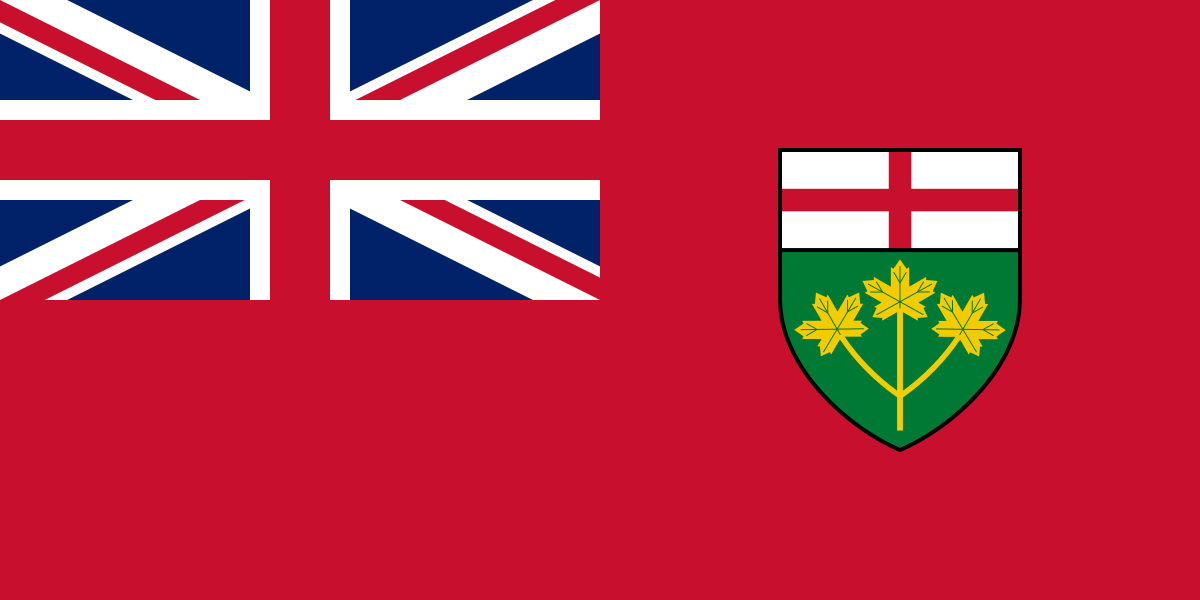
The flag of Ontario is a red ensign, twice as long as it is high, with the Union Jack in the upper quarter next to the staff and the shield of Ontario's coat of arms centred in the outer half. The shield has a red cross of St. George on white across the top and three gold maple leaves on a single stem on green below. The Government of Canada reads the cross as a symbol of England and the maple leaves as a symbol of Canada. The red field and the Union Jack copy the Canadian Red Ensign, the flag Canada flew until 1965.
Ontario's flag is red, with the Union Jack in the upper corner next to the staff and a shield in the other half. The shield shows a red cross on white above three gold maple leaves on green. If it looks like an old Canadian flag, that is the point. Ontario adopted it in 1965, the year Canada gave up the Canadian Red Ensign for the Maple Leaf, and the law that created it says so in its opening lines.
A law with one section
The Flag Act is short. Its preamble says "it is deemed expedient to adopt a flag of historical significance" and that the flag should have "the design and colouring of the Canadian Red Ensign except that the badge in the fly be the shield of the armorial bearings of the Province of Ontario granted by Royal Warrant in 1868." A single section then declares the flag in the schedule to be the provincial flag.
The schedule gives the specification. The flag is "of the proportions two by length and one by width with the Union Jack occupying the upper quarter next the staff." The shield is "centred in the half farthest from the staff." The red is set by British Admiralty Colour Code, No. T1144 for nylon worsted bunting and No. T818A for other bunting. Flags of the World notes that the code is no longer in use and matches the red to Pantone 186C.
The act names no other colours. The values listed on this page come from the drawing shown here.
The shield from 1868
The shield is older than the flag by almost a century. Queen Victoria granted Ontario's arms by warrant on 26 May 1868, the year after Confederation. King Edward VII added the crest, the supporters and the motto in 1909. The flag uses the shield alone. Early plans called for the full coat of arms, with its bear, moose and deer, and that was cut back to the shield.
The Government of Canada describes the design this way. The red cross of St. George, symbolic of England, sits in the upper third. The lower part has three golden maple leaves, a symbol of Canada, on a green background.
The maple leaves almost lost their place. Flags of the World reproduces a letter of 29 April 1868 from the Colonial Office to Garter King of Arms. It returned the drawings for the first four provinces and said the Duke "would prefer" the maple leaf to the wheatsheaf in the arms of Ontario.
"It's damn good politics"
For 98 years Ontario had no flag of its own. The Canadian Red Ensign flew over legislatures and Legion halls across the country.
Then came the national flag debate. John Diefenbaker fought to keep the Red Ensign. Lester Pearson won, and the Maple Leaf first flew in February 1965. Ontario was not sold on it. A Gallup poll in August 1964 found fewer than 40 per cent of Ontarians approved of the new flag.
The Toronto Star had floated a Red Ensign for the province in an editorial in May 1964. Premier John Robarts took up the idea, reportedly with his adviser Richard Rohmer, and former premier Leslie Frost backed it. Robarts said a provincial flag would give the ensign an "honoured place" inside Ontario's borders.
His biographer Steve Paikin tells what happened in cabinet. Darcy McKeough, a rookie minister, asked whether the plan would start a flag debate in Ontario. Robarts answered: "it's damn good politics!" He held no committee hearings and no design contest.
He was right about the politics. The leaders of the Liberals and the New Democrats supported the bill. It passed on 17 March 1965 with two Liberal members opposed. One of them, Elmer Sopha, called it "a flag of revenge" against the new national flag.
From the vote to the flagpole
A red ensign with a Union Jack needed more than a vote. The Government of Canada records that Queen Elizabeth II approved the use of the Royal Union Flag in the design that year. Flags of the World, quoting the text of the 1965 act, gives the sequence: assent on 14 April, royal approval on 11 May, proclamation on 13 May, and force of law on 21 May. The herald Conrad Swan, cited on the same page, puts the assent two days earlier, on 12 April.
The sources agree on the last date. The flag was raised for the first time on 21 May 1965.
Manitoba followed with a red ensign of its own in 1966. Alistair Fraser, in The Flags of Canada, calls Ontario's choice "a reactionary move to the loss of the Canadian Red Ensign at the national level."
A flag day, and people who want a new flag
Fifty years on, the legislature gave the flag its own day. Yvan Baker, a Liberal member, introduced the Ontario Flag Day Act on 13 May 2015. It received royal assent on 4 June 2015. Its one working section reads: "May 21 in each year is proclaimed as Ontario Flag Day." The preamble says the flag "represents all those who call Ontario home."
Not everyone agrees. In May 2015 Paikin reported on a campaign by Roberto Martella, a Toronto restaurant owner, who called the flag a tribute to a "lost empire." On 1 July 2021 Mano Majumdar, a lecturer at Western University's Ivey Business School, started a petition asking the legislature to replace the flag with one chosen democratically. "The best flags are distinct and inclusive. Ontario's is neither," it said. Eleven days later it had more than 300 signatures.
Flag enthusiasts are lukewarm too. In a 2001 survey by the North American Vexillological Association, Ontario's flag ranked 43rd out of 72 provincial, state and territorial flags.
The Flag Act has not changed. Ontario's e-Laws site lists it with no amendments.
References
[1] "Flag Act," R.S.O. 1990, c. F.20, Government of Ontario e-Laws. https://www.ontario.ca/laws/statute/90f20
[2] "Bill 101, Ontario Flag Day Act, 2015," S.O. 2015, c. 21, Legislative Assembly of Ontario. https://www.ola.org/en/legislative-business/bills/parliament-41/session-1/bill-101
[3] "Ontario," Provincial and territorial symbols of Canada, Government of Canada. https://www.canada.ca/en/canadian-heritage/services/provincial-territorial-symbols-canada/ontario.html
[4] "Ontario (Canada)," Flags of the World. https://www.fotw.info/flags/ca-on.html
[5] Steve Paikin, "Is it time for a new flag for Ontario?", TVO Today, 20 May 2015. https://amp.tvo.org/article/steve-paikin-is-it-time-for-a-new-flag-for-ontario
[6] Alistair B. Fraser, "The Rise of Provincial Flags," The Flags of Canada. http://fraser.cc/FlagsCan/Provinces/Provinces.html
[7] "Petition launched to change Ontario flag to be more inclusive, distinct," Global News, 12 July 2021. https://globalnews.ca/news/8022167/petition-change-ontario-flag/
[8] Arthur Milnes, "Today in Canada's Political History - May 21, 1965: Ontario gets a new flag," National Newswatch, 21 May 2025. https://nationalnewswatch.com/2025/05/21/today-in-canadas-political-history
[9] "Flag of Ontario," Wikipedia. https://en.wikipedia.org/wiki/Flag_of_Ontario
Common questions
- What does the flag of Ontario mean?
- The Flag Act calls it "a flag of historical significance." By law it has the design and colouring of the Canadian Red Ensign, with Ontario's shield in place of Canada's. The Union Jack in the corner points to the province's British ties. On the shield, the Government of Canada reads the red cross of St. George as a symbol of England and the three gold maple leaves as a symbol of Canada.
- Who designed the flag of Ontario?
- No designer is named in the Flag Act. The idea came from Premier John Robarts, who is reported to have worked it out with his adviser Richard Rohmer. The design was fixed by the law itself: the Canadian Red Ensign with Ontario's shield of 1868 in the fly. Flags of the World, citing the herald Conrad Swan, says the drawing was prepared by Sir Anthony Wagner, Garter King of Arms.
- When was the flag of Ontario adopted?
- The Legislative Assembly passed the Flag Act on 17 March 1965, and it received assent in April. Queen Elizabeth II approved the use of the Union Jack in the design. The act came into effect on 21 May 1965, the day the flag was first raised. The Ontario Flag Day Act, 2015 made 21 May Ontario Flag Day.
- Why does the flag of Ontario have a Union Jack?
- It was copied from the Canadian Red Ensign, which carried the Union Jack in its upper corner and served as Canada's flag until the Maple Leaf replaced it in 1965. Many Ontarians had opposed the change. Premier John Robarts gave the old design a home as the provincial flag, and the Flag Act says the flag has "the design and colouring of the Canadian Red Ensign."
- What is the difference between the flags of Ontario and Manitoba?
- Both are red ensigns with the Union Jack in the corner, adopted after Canada dropped the Canadian Red Ensign. Ontario's dates from 1965 and Manitoba's from 1966. The shield tells them apart. Ontario's has a red cross on white above three gold maple leaves on green. Manitoba's flag carries the shield of Manitoba's own arms in the same position.
- Has there been a campaign to change the flag of Ontario?
- Yes, more than once. In 2015 the Toronto restaurant owner Roberto Martella argued for a new design and called the flag a tribute to a "lost empire." On 1 July 2021 Mano Majumdar, a lecturer at Western University, started a petition asking the legislature to replace it. It had more than 300 signatures eleven days later. Ontario's e-Laws site lists the Flag Act with no amendments.
Download this flag
Free in 12 styles, from 32px icons up to 2000px, as SVG, PNG, WebP and JPG.