The Flag of the Bahamas
Commonwealth of the Bahamas
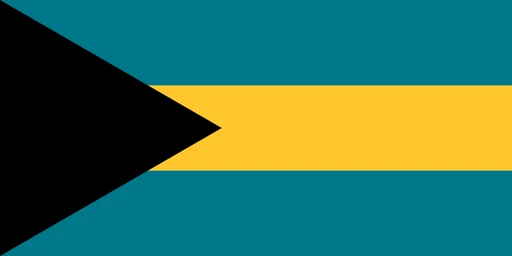
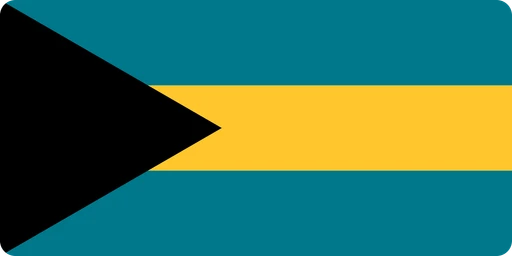
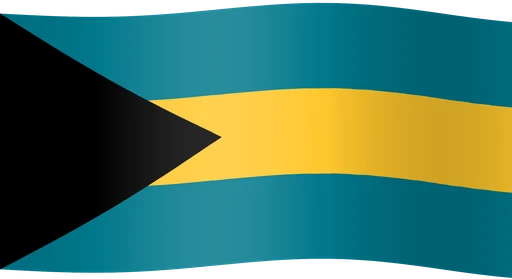
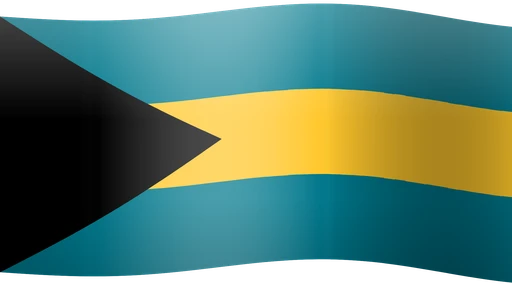
The flag of the Bahamas has three horizontal stripes, aquamarine over gold over aquamarine, with a black equilateral triangle at the hoist. The aquamarine stripes are the Caribbean Sea and the Atlantic Ocean, the gold is the sun and the beaches, and the black triangle is the strength, vigor, and force of the Bahamian people.
The flag of the Bahamas was adopted on July 10, 1973, the day the country became independent of the United Kingdom. Its aquamarine, gold, and black geometry sets it apart from most post-colonial flags in the region, which kept some element of their former rulers' insignia. This one kept none. It came out of a national competition that drew nearly 1,000 entries.
The 1973 competition
For over 250 years the Bahamas flew a British Blue Ensign defaced with a colonial badge. The badge showed a British warship chasing two pirate vessels beneath the motto Expulsis Piratis Restituta Commercia, "Pirates Expelled, Commerce Restored." London chose the scene, and it was about London's priorities: securing trade routes. It said nothing about Bahamians.
As independence negotiations gathered pace in the early 1970s under Prime Minister Lynden Pindling, the government announced a national flag competition and let the public design the country's own symbol. Nearly 1,000 entries came in from across the islands. Rather than picking a single winner, a government committee reviewed every submission and combined the strongest elements into one design, which made the final flag a piece of collective authorship.
At midnight on July 10, 1973, the new flag rose for the first time at Clifford Park in Nassau. Prince Charles attended on behalf of Queen Elizabeth II, watching a banner with no British heraldry on it at all: no Union Jack canton, no royal crest, no colonial imagery. The Bahamian independence movement had been built on self-determination, and the flag said so from its first moment on the pole.
Sea, sand, and strength
Three horizontal bands and one triangle, and between them they carry the country's geography, economy, and self-image.
The top and bottom bands are aquamarine, for the Caribbean Sea and the Atlantic Ocean that surround the archipelago's 700-plus islands and cays. Water is the defining fact of Bahamian life.
Between them sits a band of gold occupying the central third. It stands for the sandy beaches and the sun. Those white-gold beaches are a national asset in a literal sense, since they sustain the tourism economy that drives the country, and the gold also carries a sense of promise and prosperity.
On the hoist side, a black equilateral triangle points toward the fly. Its base runs the full height of the flag and it extends roughly one third of the length. Black stands for the unity, vigor, and strength of the Bahamian people, and its position at the hoist, closest to the flagpole and the position of honor, puts the people first. The forward-pointing geometry has long been read as determination, specifically the resolve to develop and possess the resources of the country's own land and sea.
Read as a whole, the triangle meets the horizontal bands head-on: the people engaging directly with the natural world that sustains them. The proportions are 1:2, and every element is precisely defined, so the design holds up at any scale.
From pirate chasers to Pan-African echoes
Abandoning the old pirate-chase badge was a conscious statement. That image had reflected British imperial concerns for centuries, and the new flag replaced an inherited narrative with a self-authored one.
The prominent black connects the Bahamian flag to the tradition of Pan-African symbolism in Caribbean flags, echoing the black, green, and gold associated with Marcus Garvey's movement. The Bahamas made one substitution: aquamarine for green. Where green usually represents the land or African heritage in Pan-African schemes, aquamarine roots the flag in the country's maritime identity.
That aquamarine-gold-black palette belongs to no other national flag. Comparisons come up with Jamaica's, which also uses black, gold, and green in a geometric design adopted at independence, but the two differ substantially in layout and emphasis. The triangular hoist element is itself relatively unusual, shared with a small group that includes Cuba, the Czech Republic, and Jordan. The Bahamian triangle, being equilateral, looks more balanced than most of them.
Protocol and variants
The National Flag and Coat of Arms Act governs the design, proportions, and display protocols. Etiquette requires the flag to be raised briskly and lowered ceremoniously, and it should never touch the ground or be flown faded or tattered.
Several variants exist beyond the national flag. A civil ensign, a red ensign with the national flag in the canton, and a naval ensign are used at sea. That is not a minor detail here: the Bahamas Ship Registry is one of the largest in the world, so thousands of commercial vessels fly the Bahamian flag on every ocean. The Governor-General, Prime Minister, and other officials have their own flag variants.
Independence Day on July 10 brings the most prominent displays, with flag-raising ceremonies across the islands. The colors are also central to Junkanoo, the street festival held on Boxing Day and New Year's Day, where aquamarine, gold, and black appear on costumes and floats. The same colors run through commercial and cultural branding, from Bahamasair's livery to tourism campaigns.
What the flag does at home
For a nation of roughly 400,000 people spread across an archipelago, the flag connects islands that can feel remote from one another. A fisherman on Eleuthera and a banker in Nassau look at the same triangle and the same aquamarine bands.
Children learn the flag's symbolism as part of civic education. Its colors run through Bahamian art, music, and daily life. Bahamian athletes have carried it at the highest level: Tonique Williams-Darling won gold in the 400 meters at the 2004 Athens Olympics, and Shaunae Miller-Uibo's dive across the finish line at Rio in 2016 put the aquamarine, gold, and black in front of a global audience.
The flag took on additional weight after Hurricane Dorian in 2019, which hit Abaco and Grand Bahama as a Category 5 storm. In the aftermath it became a rallying point for recovery, appearing on relief supplies, social media campaigns, and makeshift shelters.
Unlike some post-independence flags that face periodic redesign debates, this one has broad popular support more than fifty years on. The design that came out of nearly 1,000 submissions in the early 1970s has never seriously been challenged.
References
[1] The National Flag and Coat of Arms Act, Chapter 315, Laws of the Bahamas. Official government legislation prescribing design, proportions, and display protocols.
[2] Bahamas Information Services, Government of the Bahamas. Official descriptions of national symbols. https://www.bahamas.gov.bs
[3] Smith, Whitney. Flags Through the Ages and Across the World. McGraw-Hill, 1975. Comprehensive vexillological reference covering the Bahamian flag's adoption and context.
[4] Craton, Michael, and Gail Saunders. Islanders in the Stream: A History of the Bahamian People. 2 vols. University of Georgia Press, 1992-1998. Authoritative history providing independence-era context.
[5] Flag Institute (UK). Country profile: The Bahamas. https://www.flaginstitute.org
[6] Saunders, Gail. The Bahamas: A Family of Islands. Macmillan Caribbean, 2000.
[7] North American Vexillological Association (NAVA). Resources on Caribbean national flags.
Common questions
- What do the colors on the Bahamas flag mean?
- The two aquamarine bands are the Caribbean Sea and the Atlantic Ocean around the islands. The gold band in the middle is the sandy beaches and the sun. The black triangle at the left is the unity, vigor, and strength of the Bahamian people. Taken together it is a picture of a nation's people, the triangle, meeting the sea and land that sustain them.
- What does the black triangle on the Bahamas flag represent?
- The Bahamian people, and specifically their unity, strength, and determination. It sits at the hoist, the flagpole side and the position of honor, so the people come first. The forward-pointing shape is read as resolve, particularly the drive to develop and control the nation's own resources.
- Why doesn't the Bahamas flag have a Union Jack on it?
- That was deliberate. Leaving out British symbols made a clean break from the colonial past. The old colonial flag showed a British warship chasing pirates, an image London picked to reflect imperial priorities. The new flag came out of a national competition and was designed entirely by Bahamians.
Featured in these articles
Download this flag
Free in 12 styles, from 32px icons up to 2000px, as SVG, PNG, WebP and JPG.