The Flag of the French Southern and Antarctic Lands
Territory of the French Southern and Antarctic Lands
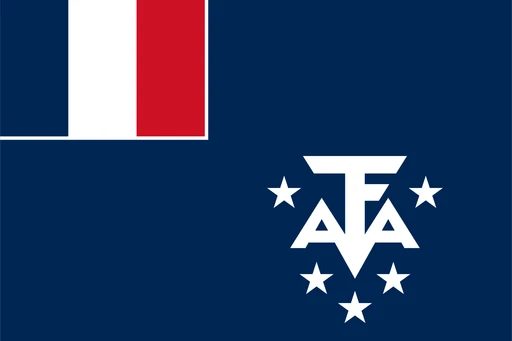
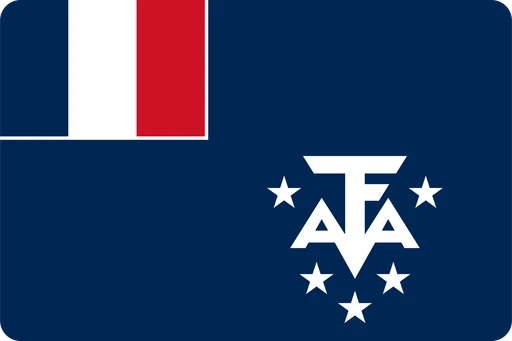
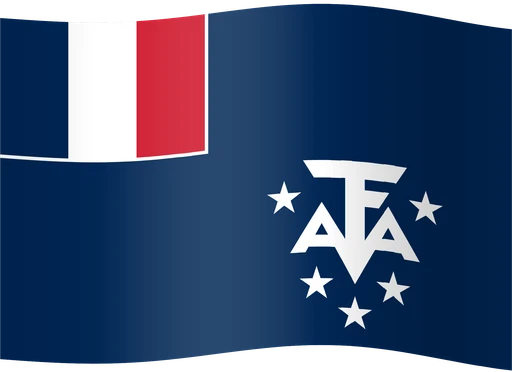
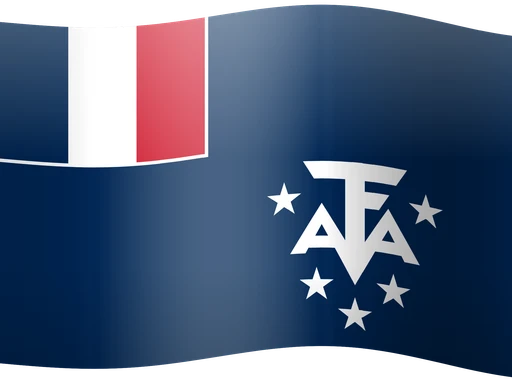
The flag of the French Southern and Antarctic Lands (Terres australes et antarctiques françaises, TAAF) is a blue ensign with the French tricolore in the canton. In the fly, the four letters T, A, A and F are interlaced in white so that they read as an anchor, with five white five-pointed stars set around them. The stars are usually taken to stand for the territory's five districts, though the founding text does not say so.
The French Southern and Antarctic Lands, or Terres australes et antarctiques françaises (TAAF), stretch across five remote archipelagos in the southern Indian Ocean plus a wedge of Antarctica. There are no cities, no voters, no schools. The flag adopted in 2007 flies over research stations, patrol boats, and ice-scoured coastlines where penguins outnumber people by orders of magnitude. It is a blue ensign with the French tricolore in the corner and, in the fly, the letters T, A, A and F twisted together into the shape of an anchor, with five white stars around them.
A territory without citizens
TAAF is divided into five districts: the Kerguelen Islands, the Crozet Islands, the Saint-Paul and Amsterdam Islands, the Scattered Islands (Îles Éparses), and Adélie Land on the Antarctic continent. Nobody is born there and nobody retires there. The only inhabitants are rotating teams of scientists, military personnel, and support staff, typically a few hundred across all stations at any one time.
Administration happens remotely, from the island of La Réunion, where a prefect appointed by the French government oversees the territory. Despite having no permanent civilian population, TAAF carries enormous strategic and scientific weight. Its exclusive economic zones cover roughly 2.3 million square kilometers of ocean, making France one of the world's largest maritime powers. The islands are biodiversity hotspots, home to large colonies of king penguins, albatrosses, and elephant seals. Climate research stations on Kerguelen and in Adélie Land feed data into global models tracking atmospheric and oceanic change.
So why does a place with no true residents need a flag? Sovereignty. A flag here speaks not to citizens but to the international community, signaling effective French control over territory that, in the case of Adélie Land, remains formally disputed. France claimed Adélie Land in 1840, but the Antarctic Treaty of 1959 froze all territorial claims on the continent, neither recognizing nor rejecting them. The flag makes a claim in that gap that diplomacy cannot state outright.
Why TAAF had no official flag until 2007
TAAF was established as a French overseas territory in 1955. For more than fifty years afterwards, the plain French tricolore was the only flag with any legal standing at its research stations. The one local alternative was informal: in 1958 the first senior administrator, Xavier Richert, put together a flag of his own, close to the current design but with three stars rather than five.
That changed in 2007. The emblem was fixed by an order of 23 February 2007, arrêté no. 2007-18, signed by the senior administrator and published in the Journal officiel des Terres australes et antarctiques françaises. The text is oddly worded for a flag document: it calls the design an "emblem" and blazons it in heraldic language, describing an azure field charged with four interlaced letters and five stars, all in silver, with the tricolore in the canton.
French Polynesia had adopted its own territorial flag back in 1984, and New Caledonia's design dates to 2010, with unofficial precursors much earlier. TAAF was a latecomer, partly because there was no local population lobbying for a distinct identity. The push came instead from vexillological societies, geographic organizations, and administrators who wanted a visual identity for international scientific forums and Antarctic Treaty meetings.
An anchor built out of letters
The field is blue and the French tricolore sits in the canton, the upper hoist corner, which puts the flag squarely in the tradition of colonial and naval ensigns rather than of national tricolors. The tricolore does the work of declaring sovereignty, and everything in the fly adds specificity.
The main device is a monogram. The letters T, A, A and F, for Terres australes et antarctiques françaises, are interlaced in white and drawn so the combined shape reads as an anchor. That is a deliberate piece of visual economy: the name of the territory and a symbol of the sea in one mark. It fits a place that has never been reached by anything except ships and, later, aircraft flying from ships' ports.
Five white five-pointed stars are arranged around the monogram, two above and three below. The 2007 order does not explain them. The usual reading is that they stand for the territory's five districts, and the arithmetic works: the Kerguelen Islands, the Crozet Islands, the Saint-Paul and Amsterdam Islands, Adélie Land, and the Scattered Islands, which were attached to TAAF in the same year the flag was adopted.
The palette stays restrained. White against blue keeps the design legible at distance and in harsh southern light. There is no coat of arms, no map, and no motto.
The flag before this one
Richert's 1958 flag is the reason the current design looks the way it does. He was a French Navy officer, and the flag he sketched borrowed the form of a naval ensign, blue with the tricolore in the canton. Its three stars are usually explained as a reference to his rank rather than to anything about the territory, and the number stopped matching the administrative map as districts were added.
That flag was never gazetted. It flew above the senior administrator's office and on the ships that served the islands, and for almost fifty years it was the only thing besides the tricolore that anyone in the territory flew. The 2007 order kept its structure, redrew the monogram, and moved the star count to five.
Nothing about this makes TAAF unusual among French overseas possessions, where local emblems have often run ahead of the paperwork by decades. What is unusual is that the paperwork, when it finally arrived, chose to formalize the administrator's improvisation rather than replace it.
Usage, protocol, and presence
You are unlikely to see this flag in daily life. It flies at Port-aux-Français on Kerguelen, at the Alfred Faure station on Crozet, at Martin-de-Viviès on Amsterdam Island, and at Dumont d'Urville station in Adélie Land. It appears on TAAF patrol vessels, including ships of the French Navy and the TAAF's own patrouilleurs that enforce fishing regulations across the territory's exclusive economic zone. Illegal fishing, particularly for Patagonian toothfish, is a persistent problem, and the flag on a patrol ship's mast carries real authority.
Protocol is straightforward: the French national tricolore always takes primacy. The TAAF flag flies alongside or beneath it, never above. At international scientific conferences and Antarctic Treaty consultative meetings, the TAAF emblem appears on documents, placards, and displays.
Alongside the flag, individual research stations have long used their own logos and shoulder patches. Some of those designs, featuring penguins or stylized landscapes, still circulate as collector's items among vexillologists and polar enthusiasts, though none of them ever had official standing.
Sovereignty on ice
France's claim to Adélie Land predates the Antarctic Treaty by over a century. Dumont d'Urville planted a flag there in January 1840, naming the coast after his wife, Adèle. The 1959 Antarctic Treaty, which France signed, froze all territorial claims on the continent: no country can expand or press its Antarctic claim, and no country has to abandon one either. If the five stars do stand for the five districts, then one of them is Adélie Land, and the flag asserts the claim quietly while France maintains it diplomatically within the treaty's framework.
There is contested ground beyond Antarctica too. Madagascar and Mauritius both dispute French sovereignty over some of the Scattered Islands included in TAAF. The Glorioso Islands, Bassas da India, Europa Island, and Juan de Nova are all subjects of ongoing diplomatic friction, and they were folded into the territory as its fifth district in 2007, the same year the flag was gazetted.
This is flag as soft power. France maintains effective occupation through scientific stations, military patrols, weather monitoring, and visible symbols of statehood. The flag does not replace a garrison or a research team, but it reinforces their presence. Climate change is reshaping the Southern Ocean, shifting fisheries and sea ice patterns, and the waters around Kerguelen and Crozet may become more economically and geopolitically significant in the coming decades.
References
[1] Journal officiel de la République française, Décret no. 2007-1400 (2007). Formal adoption of the TAAF territorial flag. (https://www.legifrance.gouv.fr)
[2] Terres australes et antarctiques françaises, official website. Administrative, historical, and geographic background on the territory. (https://taaf.fr)
[3] Flags of the World (FOTW). Detailed vexillological analysis of the TAAF flag, design variants, and adoption history. (https://www.fotw.info)
[4] The Antarctic Treaty Secretariat. Context on territorial claims and the status of Adélie Land. (https://www.ats.aq)
[5] Dumont d'Urville, Jules-Sébastien-César. Voyage au Pôle Sud et dans l'Océanie (1841-1854). Primary historical source on French Antarctic exploration and the naming of Adélie Land.
[6] Smith, Whitney. Flag Lore of All Nations (Millbrook Press, 2001). General vexillological reference.
[7] Flag Institute. Entry on the TAAF flag, design elements, and symbolism. (https://www.flaginstitute.org)
[8] United Nations Convention on the Law of the Sea (UNCLOS). Relevant to TAAF's exclusive economic zone claims. (https://www.un.org/depts/los)
Common questions
- Why is the French flag part of the TAAF flag?
- The tricolore sits in the canton, the upper hoist corner, in the manner of a colonial ensign. It marks these territories as French and points to their political and historical links to France.
- Why does the French Southern and Antarctic Lands flag have a map on it?
- It doesn't, and this is a common mix-up. The TAAF flag carries no map at all: just the tricolore in the corner, the interlaced letters T.A.A.F. shaped into an anchor, and five stars. Flags that really do carry a map of their own territory are rare, and Cyprus and Kosovo are the usual examples. The TAAF emblem makes its claim through the anchor and the stars instead.
- Why did it take until 2007 for TAAF to get an official flag?
- TAAF has been around since 1955, but there was nobody living there permanently to care about having a distinct flag. The tricolore worked fine, and the senior administrator's own unofficial three-star flag from 1958 covered the rest. What changed was the wish for a proper visual identity for use at international science meetings and Antarctic Treaty discussions, and the emblem was made official in 2007.
Download this flag
Free in 12 styles, from 32px icons up to 2000px, as SVG, PNG, WebP and JPG.