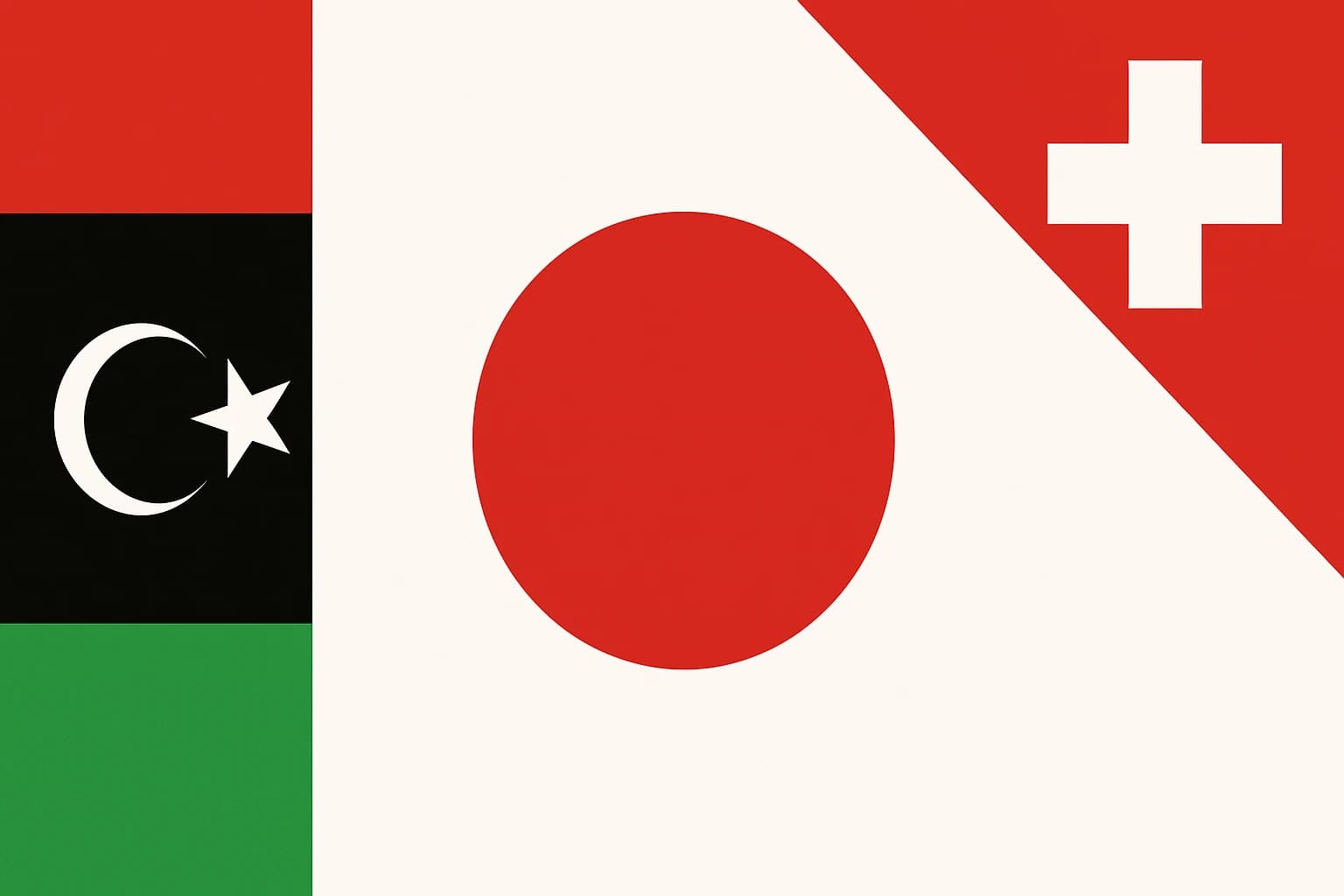
Picture a soldier on a muddy battlefield hoisting a white cloth above his head. Everyone knows what that means. Now picture a nation raising a white-dominant flag and saying, "This is who we are." Same color, opposite message. Of the roughly 195 national flags in the world, fewer than a handful use white as their primary field color, and the ones that do belong to some very old and very stubborn political traditions.
Those flags predate the surrender convention. White, in the system they came from, carried a heraldic grammar rooted in European Christian statecraft, and modern flag traditions have largely forgotten how to read it.
The unspoken rule: why nations avoid white
Scan the flags of the world and a pattern turns up fast. Red, blue, green, yellow. White appears constantly, but almost always as a stripe, a star, a crescent, or background filler. It rarely gets to be the main event.
The reasons stack up. The most obvious is the white flag of surrender, whose origins are murky. Some historians trace the practice to the Han Dynasty in China around 25 AD, others to Roman legions. The convention was locked into international law by the 1907 Hague Conventions, which codified white as the universal signal of truce and capitulation. That is a heavy association to shake.
Then came the revolutions. After 1789, France's tricolor reshaped how nations thought about flag design, and color became ideological statement: liberty, blood shed for the nation, the land, the people. The flags that followed the French model treated white as a divider between colored bands rather than a message in its own right.
The mid-20th century pushed the same way. As colonial empires collapsed across Africa, Asia, and the Middle East, newly independent nations reached for pan-Arab greens and pan-African reds, blacks, and golds. None of those palettes had room for white dominance.
The flags below predate all of it. They were designed in a different visual and political language, one where white meant something specific and prestigious.
Heraldic white: what argent meant to medieval Europe
In the formal system of European heraldry, codified roughly between the 12th and 14th centuries, white was called argent, or silver. It was one of only two metals in the tincture system, alongside gold, or. Everything else, the reds and blues and blacks and greens and purples, fell into a lower category called colors.
The hierarchy mattered because of the rule of tincture: metals had to contrast with colors. You could not place gold on white, or red on blue, without breaking the system. So white was not avoided. It was structurally required, both for legibility and for prestige.
The spiritual dimension ran alongside it. In medieval Christian iconography white was the color of divine light: the white lamb, the white liturgical vestments worn at Easter and Christmas, the white banner of the resurrection. A medieval audience seeing a white field on a banner would not have thought "surrender." It would have thought "sanctity," and probably "God is on our side."
The post-revolutionary flag tradition dropped these heraldic rules for plain stripes and populist symbolism, which is why modern eyes misread the older flags. The vocabulary is gone. Switzerland, Georgia, and the Holy Roman Empire all used white according to the older grammar.
The Swiss cross was born on a battlefield
The white cross on a red field first appeared at Laupen in 1339, when Swiss Confederacy soldiers stitched white crosses onto their clothing so they could tell each other apart in the confusion of combat. It came out of a fight, not a throne room.
The red field traces back to the canton of Schwyz, whose red banner gave the wider confederation its name. By the early 15th century the red field with a white cross had become the symbol of the Swiss Confederacy as a whole, binding together cantons that agreed on very little else.
The Swiss flag is also square, one of only two square national flags, the other being Vatican City's.
In 1863 Henry Dunant, a Swiss citizen, founded the International Red Cross. Its emblem is the Swiss flag with the colors reversed, a red cross on white. That was a direct homage, and a sign of how recognizable the Swiss design had already become by the 19th century.
In heraldic terms the white cross on red is argent on gules, metal on color, which follows the rule of tincture exactly. The cross carries Christian weight without attaching itself to any dynasty or monarch. The white is not decoration. It is the content.
Georgia's five crosses
Georgia's flag is a white field with a large red cross dividing it into four quadrants, each holding a smaller red cross. Five crosses in the Bolnisi cross configuration, with roots traceable to the 13th century under the medieval Kingdom of Georgia.
The five crosses are widely read as Christ and the four Evangelists, or as the spread of Christianity to the four corners of the earth. That is closer to a theological argument than to a modern national banner.
The design has had a rough history. When the Soviet Union absorbed Georgia in 1921 the five-cross flag was suppressed, and for seven decades Georgia flew a different flag under Moscow's control. The old banner survived in memory and in exile.
In 2003, during the Rose Revolution, Georgians carried the five-cross flag through the streets of Tbilisi. Mikheil Saakashvili restored it as the official national flag in 2004 after becoming president. That was a reclamation of both religion and culture, and the white field picked up a political meaning it had never had before: we predate you, and we will outlast you.
Adopting a nearly all-white flag in the 21st century took some nerve. Georgia's choice rejected Soviet-era symbolism and aligned deliberately with medieval Georgian Christian identity. A white field offers no cover and no ideological hedge.
The Holy Roman Empire's imperial banners
The Holy Roman Empire's heraldry was complicated. The imperial black eagle on a gold field is its best-known symbol, and its legacy shows up in flags across Central Europe today.
White featured heavily too. Emperors from Charlemagne's era through Charles V, who reigned from 1519 to 1556, and after, used white in personal banners, battle standards, and ceremonial regalia. The white-and-red imperial banner turned up in a range of contexts. White fields signaled the papal-imperial alliance and the Emperor's dual role as temporal ruler and spiritual sovereign: he ruled by divine mandate, and white was the color of that mandate.
The Empire's heraldic ecosystem was enormous, with hundreds of constituent princes, bishops, and free cities carrying their own arms. The Emperor's use of argent put him in a different register from all of them, above the political colors of factions and parties. White said: we answer to God, not to you.
The influence outlasted the Empire, which dissolved in 1806. Austria's red-white-red triband descends directly from the Babenberg dynasty's arms, documented as early as 1230.
White persisted in Central European heraldry as a direct inheritance from the imperial tradition. It was not abandoned so much as diluted and gradually misread.
Why modern vexillology misreads these flags
The three traditions share a lineage. All are rooted in pre-modern European Christian heraldry, all use white as argent rather than as absence or neutrality, and all tie religious identity to political legitimacy.
Modern vexillology, shaped by post-1789 nationalism and post-1945 decolonization, struggles to read them. The default contemporary interpretation of white is "surrender" or "neutrality," because that is the only grammar for white that current flag literacy has.
Switzerland makes the point neatly. One of the world's most famously neutral nations flies a flag whose white cross was born on a battlefield in 1339 and speaks the language of medieval Christian militancy. The flag and the foreign policy tell completely different stories, which is a reminder that flag color carries historical meaning rather than current political meaning.
As nations designed flags through the 20th and 21st centuries, the heraldic tradition that made white a prestigious color fell away, and the global flag vocabulary is poorer for it.
The pattern is not only European. Japan's Hinomaru, a red disc on a white field, puts enormous cultural weight on its white background.
The white crescents and stars on various Islamic flags, from Pakistan to Turkey, also draw power from white fields and white symbols, which complicates any tidy East-versus-West or old-versus-new reading.
White's association with surrender is neither universal nor inevitable. It is a specific convention that only became dominant after the heraldic world that gave white its authority had already faded. Switzerland, Georgia, and the Holy Roman Empire did not break the rule. Their flags are older than it.