The Flag of Georgia
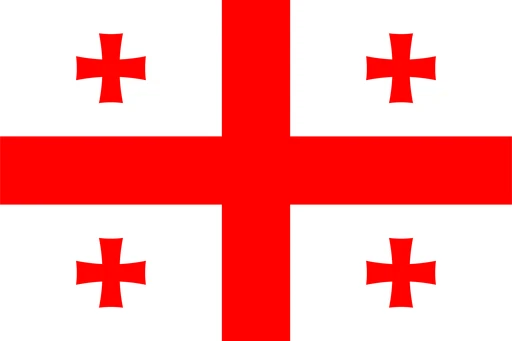
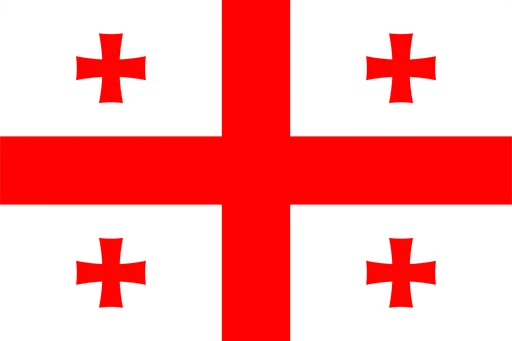
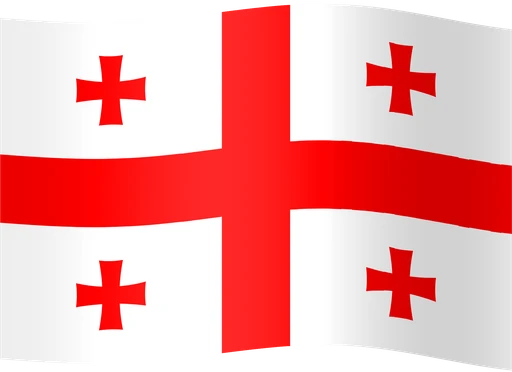
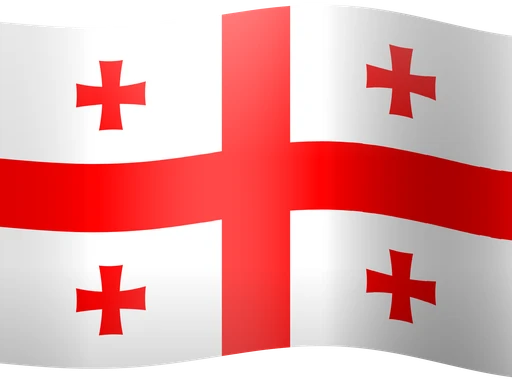
The flag of Georgia, also known as the Five Cross Flag, has a white field with a large red cross running to the edges, and four smaller red Bolnur-Katskhuri crosses in the quadrants. The arrangement is a Jerusalem cross, and the design is read as a statement of Orthodox Christian faith. The ratio is 2:3.
Georgia's flag is white, with a large red cross reaching all four edges and a smaller red cross set in each quadrant. The layout is a Jerusalem cross, and the design is openly religious in a country where Orthodox Christianity is central to national identity. Parliament adopted it on January 14, 2004, ten days after Mikheil Saakashvili won the presidency and less than two months after the Rose Revolution. It replaced a flag that stood for the 1918 republic and for the recovery of independence from Moscow, and it arrived carrying the branding of the party that had just taken power.
A Jerusalem cross built from Georgian church ornament
The flag is 2:3. The central cross runs the full height and width of the field. In each of the four white quadrants sits a smaller red cross of the bolnur-katskhuri form, whose arms widen toward the ends and finish in shallow concave curves. The name comes from two churches: the Bolnisi Sioni basilica south of Tbilisi, built in the late fifth century, and the church at Katskhi, where the same cross form is cut into stone. The motif is old and well documented in Georgian architecture, whatever the arguments about the flag itself.
The five-cross arrangement is the form known as the Jerusalem cross, best known from the arms of the crusader Kingdom of Jerusalem. Georgian sources explain the five crosses either as the five wounds of Christ or as Christ with the four Evangelists. The 2004 decree specifies geometry and color rather than meaning, setting the red at Pantone 2347c.
The construction drawing attached to that decree did not quite match the flag as anyone actually drew it, since the stated arm widths produced proportions different from the intended image. The specification was revised in 2018 to bring the measurements into line. The same design serves as national flag on land and as the ensign at sea, with no separate government variant.
What the medieval evidence actually shows
The strongest single piece of evidence for medieval use is a portolan atlas of 1367 attributed to the Pizzigano brothers, which marks Tbilisi with a Jerusalem cross flag. Beyond that the record thins quickly. Tradition assigns to Queen Tamar, who ruled from 1184 to 1213 at the height of the Georgian kingdom, a white banner bearing a red cross and a star, but the accounts of it postdate her reign by a long way. The historian D. Kldiashvili suggested that the four small crosses were added under George V, who ruled in the first half of the fourteenth century and drove out the Mongols, an attribution that is plausible but undocumented. In 2021 the State Council of Heraldry announced that a copper coin from the reign of David IV carried a folded five-cross composition on its reverse, and read it as direct confirmation.
Against this, the same Jerusalem cross flag appears in the fourteenth century Book of All Kingdoms assigned to Sivas rather than to Georgia, which suggests the symbol was not exclusively Georgian in the period. Nor was its use continuous. The Georgian kingdom fragmented at the end of the fifteenth century, and no Georgian state flew the design for roughly five hundred years afterward. Most of the historical case was assembled in the 1990s, by vexillologists and by the people campaigning for the flag's adoption.
The cherry red flag of 1918 and the banners that replaced it
The Democratic Republic of Georgia declared independence in May 1918 after the collapse of the Russian Empire, and held it for less than three years. Its flag was a dark cherry red field with narrow black and white bands in the canton. The sculptor Iakob Nikoladze won the competition to design it. Cherry red was treated as the Georgian national color, black stood for the suffering of the years under Russian rule, and white for what the new state hoped to become.
The Red Army invaded in February 1921 and the flag went with the republic. The Georgian SSR flew a plain red banner with the republic's initials in the canton, first in Georgian script, then in Cyrillic from 1922, then back to Georgian in 1937. The 1951 flag, designed by Severian Maysashvili and adopted on April 11 of that year, added a blue horizontal bar across the upper part of the field and set a red hammer and sickle inside a blue sun in the canton. It was the only union republic flag whose hammer and sickle was red rather than gold.
In November 1990 the Supreme Council of Georgia brought back Nikoladze's cherry red flag. Georgia declared independence on April 9, 1991, and that flag remained in place through the wars and instability of the decade that followed.
From party banner to national flag
By the late 1990s a campaign to replace the 1918 flag with the five-cross design had gathered momentum, and it had the backing of Catholicos-Patriarch Ilia II, whose endorsement carried real weight. Parliament passed a bill in 1999 to make the change. Eduard Shevardnadze, then president, declined to sign it, and the flag stayed as it was.
The design did not go away. Saakashvili's United National Movement, formed in 2001 in opposition to Shevardnadze, took the five-cross flag as its party emblem. It flew at the movement's rallies for two years before the parliamentary elections of November 2003, so when those results were rejected as rigged and crowds filled Rustaveli Avenue in Tbilisi, the flag already read as the symbol of the opposition. Shevardnadze resigned on November 23. Saakashvili won the presidential election of January 4, 2004. Parliament adopted the flag ten days later, and Saakashvili signed Decree No. 31 confirming it on January 25.
That sequence left the flag in an odd position. It became the national flag of Georgia while still functioning as the logo of the governing party, and the association with the United National Movement did not disappear when Saakashvili left office in 2013.
The flag in Georgian public life
January 14 is Georgian Flag Day, marking the parliamentary vote of 2004. The armed forces and the coast guard use standards derived from the national design, and the flag serves as civil and state ensign without modification.
Because the design is explicitly Christian, it sits close to the Georgian Orthodox Church, an institution that polls consistently as the most trusted in the country. That makes the flag easy to display at religious occasions and harder to read as neutral in a state with substantial Muslim populations in Adjara and Kvemo Kartli.
The flag has been prominent in the protest politics of the 2020s. During the demonstrations against the foreign agents law in 2024, protesters in Tbilisi carried the five-cross flag beside the twelve stars of the European Union, using the pairing to argue that a European orientation was the national position rather than a partisan one. The flag does not fly in Abkhazia or South Ossetia, both outside Georgian control and both using flags of their own.
References
[1] Decree No. 31 of the President of Georgia, January 25, 2004, and the Law of Georgia on the National Flag. Official legal text specifying the design, construction and colors, with the construction sheet revised in 2018.
[2] Flags of the World (FOTW), Georgia page. https://www.fotw.info/flags/ge.html. Construction details, Pantone specifications, the 2018 revision, and the Georgian SSR and 1918-1921 flags.
[3] State Council of Heraldry at the Parliament of Georgia. http://heraldika.ge/. The official body responsible for state symbols, and the source of the 2021 claim regarding the coin of David IV.
[4] Donald Rayfield, Edge of Empires: A History of Georgia (Reaktion Books, 2012). Standard one-volume history covering the medieval kingdom, the 1918-1921 republic, and the Saakashvili period.
[5] Stephen F. Jones, Georgia: A Political History Since Independence (I.B. Tauris, 2012). The Shevardnadze presidency, the rise of the United National Movement, and the Rose Revolution.
[6] Antony Eastmond, Royal Imagery in Medieval Georgia (Pennsylvania State University Press, 1998). Scholarly treatment of Georgian royal and religious iconography, including the imagery associated with Queen Tamar.
[7] Eurasianet, "The Flag of Change: Georgia's New Banner." https://eurasianet.org/the-flag-of-change-georgias-new-banner. Contemporary reporting on the 2004 adoption and the reaction to it.
[8] Encyclopaedia Britannica, "Flag of Georgia (country)." https://www.britannica.com/topic/flag-of-Georgia-national-flag. Summary of the design, the 1918 flag, and the 2004 change.
Common questions
- Why are there five crosses on the Georgian flag?
- The arrangement is a Jerusalem cross, a large cross with a smaller one in each quarter, and it is read as a statement of Orthodox Christian faith. The usual explanations are that the five crosses stand for the five wounds of Christ, or for Christ together with the four Evangelists. Neither reading is fixed in law. The four small crosses are the Bolnur-Katskhuri type, named after the Bolnisi Sioni basilica and the church at Katskhi, where the form appears in early Georgian stone carving.
- When did Georgia readopt the Five Cross Flag?
- Parliament voted for it on January 14, 2004, and President Mikheil Saakashvili signed Decree No. 31 confirming it on January 25. January 14 is now marked as Georgian Flag Day. The flag it replaced was not a Soviet one but the cherry red flag of the 1918-1921 first republic, which had been in use again since November 1990.
- Why did Georgia change its flag?
- The change was political. A campaign through the 1990s argued that the five-cross design was the historic banner of the medieval Georgian kingdom, and it had the backing of Catholicos-Patriarch Ilia II. Parliament passed a bill to adopt it in 1999, but President Eduard Shevardnadze never endorsed it. Saakashvili's United National Movement then adopted the flag as its own emblem, and it was carried through the Rose Revolution protests of November 2003. Once Shevardnadze resigned and Saakashvili won the presidency, the flag followed within weeks.
Featured in these articles
- Georgia's Flag Was a Party Logo First. A Revolution Made It the Nation's.
- The White Flag That Isn't Surrender: How Switzerland, Georgia, and the Holy Roman Empire Turned a Blank Canvas Into Bold Identity
- The Vatican's Crossed Keys: How the World's Smallest State Flies the Most Theologically Loaded Flag
Download this flag
Free in 12 styles, from 32px icons up to 2000px, as SVG, PNG, WebP and JPG.