Black-Red-Gold or Black-White-Red: The Flag Fight That Brought Down a German Government
Julio Song · · 8 min read
In May 1926, Germany lost a government over a flag. The chancellor, Hans Luther, had backed a decree telling some German embassies and consulates to fly a second flag next to the national one. Within days the Reichstag voted him out.
It sounds absurd until you know the history. Germany had two tricolours, and each one stood for a different idea of what Germany was. Black, red and gold meant liberals, students and the failed revolution of 1848. Black, white and red meant Bismarck, the Kaiser and the empire of 1871. For about a hundred years, choosing between them meant choosing a side.
Dyed coats and a castle ruin
The black-red-gold story starts with clothing. During the wars against Napoleon, the Lützow Free Corps was a volunteer unit of the Prussian army made up of men who arrived in whatever they owned. According to deutschland.de, the corps had no uniform at first, so it dyed the men's existing clothes black and added red cuffs and gold buttons. It was a practical fix, not a design decision.
The veterans carried the colours home. Former Lützow men helped found the student fraternity movement at Jena in 1815, and its banner used red and black with gold trim. By the early 1830s, the three colours stood for a German nation-state that did not yet exist.
The colours went public at Hambach. On 26 and 27 May 1832, somewhere between 20,000 and 30,000 people climbed to the ruined castle above Neustadt an der Weinstraße and flew black-red-gold flags. The German Confederation answered with two years of measures against liberal movements. Some of the festival's organisers were arrested. Others fled abroad.
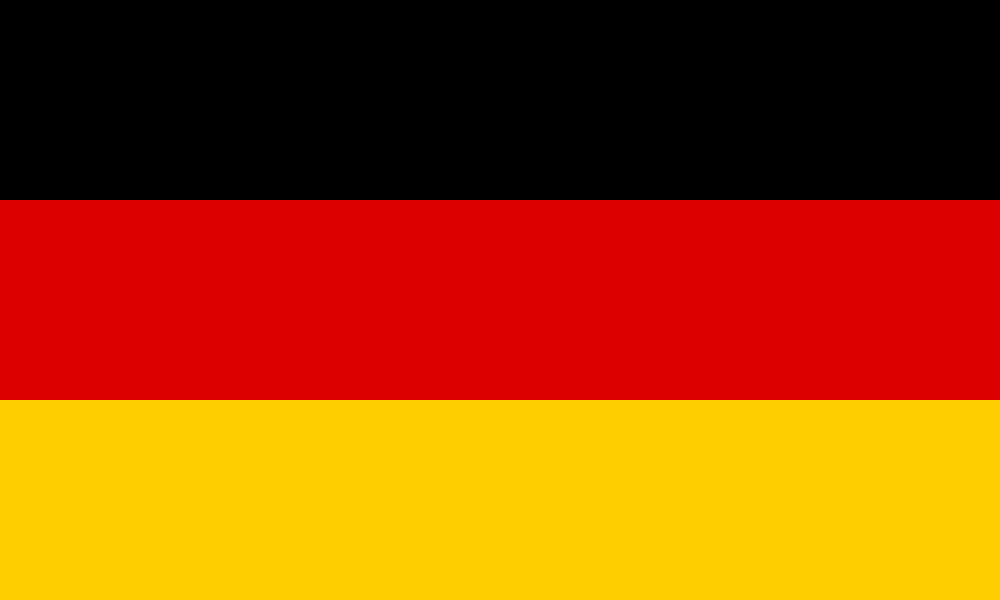
Then came 1848. With revolution spreading across Europe, the Confederation's own diet adopted black-red-gold in March of that year, and the new parliament in Frankfurt made it the German ensign by law in November. The revolution failed. Prussia restored the old order by 1852. Yet nobody repealed the flag laws, so plenty of Germans went on treating black-red-gold as the true German flag.
 GermanyView flag →
Bismarck picks different colours
When Germany did unite, it did so under Prussia, and Prussia had no use for the colours of 1848.
In 1867 the new North German Confederation adopted black, white and red. Flags of the World explains the logic: the black and white of Prussia joined to the red and white of the Hanseatic trading cities. Two existing state colour schemes were simply combined. Nothing in it pointed back to students or barricades.
The 1871 constitution of the German Empire repeated the wording. Its Article 55 reads: "Die Flagge der Kriegs- und Handelsmarine ist schwarz-weiß-rot." The war fleet and the merchant fleet both sailed under the new colours.
 German EmpireView flag →
Black-white-red stayed the empire's flag for the next half century, right through the First World War. Millions of Germans died in that war under those colours, and the attachment did not vanish when the empire collapsed in 1918.
A constitution that tried to keep both
The National Assembly that met in Weimar in 1919 faced an awkward choice. A Bundestag research paper notes that the imperial black-white-red still flew over the Weimar National Theatre when the assembly opened. The revolution's own colour was red, which the Social Democrats saw as a party banner, not a national one. Black-red-gold offered a way back to the democrats of Hambach and 1848.
The right wanted none of it. Hugo Preuß said conservatives and monarchists clung to black-white-red "wie an die Erinnerung eines verlorenen Paradieses," like the memory of a lost paradise.
So the assembly split the difference. Article 3 of the Weimar Constitution said: "Die Reichsfarben sind schwarz-rot-gold. Die Handelsflagge ist schwarz-weiß-rot mit den Reichsfarben in der oberen inneren Ecke." The national colours became black, red and gold. Merchant ships kept black, white and red, with a small black-red-gold canton in the corner.
The compromise pleased nobody. The historian Peter Reichel later called it the start of a "Flaggendauerstreit," a permanent flag dispute, one that "letztlich nur Verlierer kennt," with only losers in the end.
The stalemate shows up in the paperwork. A 1921 regulation on official flags created ten designs for government use. Five were based on black-red-gold. Five were based on black-white-red. The Bundestag paper describes it as the Article 3 compromise turned into numerical parity.
Murderers' flags and new martyrs
The argument got uglier after the murder of Walther Rathenau in 1922. In the Reichstag, the Social Democrat Otto Wels told the republic's enemies on the right that black-white-red had become "zur Mörderfahne," the murderers' flag. A new Law for the Protection of the Republic made it a crime to insult the national colours.
Supporters of the republic organised too. In 1924 they founded the Reichsbanner Schwarz-Rot-Gold, a cross-party veterans' league that carried the republic's tricolour from the cities out into the countryside. By the mid-1920s each flag had its marchers, its newspapers and its martyrs.
That was the mood in Berlin when Hans Luther made his move.
One decree, one letter, one week
Luther was a chancellor with no party. He had held office since January 1925. In spring 1926, with the backing of President Paul von Hindenburg, he pushed through a flag decree dated 5 May 1926.
The text was narrow. German missions in countries outside Europe, and in European port cities, were to fly the black-red-gold national flag next to the black-white-red merchant flag.
Republicans read it as the old colours sneaking back onto official buildings by order from above. The Social Democrats, the Catholic Centre, the liberal DDP, the republican press, the Reichsbanner and the trade unions all protested. Philipp Scheidemann called black-white-red the "Fahne der Putschisten," the flag of the coup plotters.
Hindenburg made it worse. He wrote a letter calling for reconciliation over the flag question. According to the Bundestag paper, republicans took his appeal as a barely hidden call to bring back the monarchy.
The Reichstag debated the decree in May. Eduard David told the chamber that the old martyrs of black-red-gold from the previous century now had new martyrs beside them. On 12 May 1926, a Reichstag majority passed a vote of no confidence in Luther. His government fell.
The decree outlived him. The Bundestag paper states it plainly: the government fell over the colour question, but the flag decree stayed in force. Luther lost his job, and German embassies in trading ports went on flying both flags.
The designer who tried to end it
One man thought good design would fix a political problem. Edwin Redslob held the post of Reichskunstwart, the republic's official adviser on art and symbols. Nobody had consulted him on the decree.
He proposed a unity flag. A black cross would divide the field into four parts in alternating red and gold, so both camps would see something of their own. The press mocked it, and nobody adopted it. Redslob tried again with a public competition. By October 1926 about a thousand flag designs had reached his office, according to the Bundestag's account, and more kept arriving until 1929.
None of them worked, because the fight was never about how the flag looked. Redslob's friend Ferdinand Friedensburg, deputy head of the Berlin police, saw it clearly: "Es ist der Kampf zwischen zwei fundamental verschiedenen Staatsformen." It was a fight between two different kinds of state. A prettier flag did not settle that.
Looking back in 1949, Otto Braun said the flag question had played a role in Weimar politics "die viele materiell wichtigere Fragen überwog," outweighing many questions of far more practical weight.
How the fight ended, twice
The Nazis ended the flag dispute by destroying both sides. On 12 March 1933, soon after Hitler took power, black-red-gold was dropped and black-white-red returned next to the swastika banner. After Hindenburg died in 1934, the imperial colours faded too. From 1935, only the swastika flew.
That history settled the question for the next generation. Black-white-red had stood next to the swastika. Black-red-gold had been banned by it. When West Germany wrote its constitution in 1949, the colours caused no controversy. The black-red-gold tricolour flew over the Parliamentary Council as it met, and Article 22 of the Basic Law settled it in one line: "The federal flag shall be black, red and gold."
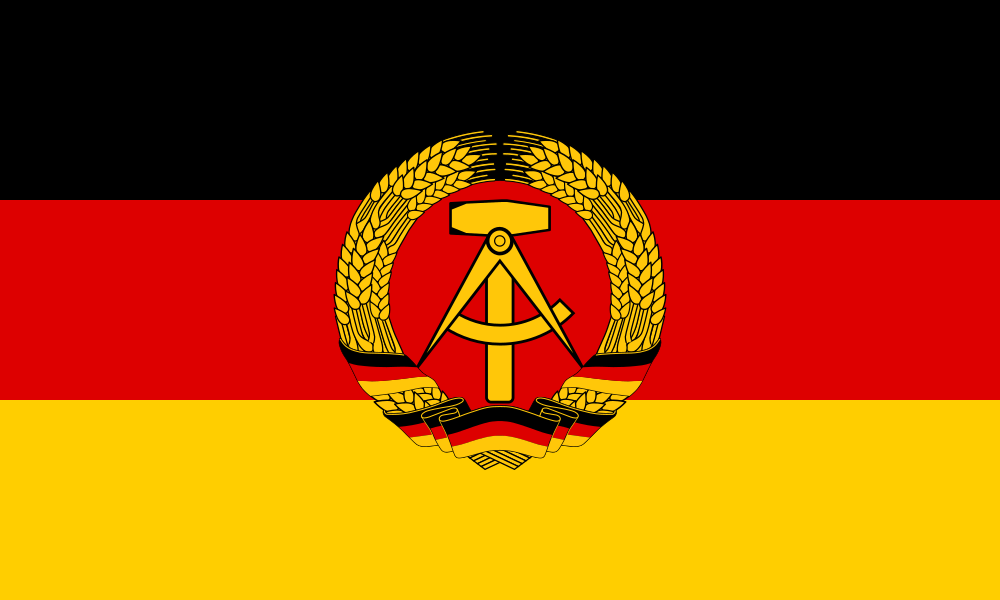
East Germany chose the same colours. For years the two German states flew identical flags. Then on 1 October 1959, the GDR added its emblem of hammer and compass inside a wreath. West Germans called the result the "Spalterflagge," the splitter's flag. Flags of the World records that the change led to street scuffles in Berlin and to West German efforts to keep the flag away from international sports events.
 East GermanyView flag →
The splitter's flag lasted until 3 October 1990, when the two states reunited under the plain tricolour.
What the 1926 crisis tells you
A flag fight looks petty from the outside. Luther's decree changed what flew over some German missions abroad. It still brought down a government, because everyone in the Reichstag knew the flags were stand-ins for something bigger. Black-red-gold said the republic was legitimate. Black-white-red said it was a mistake.
The colours Germans fly today belong to the side that lost when the 1848 revolution failed, lost again in 1867 and won for good only in 1949. When you see the tricolour at a football match, you are looking at the flag of Hambach and Frankfurt. You are also looking at the flag whose defenders brought down a chancellor in 1926, and which a dictatorship banned. Germany chose it twice, in 1919 and in 1949, and only the second choice held.
Julio Song
Writer
Julio is a staff writer at FlagDB. He studied Mathematics at the University of Madrid and has a passion for vexillology.
More from Julio Song →Related articles

The Flag With a Hole: How Hungary, Romania and East Germany Cut Communism Out of Their Flags
The Flag That Had to Please Everyone: How the European Union's Circle of Stars Became the Most Negotiated Image in History