The Flag of the German Empire
The German Empire
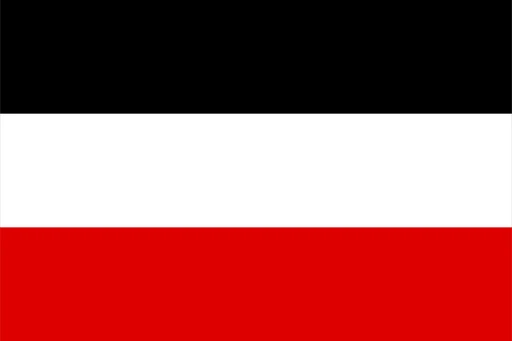
The flag of the German Empire is a horizontal tricolor of three equal stripes: black on top, white in the middle and red at the bottom, in proportions of 2:3. Black and white are the colors of Prussia. Red and white are the colors of the Hanseatic port cities of Hamburg, Bremen and Lübeck. The flag joins the two pairs. It began in 1867 as the ship flag of the North German Confederation, passed to the German Empire in 1871 and was declared the national flag in 1892. The Weimar Republic replaced it with black-red-gold in 1919.
The flag of the German Empire is three equal stripes of black, white and red. It was drawn up for ships. A Hamburg trade official proposed the colors in a newspaper in 1866, a constitution adopted them for the navy and the merchant fleet in 1867, and for 25 years Germany had no national flag in law at all. That status came in 1892. Black-white-red then lost it in 1919, got half of it back in 1933 and lost it again in 1935. Today it is legal to own and often a matter for the police to fly.
A flag for ships first
In 1866 Prussia and its north German allies formed the North German Confederation. Shipping interests wanted one flag that foreign ports would recognize.
On 22 September 1866 Adolf Soetbeer, secretary of the Hamburg Chamber of Commerce, made a proposal in the Bremer Handelsblatt. Take the black and white of Prussia. Add the red and white of the Hanseatic cities. Otto von Bismarck put the idea into his draft outline for the constitution on 9 December 1866, in a passage requiring merchant ships of every member state to fly black-white-red. Prince Adalbert of Prussia endorsed it on 25 December.
The constitution took effect on 1 July 1867. Article 55 is one sentence long: "Die Flagge der Kriegs- und Handelsmarine ist schwarz-weiß-roth." The flag of the navy and the merchant fleet is black-white-red. It says nothing about land, and nothing about a national flag.
When the German Empire was founded in 1871, its constitution of 16 April kept Article 55 word for word.
Three stripes, two to three
Article 55 named colors and no design. The design came on 25 October 1867 in an ordinance on the federal flag for merchant ships, signed by King Wilhelm I at Schloss Babelsberg and countersigned by Bismarck. It describes a rectangle of three horizontal stripes of equal width, black at the top, white in the middle and red at the bottom, with a height to length ratio of two to three. Merchant ships fly it at the stern or on the rear mast, as a rule from the gaff. They are forbidden from adding navy-style badges or pennants.
The colors had a plain logic. Black and white were Prussian, used by the Teutonic Knights and by the Hohenzollern family. Red and white appeared in the arms of Hamburg, Bremen and Lübeck. Wilhelm I accepted the red and white as standing for Brandenburg too. The flag also left out gold, which set it apart from the black and gold of Austria.
No shade of red was laid down in 1867. The master image on this page uses #dd0000, the red of the public domain drawing it is taken from.
National flag, 25 years late
For its first two decades the empire had a ship flag and no national one. The Bundestag's own history of the German colors says black-white-red had little significance at first, and that its acceptance grew steadily.
Wilhelm II closed the gap. On 8 November 1892, aboard the ironclad Baden at Kiel, he signed the ordinance on the use of the Reich flag, countersigned by Chancellor Leo von Caprivi. Paragraph 1 says the flag laid down for merchant ships "forms the German national flag." Paragraph 2 gives the navy its separate war flag. Paragraph 3 creates service flags for imperial offices: the national flag with a badge in the white stripe. The Foreign Office got an imperial eagle, the navy an anchor, the post office a post horn and other departments an imperial crown. The ordinance took effect on 1 April 1893.
The flag fight of the Weimar years
The monarchy fell in 1918, and the new republic chose the colors of the 1848 democrats. Article 3 of the Weimar constitution of 11 August 1919 reads: "The Reich colors are black-red-gold." Its second sentence was a compromise. The merchant flag stayed black-white-red, with the new colors in the upper inner corner. A flag ordinance of 11 April 1921 let the older flags stay in use until the end of that year.
The compromise did not end the argument. Monarchists mocked the republican tricolor as "black-red-mustard." The German National People's Party and the German People's Party kept using the old colors. On 5 May 1926 Chancellor Hans Luther ordered German missions outside Europe to fly the merchant flag beside the national flag. The Reichstag debated the order on 12 May, and Luther's government fell over it.
Back in 1933, out in 1935
On 12 March 1933 President Paul von Hindenburg decreed that black-white-red and the swastika flag were to be hoisted together until a final rule was made. The old flag came back at a ratio of 3:5.
The final rule was the Reich Flag Law of 15 September 1935. Article 1 kept the colors: "The Reich colors are black-white-red." Article 2 gave the flag status to something else. The swastika flag became the Reich flag, the national flag and the merchant flag. Hermann Göring called the old tricolor reactionary.
It had one more wartime use. The National Committee for a Free Germany, made up mostly of German prisoners of war and exiles, put black-white-red on its propaganda and armbands.
Legal to own, awkward to fly
Neither postwar German state took the flag back. The Parliamentary Council chose black-red-gold for the Federal Republic in 1949 with one vote against. In East Germany an early proposal for black-white-red lost to the same colors.
With the swastika banned, the far right turned to the imperial flag as a legal stand-in, and the Reichsbürger movement uses it to signal rejection of the Federal Republic. On 29 August 2020 right-wing extremists carrying imperial flags ran up the steps of the Reichstag building during a protest in Berlin. That set off a debate about a ban.
The flag itself contains no outlawed emblem. A Baden-Württemberg administrative court held in 2005 that showing it is not a crime in itself, and in early 2021 the federal government declined a general criminal ban. In June 2021 the state and federal interior ministers settled on a model decree for the states to adopt. It names the Reich flag from 1892 alongside three war flags. Police act in six kinds of situation, including display with intimidating slogans, with Nazi symbols, at places or dates with historical weight, or at gatherings with a paramilitary look. The legal basis is the administrative offense of public nuisance. Fines run up to 1,000 euros, and the flag is liable to be seized.
References
[1] "Verfassung des Norddeutschen Bundes," Bundesgesetzblatt des Norddeutschen Bundes 1867, Nr. 1, pp. 1-23, Article 55. Wikisource. https://de.wikisource.org/wiki/Verfassung_des_Norddeutschen_Bundes
[2] "Verordnung, betreffend die Bundesflagge für Kauffahrteischiffe," 25 October 1867, Bundesgesetzblatt des Norddeutschen Bundes 1867, Nr. 5, p. 39. Wikisource. https://de.wikisource.org/wiki/Verordnung,_betreffend_die_Bundesflagge_f%C3%BCr_Kauffahrteischiffe
[3] "Verfassung des Deutschen Reiches (1871)," 16 April 1871, Reichsgesetzblatt 1871, Nr. 16, pp. 63-85, Article 55. Wikisource. https://de.wikisource.org/wiki/Verfassung_des_Deutschen_Reiches_%281871%29
[4] "Verordnung über die Führung der Reichsflagge," 8 November 1892, Reichsgesetzblatt 1892, Nr. 47, pp. 1050-1051. Wikisource. https://de.wikisource.org/wiki/Verordnung_%C3%BCber_die_F%C3%BChrung_der_Reichsflagge
[5] "Verfassung des Deutschen Reichs (1919)," 11 August 1919, Article 3. Wikisource. https://de.wikisource.org/wiki/Verfassung_des_Deutschen_Reichs_%281919%29
[6] "Reichsflaggengesetz," 15 September 1935, Reichsgesetzblatt 1935, Teil I, Nr. 100, p. 1145. Wikisource. https://de.wikisource.org/wiki/Reichsflaggengesetz
[7] "Die Bundesflagge," Deutscher Bundestag, on the history of the German national colors. https://www.bundestag.de/parlament/symbole/flagge
[8] Christian Rath, "Reichskriegsflaggen und Rechtsextreme," taz, 13 June 2021, on the interior ministers' model decree. https://taz.de/Reichskriegsflaggen-und-Rechtsextreme/!5774762/
[9] "Schwarz-Weiß-Rot," Wikipedia (German), on Soetbeer's proposal, Bismarck's draft and the legal position today. https://de.wikipedia.org/wiki/Schwarz-Wei%C3%9F-Rot
[10] "Flaggenstreit," Wikipedia (German), on Luther's flag order of 5 May 1926 and the fall of his government. https://de.wikipedia.org/wiki/Flaggenstreit
[11] "Flag of the German Empire," Wikipedia. https://en.wikipedia.org/wiki/Flag_of_the_German_Empire
[12] "German Empire 1871-1918," Flags of the World. https://fotw.info/FLagS/de1871.html
Common questions
- What do the colors of the German Empire flag mean?
- The flag joins two older pairs of colors. Black and white are the colors of Prussia, carried earlier by the Teutonic Knights and the Hohenzollern family. Red and white are the colors of the Hanseatic cities of Hamburg, Bremen and Lübeck. King Wilhelm I of Prussia also read the red and white as the colors of Brandenburg. No law of the period assigns the stripes any other meaning.
- Who designed the black-white-red flag?
- No single designer is credited. Adolf Soetbeer, secretary of the Hamburg Chamber of Commerce, proposed the color combination in the Bremer Handelsblatt on 22 September 1866. Otto von Bismarck wrote it into his draft for the North German constitution that December. The layout of three equal stripes at 2:3 comes from an ordinance signed by King Wilhelm I and Bismarck on 25 October 1867.
- When was the black-white-red flag used?
- It was the ship flag of the North German Confederation from 1867 and of the German Empire from 1871. It became the national flag by an ordinance of 8 November 1892. The Weimar Republic replaced it in 1919, and the older flags were phased out by the end of 1921. It was flown again beside the swastika flag from 12 March 1933 until the Reich Flag Law of 15 September 1935.
- Why did Germany switch from black-white-red to black-red-gold?
- The monarchy fell in 1918, and the Weimar National Assembly wanted the colors of the 1848 democratic movement. Article 3 of the 1919 constitution made black-red-gold the national colors. As a compromise, the merchant flag stayed black-white-red with a small black-red-gold canton. In 1949 the Parliamentary Council chose black-red-gold again for the Federal Republic, with one vote against.
- Is the German Empire flag banned in Germany?
- No. The plain black-white-red flag carries no banned emblem, and the federal government declined a general criminal ban in early 2021. Since 2021 the German states have worked from a shared model decree. It lets police step in when the flag is shown in certain settings, such as with intimidating slogans or at historically charged places and dates. Fines reach 1,000 euros and the flag is liable to be seized.
- Is the German Empire flag the same as the Reichskriegsflagge?
- No. The flag on this page is the plain tricolor, which served as the merchant flag and from 1892 as the national flag. The Reichskriegsflagge was the separate war flag flown by the navy. The 1892 ordinance treats the two apart: paragraph 1 names the national flag, and paragraph 2 reserves the war flag for the navy and certain military authorities.
Download this flag
Free in 12 styles, from 32px icons up to 2000px, as SVG, PNG, WebP and JPG.