Drawn at a School Desk: The Teenagers Behind the Flags of Alaska, Papua New Guinea and Australia
Julio Song · · 9 min read
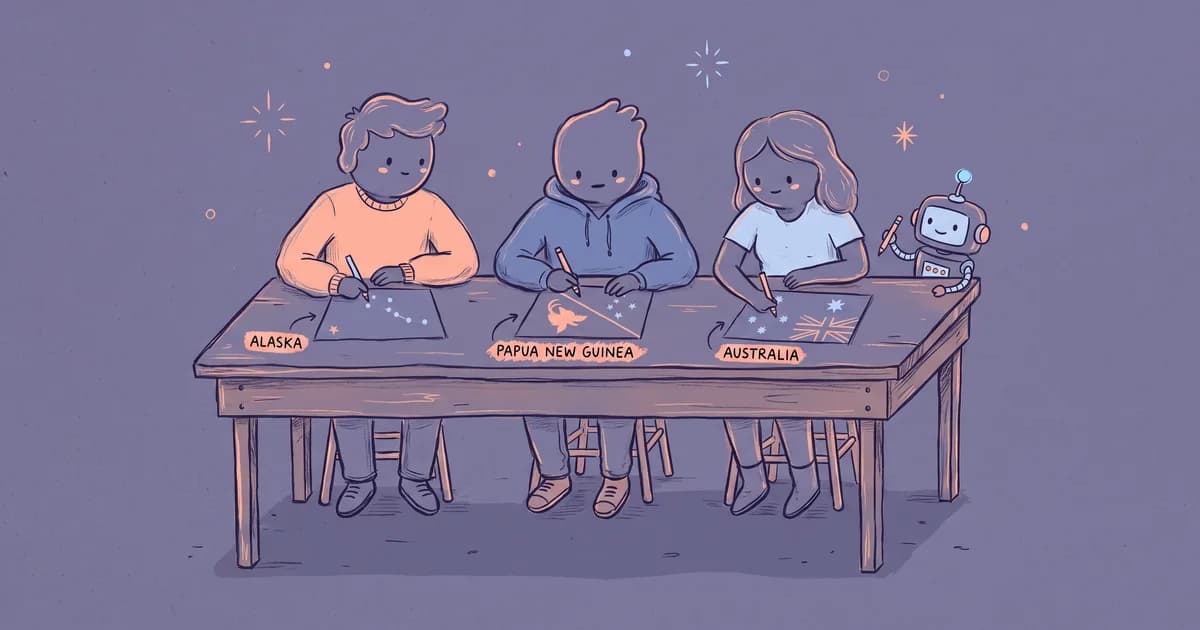
Three flags still in use today started life on paper belonging to a teenager. One was a seventh grader at a children's home in Alaska. One was a mission-school pupil on an island off Papua. One was a Melbourne schoolboy who shared a prize with an architect and a ship's officer.
None of them was a trained designer. Each one beat a field of rivals, and two of them went up against grown professionals. And in all three cases, nobody has ever fully agreed on how old the designer was.
A 1927 school contest, a 1971 exercise book and a 1901 competition with 32,823 entries each ended the same way, with a kid's drawing on a flagpole.
Eight stars from a children's home
In the 1920s, Alaska was a territory with no flag of its own. The American Legion's Alaska department ran a contest to fix that, and the competition was announced in the Seward Gateway on 31 December 1926. Entry was limited to schoolchildren, from seventh grade to twelfth grade.
Benny Benson lived at the Jesse Lee Home for Children in Seward. He drew eight gold stars on a blue field: seven for the Big Dipper, one for the North Star. His design didn't sweep the local round. It placed third for Seward, and he nearly pulled out after that result.
He went on to win anyway. The Alaska State Museum counts 142 entries in the territory-wide contest. Benson's entry came with a short explanation, which the museum prints in full:
"The blue field is for the Alaska sky and the forget-me-not, an Alaskan flower. The North Star is for the future state of Alaska, the most northerly in the union. The Dipper is for the Great Bear, symbolizing strength."
Read that again and notice the word "state." Alaska wouldn't become one until 1959. A kid in a children's home wrote the territory's political ambition into its flag three decades early.
The legislature moved fast. It adopted the design on 2 May 1927, and the flag first flew on 9 July 1927 at 4 p.m., on the flagpole of the Jesse Lee Home itself. Alaska kept the design when it became a state.
The flag a committee built, and nobody wanted
Papua New Guinea's story is the clearest case of a teenager beating the professionals, because the professionals went first.
In 1970 Papua and New Guinea had no flag of its own. The Select Committee on Constitutional Development gathered ideas from the public. An artist in the Department of Information and Extension Services named Hal Holman took the most popular answers and built a flag from them. According to Flags of the World, the colours and symbols people suggested most often were "blue, gold, green, and birds, drums, spears and stars."
Holman's result was a vertical tricolour of blue, gold and green, with the Southern Cross and a bird of paradise laid over it. The House saw it on 17 November 1970.
It flopped. The committee's deputy chairman, Littler, later wrote that people saw it as "a mechanically contrived outcome designed by the Select Committee." That's a polite way of saying it looked like a survey result. Every box was ticked and nothing held together. Mark Sensen, writing for Flags of the World, noted that the empty middle stripe "doesn't result in a unified flag."
A page torn from an exercise book
So the committee went on tour. In January and February 1971, two groups travelled the country to hear reactions. Littler led one of them.
On 12 February 1971, at a meeting on Yule Island, a pupil from the Catholic Mission School handed him a page from her exercise book. Her name was Susan Karike. She had redrawn the flag from scratch.
She threw out Holman's palette. Her flag split diagonally, black below with the white stars of the Southern Cross, red above with a gold bird of paradise. Her reason for the colours was simple. They were, she said, "the colours most commonly used by our people in their traditional ceremonies."
Littler's reaction, in his own account: the design "had instant appeal," and he thought, "This is the flag."
Look at what she kept and what she dropped. The bird of paradise and the Southern Cross survived, because the public had asked for birds and stars. The three-stripe structure and the borrowed palette went. Holman had treated the survey as a shopping list. Karike treated it as a brief.
The adults then moved quickly. Ross and Pat Johnson had her sketch made up on a larger piece of cloth. On 1 March the committee met in Port Moresby, rejected the tricolour and chose her design. On 4 March 1971 the House adopted the committee's report recommending it.
The legal paperwork followed. National Identity Ordinance No. 41 of 1971, dated 25 June, set out the flag, and it was published in the Government Gazette on 1 July 1971. Papua New Guinea didn't become independent until 16 September 1975. Karike's flag was waiting for it four years early, the same trick Benson's North Star pulled in Alaska.
Five winners, one schoolboy
Australia's flag competition ran at a scale the other two never approached. The new Commonwealth government announced it on 29 April 1901, and it drew 32,823 entries from men, women and children. Judges weighed history, heraldry, distinctiveness, utility and the cost of manufacture.
On 3 September 1901, at the Royal Exhibition Buildings in Melbourne, Prime Minister Edmund Barton named not one winner but five. Their designs were nearly identical, each pairing a large Commonwealth Star with the Southern Cross. The five were:
- Ivor Evans, a 14-year-old schoolboy from Melbourne
- Leslie John Hawkins, a teenager apprenticed to a Sydney optician
- Egbert John Nuttall, a Melbourne architect
- Annie Dorrington, an artist from Perth
- William Stevens, a ship's officer from Auckland
So two of the five winners were teenagers. A boy still in school landed on the same answer as an architect and a professional artist.
Evans's version had one detail the judges liked. According to his Wikipedia biography, judge John Evans praised the technical accuracy of how the Southern Cross stars were sized by brightness. The schoolboy had done his astronomy homework.
The adults then edited the kids. The 1901 design gave the Southern Cross stars nine, eight, seven, six and five points. By 1903 all but the smallest had seven. King Edward VII's approval was confirmed in the Commonwealth Gazette of 20 February 1903, and the large Commonwealth Star gained a seventh point, for the territories, on 19 December 1908.
Why the kids kept winning
Side by side, the three stories share a pattern.
Each winning design uses few elements. Alaska has eight stars and one colour field. Papua New Guinea has two triangles, a bird and five stars. Australia's five winners each arrived at the same short list of symbols without comparing notes.
Each one also ties its symbols to something the designer saw around them. Benson looked up at the Big Dipper. Karike looked at the colours worn at ceremonies around her. Evans counted stars by brightness.
The losing approach, where you have one on record, did the opposite. Holman's tricolour tried to honour every popular answer at once. It's the classic committee flag, and it's the one nobody remembers.
There's a lesson in that for you if you ever sit on a flag panel. Read the public's ideas as a list of feelings to capture, then hand the drawing to someone with a single point of view. Sometimes that person is fourteen.
The ages that won't sit still
For three people this famous, the basic fact of their age keeps shifting. I find that odder than any of the designs.
Benson was long said to be 13 when he won. In 2022, records from a Russian Orthodox priest in Chignik showed he was born on 12 September 1912, not 12 October 1913. A Superior Court judge corrected his birth date on 28 February that year. He had been 14. The error likely began with Benson himself, who had no birth certificate when he registered for the draft in 1940 and gave the date he believed was right.
Karike is usually described as 15. Flags of the World records one source putting her at 18 and another calling her "a local art teacher." Littler, who met her, called her only "a young Papuan girl."
Evans was born on 24 July 1887. That makes him 13 when the competition opened in April 1901 and 14 by the September announcement, which is why you'll see both numbers in print.
None of these gaps changes who drew what. They do tell you how little attention anyone paid to these kids while the flags were being adopted. Adults recorded the designs with precision, down to star points and gazette numbers. Nobody wrote down a birthday.
What they got for it
The rewards were uneven.
Benson did best. Alaska's Flag Act set aside $1,000 to send him to Washington, D.C., and when a meeting with the president fell through, lawmakers amended it so the money went to his education instead. Mountains, streets, airports and schools now carry his name. He died in Kodiak at 59.
Evans got £40, a fifth of the £200 prize. He stayed close to flags for life. He joined his father's canvas-goods firm, Evan Evans, and became its managing director in 1922. In 1951 he suggested every school receive an Australian flag for the 50th anniversary of Federation, and more than 10,000 were handed out. He died in 1960.
Karike's story ends worst. She died on 11 April 2017. Two years later her husband, Nanny Huhume, told The National that she never received proper recognition or compensation, and that he waited three months for government help to bury her. "No proper recognition was given when my wife was still alive and up to the time when she died and was buried," he said. In his view the flag still belongs to her.
Three kids, three flagpoles
A seventh grader, a mission-school pupil and a Melbourne schoolboy each solved a problem that adult institutions had set. Two of them did it years before their homes became a state and a nation.
The next time you see eight gold stars on blue, a bird of paradise over a black triangle, or a Southern Cross beside a seven-pointed star, you're looking at homework. It's homework that passed every test a legislature set, then waited decades for the adults to agree on the designer's birthday.
Julio Song
Writer
Julio is a staff writer at FlagDB. He studied Mathematics at the University of Madrid and has a passion for vexillology.
More from Julio Song →