Imagine standing on the deck of a Polynesian voyaging canoe a thousand years ago. The ocean is black. The horizon is gone. All you have is a tight diamond of four bright stars hanging low over the southern horizon, and that's enough. Those four stars told you where you were, where you were going, and how to get home.
In 2016, 56.6% of New Zealand voters chose to keep those same four stars on their national flag rather than adopt a silver fern design. The Southern Cross, known astronomically as Crux, is the smallest of all 88 modern constellations. It still appears on more national flags than any other star pattern: Australia, New Zealand, Samoa, Papua New Guinea, and Brazil, plus territory flags from the Cocos Islands to Tierra del Fuego.
How did five modest stars become the emblem of an entire hemisphere? Navigation, colonial identity, indigenous reclamation, and the surprisingly fierce politics of putting stars on cloth. The constellation's meaning has never been fixed. It gets rewritten by whoever is looking up at it.
The oldest navigators
Long before any European flag existed, the Southern Cross was a working tool.
Polynesian wayfinders used Crux (known in Māori as Te Punga or Māhutonga) as a key reference for latitude and direction. It was part of a sophisticated system of star compasses that enabled the settlement of islands scattered across thousands of miles of open Pacific Ocean. These were not casual observations. This was precision navigation, passed down orally through generations.
Aboriginal Australians built the Southern Cross into something stranger: the "Emu in the Sky," a dark constellation formed by the Coalsack Nebula and the dark patches of the Milky Way around it. Where Western astronomy looks at bright points and connects them, Aboriginal sky knowledge reads the dark spaces between stars. That tradition stretches back an estimated 65,000+ years, which makes it one of the oldest continuous astronomical cultures on Earth.
Samoan navigators knew the constellation as Sumu, the triggerfish, and used it alongside other star groups to voyage between island chains. Different name, same stars, same purpose.
So when European flags later put the Southern Cross on national banners as a "discovery," they were branding something that indigenous peoples had named, mapped, and navigated by for millennia. The stars were already spoken for.
European "discovery" and the birth of a navigational icon
Ancient Greeks could see Crux from the Mediterranean. Ptolemy catalogued its stars as part of the constellation Centaurus around 150 AD. But Earth's axis wobbles over thousands of years (a phenomenon called precession of the equinoxes), and by the 16th century, the Southern Cross had sunk below the European horizon. For most European sailors, it was genuinely unknown.
Portuguese and Spanish navigators "rediscovered" Crux during voyages around the Cape of Good Hope. Amerigo Vespucci described it in a 1501 letter. Andrea Corsali's 1515 letter to Giuliano de' Medici included the first known European depiction, comparing the four stars to a Christian cross. That comparison stuck, and it shaped how Europeans read the constellation for centuries afterwards.
French astronomer Augustin Royer separated it from Centaurus in 1679 and catalogued it under its own name: Crux.
Its practical value was the reason anyone cared. Unlike the Northern Hemisphere's Polaris, there is no bright south pole star. Navigators learned to extend the long axis of Crux about 4.5 times its length to approximate the south celestial pole, which made the Southern Cross the most important navigational reference below the equator.
That is also how it became shorthand for the south itself, a geographic identity that colonists would soon claim as their own.
How settlers turned stars into national identity
The Eureka Stockade flag of 1854 is one of the earliest political uses of the Southern Cross. Gold miners in Ballarat, Australia, rebelling against British colonial authorities, flew a white cross of five stars on a blue field. It was a symbol of democratic defiance and southern distinctiveness. The message was clear: we are not Britain. We are here, under these stars.
When Australia federated in 1901, the national flag competition drew over 32,000 entries. The winning design placed the Southern Cross on the fly half alongside a Commonwealth Star (initially six-pointed, changed to seven in 1908 to represent territories).
New Zealand adopted its current flag in 1902, with four red five-pointed stars, white-bordered, standing for the four brightest stars of Crux. The red was deliberate, chosen to tell the flag apart from Australia's white stars. An early assertion of separate national identity within the British Empire, made entirely through the color of the same constellation.
Brazil's flag, adopted in 1889 with its current design finalized in 1992, takes the most astronomically literal approach. It depicts 27 stars representing states and the Federal District, arranged as they appeared in the sky over Rio de Janeiro at 8:30 AM on November 15, 1889, the moment the republic was proclaimed. The Southern Cross sits prominently among them.
The logic was the same every time. Colonists and new nations needed a symbol that said "we are not Europe," and the Southern Cross, invisible from London, Lisbon, or Madrid, did that job better than anything else available.
Five flags, five interpretations
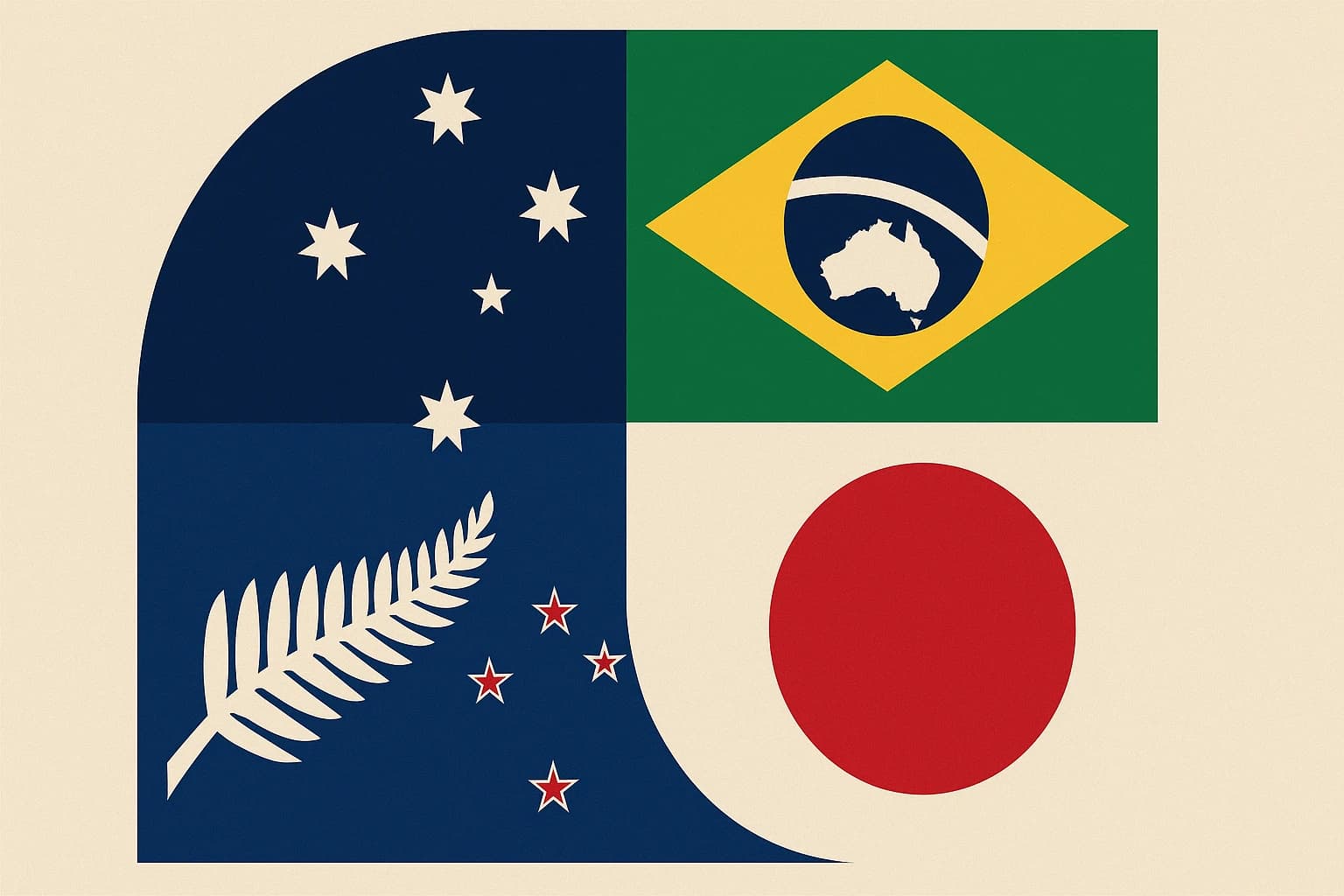
Australia's flag has five white seven-pointed stars: one each for Alpha, Beta, Gamma, and Delta Crucis, plus the smaller Epsilon Crucis. Alongside the Commonwealth Star, the constellation stands for both the southern sky and the country's federal structure.
New Zealand's four red stars leave out Epsilon Crucis, the faintest of the group, and use red with white borders. The result looks similar to Australia's flag while being intentionally different, which is a source of ongoing confusion and occasional diplomatic awkwardness. (New Zealanders, understandably, find this frustrating.)
Papua New Guinea's flag, adopted at independence in 1975, was designed by a 15-year-old student named Susan Karike. Five white stars sit on a red and black diagonal alongside a Raggiana bird-of-paradise, putting colonial-era celestial symbolism next to indigenous natural imagery in a way no other Southern Cross flag does.
Samoa's flag, adopted in 1949 and modified at independence in 1962, originally featured four stars but added a fifth to match the actual constellation. The stars appear white on a deep blue canton, and the flag's design was chosen by a committee of Samoan chiefs. That makes it one of the few Southern Cross flags selected entirely by indigenous leadership.
Brazil's approach is unlike the rest. The stars are cartographic rather than decorative. Each one is assigned to a specific state, which makes the flag a working star map, and it is the only national flag where the Southern Cross is both symbol and literal celestial chart.
New Zealand's flag referendum
In 2015 and 2016, New Zealand held a two-stage binding referendum on whether to change its flag, at a cost of NZ$26 million. It was the first time any country had put its flag design to a national vote.
The leading alternative was Kyle Lockwood's silver fern design, a white fern on black and blue. It would have dropped the Southern Cross entirely and swapped celestial symbolism for botanical, trading shared hemispheric identity for something recognizably New Zealand and nothing else.
Proponents of change, including Prime Minister John Key, argued the existing flag was too easily confused with Australia's and that the Southern Cross was a colonial inheritance. Opponents countered that the stars honored both European and Māori navigational heritage and that veterans had fought under those stars.
The final result: 56.6% voted to keep the current flag.
The outcome revealed a generational and cultural split. Younger and Māori voters were slightly more open to change. But the cost of the referendum, attachment to the existing design, and political opposition to Key himself all complicated the picture. Many people who might have supported a new flag voted "keep" simply because they disliked the process or the alternative design.
The referendum's failure did not end the conversation. It showed that the Southern Cross carries emotional weight well beyond its astronomical origins, and that it is contested ground where colonial history, indigenous identity, military memory, and national branding all meet.
Reclaiming the stars
In recent decades, Māori cultural advocates have reframed the Southern Cross as Māhutonga rather than a colonial imposition: a star grouping Polynesian navigators used long before James Cook sailed anywhere near New Zealand. The argument follows from that. Any flag bearing Crux honors indigenous knowledge whether or not the colonists intended it to, because the stars belong to Polynesia first.
Aboriginal Australians have made a similar point through the Emu in the Sky tradition. Some have proposed that any future Australian flag redesign should acknowledge that the Southern Cross belongs to the world's oldest astronomical tradition, not to British settler identity.
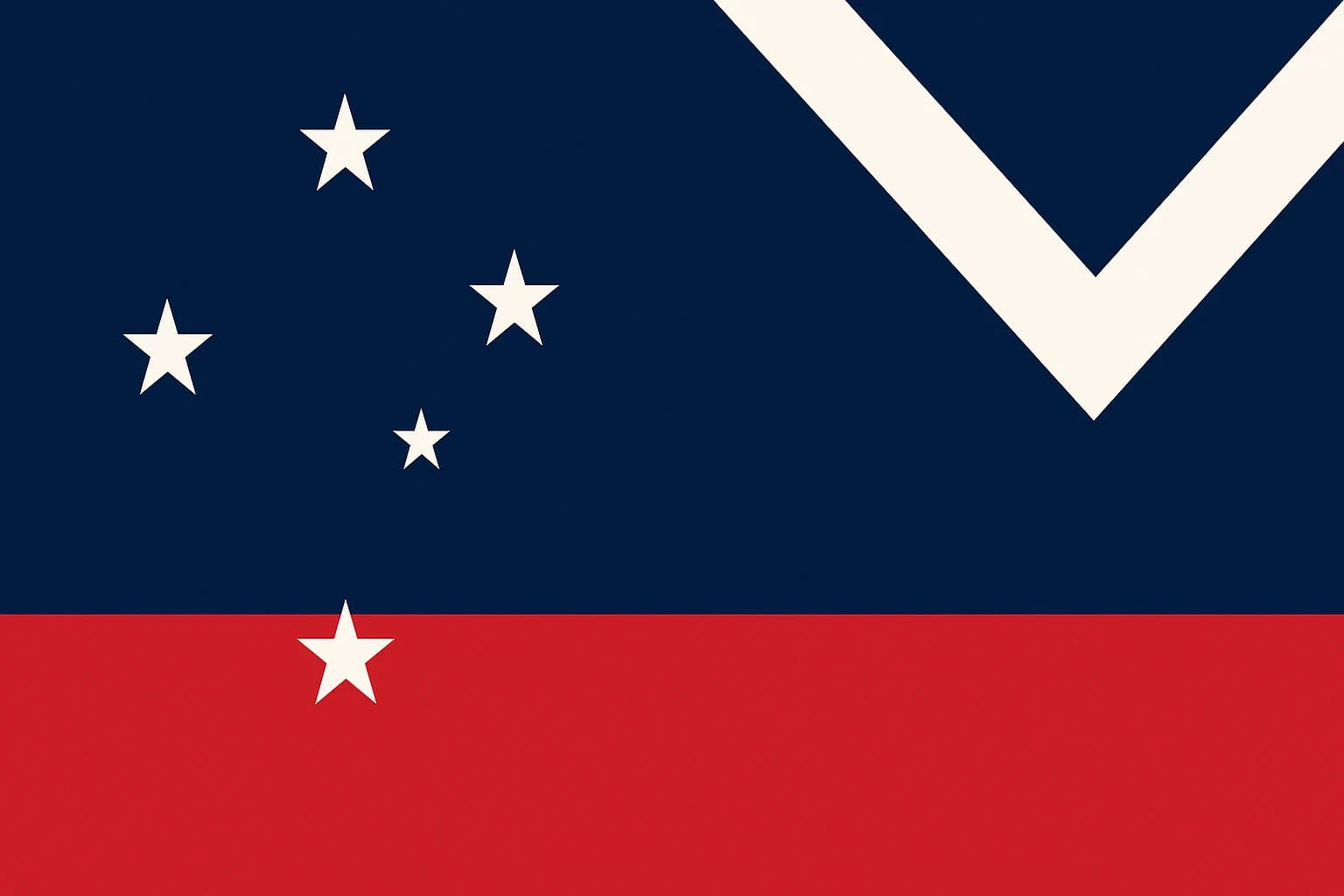
The movement toward flag changes in Australia, especially around reconciliation and republic debates, keeps the Southern Cross in political play. Some redesign proposals keep the constellation while removing the Union Jack, decolonizing the flag without erasing the stars.
Across the Pacific the constellation is shifting from a marker of European geographic "discovery" to a symbol of shared indigenous navigational heritage. Its meaning is being rewritten for a post-colonial era, much as it was rewritten when colonists first put it on cloth.
The odd part is how little there is to look at. Crux is small, and easy to miss if you don't know where to look. It has still managed to be a sacred navigation marker, a Christian cross, a colonial claim, a democratic rebellion, a national brand, and now a symbol of indigenous reclamation, which is a lot of work for four stars and a faint fifth.