South Africa's Flag Was Designed to Mean Nothing, and That's the Point
Julio Song · · 8 min read
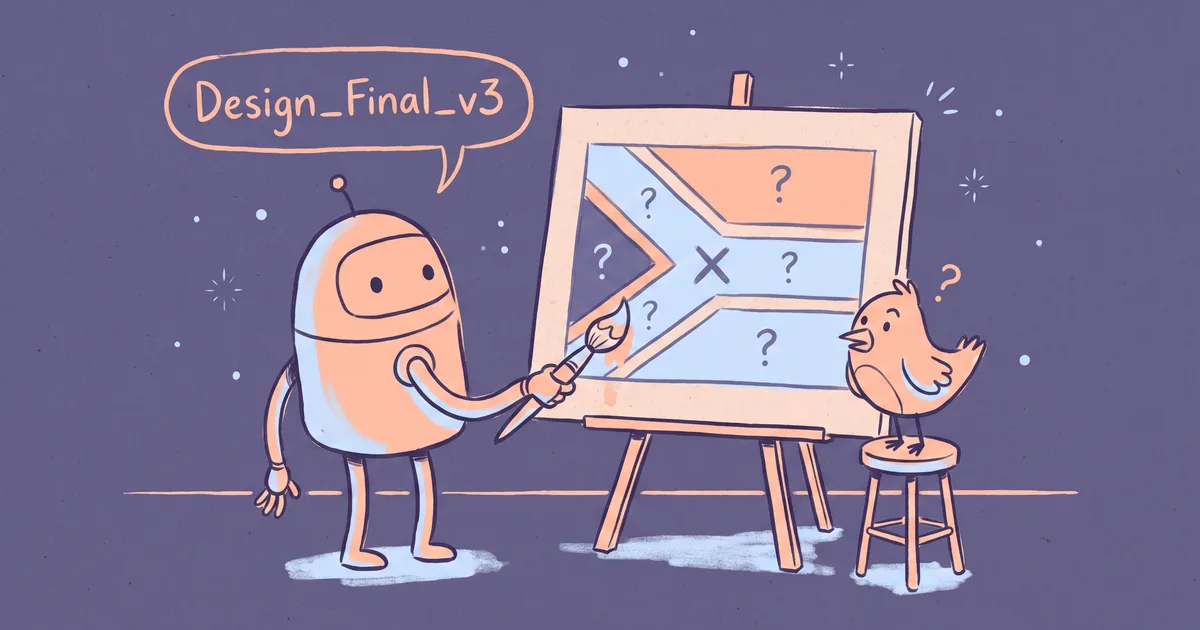
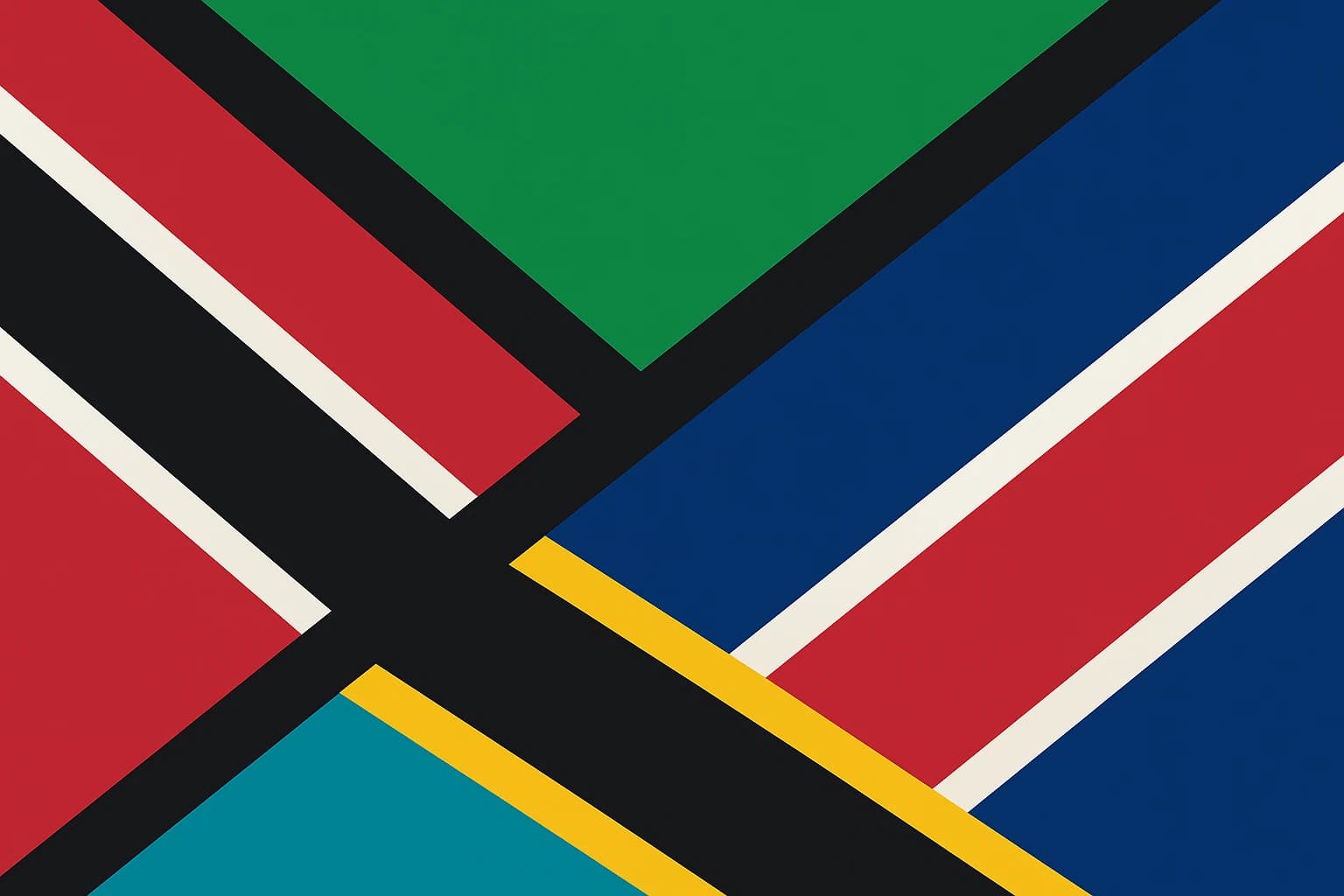
South Africa's flag holds a Guinness World Record for the most colors in a national flag among United Nations member states. Six colors, arranged in a converging Y, sit on one rectangle of cloth. Most flags stop at three or four.
Here's the strange part. The government that adopted the flag will not tell you what any of those six colors mean. Ask, and the official answer is firm: none of them carry a fixed meaning. That refusal wasn't an oversight. It was the design brief, and it took a failed national competition, two of the country's top negotiators, and one heraldist with seven days on the clock to arrive at it.
A flag built for two audiences that hated each other
To see why South Africa needed a flag that refused to mean anything specific, look at the one it replaced. From 1928 to 1994, the country flew a flag striped orange, white and blue, with three miniature flags stitched into the center band. One was the Union Jack. The other two belonged to the old Boer republics, the Orange Free State and the South African Republic.
That flag was adopted by an Act of Parliament on 31 May 1928, a compromise between white English speakers and white Afrikaners after decades of tension between them. It said nothing about the Black majority who made up most of the population living under it. By the time apartheid was ending, the flag carried the full weight of the system it had flown over for six and a half decades. The African National Congress made a new national flag a condition of the negotiations that dismantled white minority rule, and the country's Commission on National Symbols opened for business on 7 September 1993 to find one.
Seven thousand designs, zero winners
The commission, chaired by Prof. Elize Botha, tried the democratic route first: ask the public. By 13 October 1993, roughly 7,000 sketches had arrived, submitted by ordinary citizens and schoolchildren. Assessors cut that pile down to 130, then 10, then a final shortlist of six, working under a deadline so tight that one participant later described the process as five hours spent absorbing what amounted to three kilometers of laid-out designs.
None of the six survived contact with an audience. They failed, in the words of the academic account of the episode, "to elicit any enthusiastic support, either from within the Negotiating Council or from the public at large." One frustrated negotiator reportedly wondered aloud whether advertising agencies were capable of anything better. The agencies then proved the point by doing worse. Four design studios were briefed at the end of October and produced more than 35 proposals within a week, heavy on roundels, protea flowers and peace doves. Those got rejected too, dismissed as unsuitable for a national flag. South Africa's first democratic election was closing in, and the country had no flag ready to fly at it.
A sketch that sat in a notebook for six months
The man who eventually solved the problem had been carrying a version of the answer since before the public competition even started. Frederick Brownell, South Africa's State Herald from 1982 to 2002, had already designed one country's national flag from scratch, for Namibia in 1990, so he understood exactly how much pressure the job carried and how little margin it left for a wrong choice.
At an international vexillology conference in Zurich on 25 August 1993, weeks before South Africa's own commission had even reviewed its first submission, Brownell sketched a shape where three colored bands converge into one, a heraldic form called a pall. He later traced part of the idea to the vestments worn by Anglican priests, a nod to his own upbringing in the church. The sketch went into a notebook and stayed there while the official competition ran its course and failed twice over.
Two negotiators, one week
By February 1994, the flag had become a political emergency rather than a design problem. On 15 February, the Transitional Executive Council appointed Roelf Meyer and Cyril Ramaphosa to a sub-committee on national symbols. These were not minor officials. Meyer and Ramaphosa were the two chief negotiators steering South Africa's entire transition out of apartheid, representing the government and the ANC respectively. Handing them the flag question was an admission that it had stopped being a design brief and started being a negotiation.
On 28 February, their sub-committee set up a Joint Technical Working Committee, convened by Brownell himself and staffed with representatives from both the ANC and the government. The committee had one week to report back, by 8 March. Brownell got the call that put him on the clock, on a Saturday night, and pulled his Zurich sketch back out. "It truly scared the living daylights out of me," he said afterward, "because I was fully aware that the first democratic election was only eight weeks away."
Every member of the working committee agreed on one requirement before a single color was chosen: the design had to show things coming together, not staying apart. Brownell's refined pall did exactly that, and it needed colors from both political traditions to make the point. Red, white and blue nodded to the old Boer republics and the British colonial period. Black, green and gold came from the ANC's own flag. Even the shade of red took negotiating. English-descent South Africans wanted plain red. Some Afrikaners wanted the orange of the old flag preserved instead. De Klerk settled on a shade called chilli red, close enough to satisfy neither camp fully and specific enough to belong to no one. The Transitional Executive Council approved the design on 15 March 1994, six weeks before the vote that would end apartheid rule.
A shape that means something, colors that don't
Here's where the flag gets genuinely unusual. Its central pall, the converging Y that gives the design its signature, does carry an official interpretation. According to the South African government, it represents "the convergence of diverse elements within South African society, taking the road ahead in unity." That line echoes the motto on the country's old coat of arms, Ex Unitate Vires, Latin for "unity is strength."
The six colors get no such treatment. The government's official position is blunt: "individual colours, or colour combinations represent different meanings for different people and therefore no universal symbolism should be attached to any of the colours." A national flag, the single most literal piece of state symbolism a country owns, ships with a clause refusing to explain its own palette.
That refusal is not a gap in the design. It is the design. Assign red to sacrifice or green to the land, the way plenty of flags do, and someone will ask whose sacrifice and whose land. A country weeks from its first democratic election, negotiated out of decades of racial rule at enormous cost, had no room for that argument playing out over its own national symbol. Ambiguity was the safer choice, and Brownell's committee built it in on purpose.
A flag lowered at midnight, and one raised the next morning
The calendar kept the pressure on right to the end. F.W. de Klerk didn't formally proclaim the new flag until 20 April 1994, a bare seven days before the election. The old orange, white and blue flag came down for the last time moments before midnight on 26 April. One minute past midnight, the new flag went up, on the same day millions of South Africans lined up to vote in an election open to every race for the first time in the country's history.
It flew again two weeks later, on 10 May, over Nelson Mandela's inauguration as the country's first democratically elected president. A design pulled from a six-month-old notebook sketch and finished on a one-week deadline had, inside a single month, become the backdrop to the two events that defined the new South Africa.
From emergency fix to global reference
Nobody involved expected the rushed compromise to last, let alone become one of the world's most recognized flags. It has. Guinness World Records still credits it as the color-count leader among UN member flags, though South Sudan later matched the total with six colors of its own when it became a national flag at independence in 2011.
Mandela awarded Brownell the Order for Meritorious Service in 2000, and Brownell went on to win vexillology's Vexillon Award twice, in 1995 and 2015, the only designer to do so. He died at his home in Pretoria in May 2019, having spent one week in 1994 solving a problem that had already defeated a public competition, a panel of advertising agencies, and a recessed parliament.
Most national flags argue for something specific: a founding myth, a religion, a revolution. South Africa's flag was built to do the opposite. Six colors and one converging shape, asking nothing of any single element beyond standing together on the same cloth. In a country still working out what unity meant in practice, refusing to finish that sentence turned out to be exactly the point.
Julio Song
Writer
Julio is a staff writer at FlagDB. He studied Mathematics at the University of Madrid and has a passion for vexillology.
More from Julio Song →