Why Rwanda's New Flag Has No Red: The Flag It Announced in 1999 and Never Raised
Julio Song · · 9 min read
In May 1999, Rwanda told the world what its next flag would look like. Red for the blood of all Rwandans, white for justice, green for prosperity, with a new coat of arms in the middle. Reuters carried the story, complete with the official explanation of each colour.
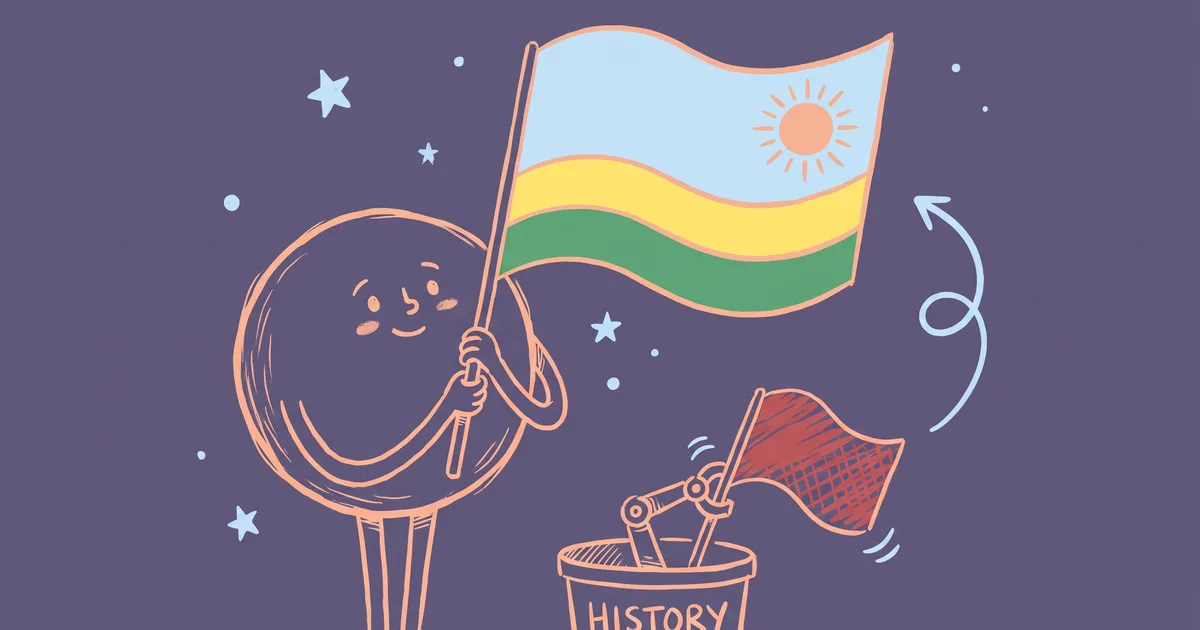
That flag never flew. The one Rwanda raised on December 31, 2001 looks nothing like it. It is sky blue, yellow and green, with a golden sun in the top corner. There is no red anywhere on it, and no letter R. To see why the red vanished between those two dates, you have to start with the flag Rwanda was trying to leave behind, and with the reason it had a letter on it at all.
A letter added to fix a mix-up
Rwanda's first flag was a vertical tricolour of red, yellow and green, the pan-African colours. According to Britannica's history of the flag, it was adopted on January 28, 1961, and the colours stood for the blood shed for liberation, peace and tranquillity, and hope and optimism.
There was one problem. Guinea had already claimed that exact design. Its red, yellow and green vertical tricolour dated from November 10, 1958, when President Sékou Touré tied red to the blood of anti-colonial martyrs, yellow to Guinean gold and the African sun, and green to the country's vegetation.
Guinea's flag also has a near twin in Mali's, which runs the same three colours in reverse order. Guinea's official description, quoted by Flags of the World, goes as far as pointing out that Guinea's green is a malachite shade while Mali's is grassier. That is how close these designs sit.
So in late September 1961, Rwanda added a black R to the centre. Britannica records that the letter did two jobs. It told the flag apart from Guinea's, and it stood for the country's name, for revolution, and for referendum.
That last word had a specific meaning. On September 25, 1961, Rwandans voted on whether to keep the monarchy and King Kigeli V. Close to 80 percent voted against on both questions, and the monarchy was finished. The flag stayed the same when Rwanda gained independence from Belgium on July 1, 1962.
As fixes go, it was a practical one. Nobody in 1961 was thinking about what the letter would come to mean.
How three stripes became a liability
The genocide began on April 6, 1994, after a plane carrying the presidents of Rwanda and Burundi was shot down. The United Nations outreach programme on the genocide estimates that more than one million people died before the Rwandan Patriotic Front (RPF) took military control on July 4, 1994.
Through all of it, the national flag was still the red, yellow and green tricolour with the R. It had flown over every government since 1961, including the one that presided over the killing.
The decision to replace it came early. In June 1998, Agence France-Presse reported that Prime Minister Pierre-Célestin Rwigema had confirmed the government and political parties had already decided to change the anthem and the flag at a meeting in Gitarama.
By the following year the reasons were on the record. Officials told Reuters that the old flag was seen as a symbol of the previous Hutu-dominated government whose ideology lay behind the genocide. The Associated Press reported that the government and political parties said the old symbols represented extreme Hutu nationalism.
The flag was not the only target. The coat of arms showed farm tools. For many Rwandans, the AP wrote, hoes and machetes did not represent a pastoral idyll but were symbols of 1994, when those same tools were used to kill. Reuters described the old arms as showing a hoe, a bow and arrow and a sickle, which carried echoes of the crude weapons used in the genocide.
The national motto was going too. "Freedom, Cooperation, Progress" was set to become Unity, Labor, Courage.
The red flag that never flew
On May 18, 1999, Reuters described the replacement in detail. It was a red, white and green flag with a new coat of arms in the centre, showing an ear of sorghum, a wreath and a bird. Red stood for "the blood of all Rwandans." White meant "transparency and justice." Green meant "hoped-for prosperity."
Look at that red for a moment. On the old flag, red was the blood shed for liberation. The 1999 proposal kept the colour and tried to widen its meaning to every Rwandan. It was an attempt to reclaim red rather than give it up, and I find it the most interesting moment in the whole process.
The idea lasted less than five months. On October 1, 1999, Reuters and CNN reported that Rwanda had adopted a new national flag, and this time the description had changed completely. The flag was now mainly blue and green, with a sunrise. Red was gone.
Even that report got ahead of events. Whitney Smith of the Flag Research Center pointed out that the Cabinet had only decided, on September 30, to propose a flag change. Rwanda's constitutional process still had to run.
In December 1999, the government opened a design competition. The guidelines, reported by Africanews and collected by Flags of the World, named the preferred colours as yellow, green and sky blue, and asked for the rays of the rising sun shining through.
So within seven months, the official brief moved from red, white and green to blue, yellow and green. The reports from the time do not say who argued for dropping red, or why. They do show that the palette was written into the brief before any entries came in, so the artists who entered never had red to work with.
One sun, 24 rays
The winning design came from Alphonse Kirimobenecyo, a Rwandan artist and engineer. Rwanda's parliament adopted it by amending Article 3 of the 1991 constitution on October 25, 2001, and the flag went up on December 31, 2001.
Kirimobenecyo, according to the Wikipedia history of the flag, intended it as a symbol of unity, patriotism and hope.
The design follows the 1999 brief closely:
- A blue band covering the top half of the flag
- Equal yellow and green bands sharing the bottom half
- A golden sun with 24 rays in the upper fly corner
Each colour has an assigned meaning. Per the flag law summarised by Flags of the World, blue stands for happiness and peace, yellow for economic development, and green for the hope of prosperity. The sun stands for light, and for unity, transparency and the fight against ignorance.
Notice what happened to "transparency." In the 1999 proposal it belonged to the white stripe. In 2001 it moved to the sun, so the word outlasted its colour.
The flag did not arrive alone. A new national anthem, "Rwanda Nziza", took over on January 1, 2002, the day after the flag went up. It also won a national contest, with lyrics written by Faustin Murigo while he was held in Karubanda prison. A new emblem replaced the old coat of arms on the same day as the flag, and the hoe, the bow and the sickle went with it.
Written into the constitution
Rwanda wrote a description of the flag straight into its constitution.
Article 9 of the 2003 Constitution, as revised in 2015, spells it out stripe by stripe. Green at the bottom, yellow above it, those two covering half the flag, and a blue upper half bearing the sun with its rays of golden yellow on the right-hand side. The same article sets the motto: "Ubumwe, Umurimo, Gukunda Igihugu," or Unity, Work, Patriotism.
Compare that to the 1999 plan. "Unity, Labor, Courage" became "Unity, Work, Patriotism." Courage dropped out along with red.
The technical details sit in Law No. 34/2008 of August 8, 2008. It sets the exact shades: Pantone 299 C 2X for the blue, RAL 1023 for the yellow, RAL 6029 for the green, and RAL 1003 for the golden sun, on a 2:3 flag.
In 2018 Rwanda added teeth. Law No. 42/2018, signed by President Paul Kagame, inserted a new chapter of offences into the flag law. Anyone who publicly and intentionally shows contempt for, removes, destroys or desecrates the national flag faces one to two years in prison and a fine of one to two million Rwandan francs. Using another flag and passing it off as the national one carries the same prison term.
That is a lot of legal protection for a flag that was 17 years old at the time, and it tells you how seriously the government takes it.
A fresh start, or a new owner?
Not everyone accepted the official story. Some Rwandans at the time saw the change as an attempt by the RPF to assert its political power by rewriting the state's symbols.
I think both readings fit the evidence. The old flag belonged to the order that produced the genocide, and the government said so in plain terms. The RPF had also won a war, and a winner rewriting the state's symbols is making a political statement whatever its motives. The 1999 reports describe the government and political parties agreeing to the change. They do not describe any public vote on the design itself.
What sets Rwanda apart is how far the redesign went. Rather than tweaking the old flag or swapping out the R, it threw out the vertical layout, the letter and the colour red, and ended up with a flag that shares nothing with its predecessor.
Meanwhile Guinea still flies the red, yellow and green tricolour that Rwanda's first flag copied. Mali still flies its mirror image. In Conakry and Bamako those stripes carry none of the history they carried in Kigali, which suggests the stripes themselves were never the problem.
Reading the flag today
When you look at Rwanda's flag now, the most telling feature is something you do not see. The 1999 proposal tried to keep red, and the government changed course within months. By December 1999 the competition brief asked for sky blue, yellow and green and a rising sun, and that is exactly what Alphonse Kirimobenecyo delivered. His flag has flown since December 31, 2001, and since 2018 desecrating it in public carries up to two years in prison.
The R lasted 40 years. It was added in 1961 to stop people mistaking Rwanda for Guinea, and it ended up standing for a government the country wanted to leave behind.
Julio Song
Writer
Julio is a staff writer at FlagDB. He studied Mathematics at the University of Madrid and has a passion for vexillology.
More from Julio Song →