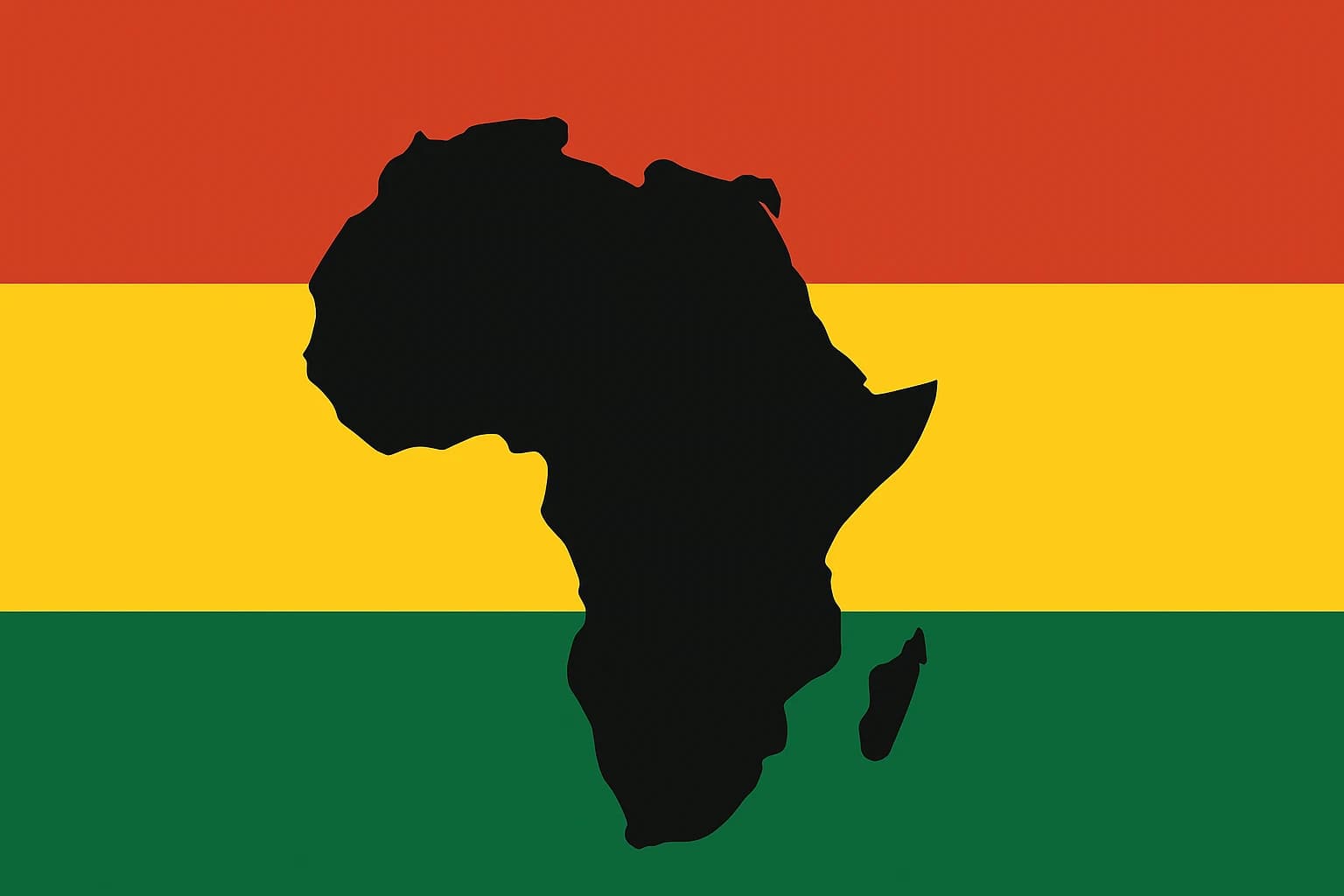
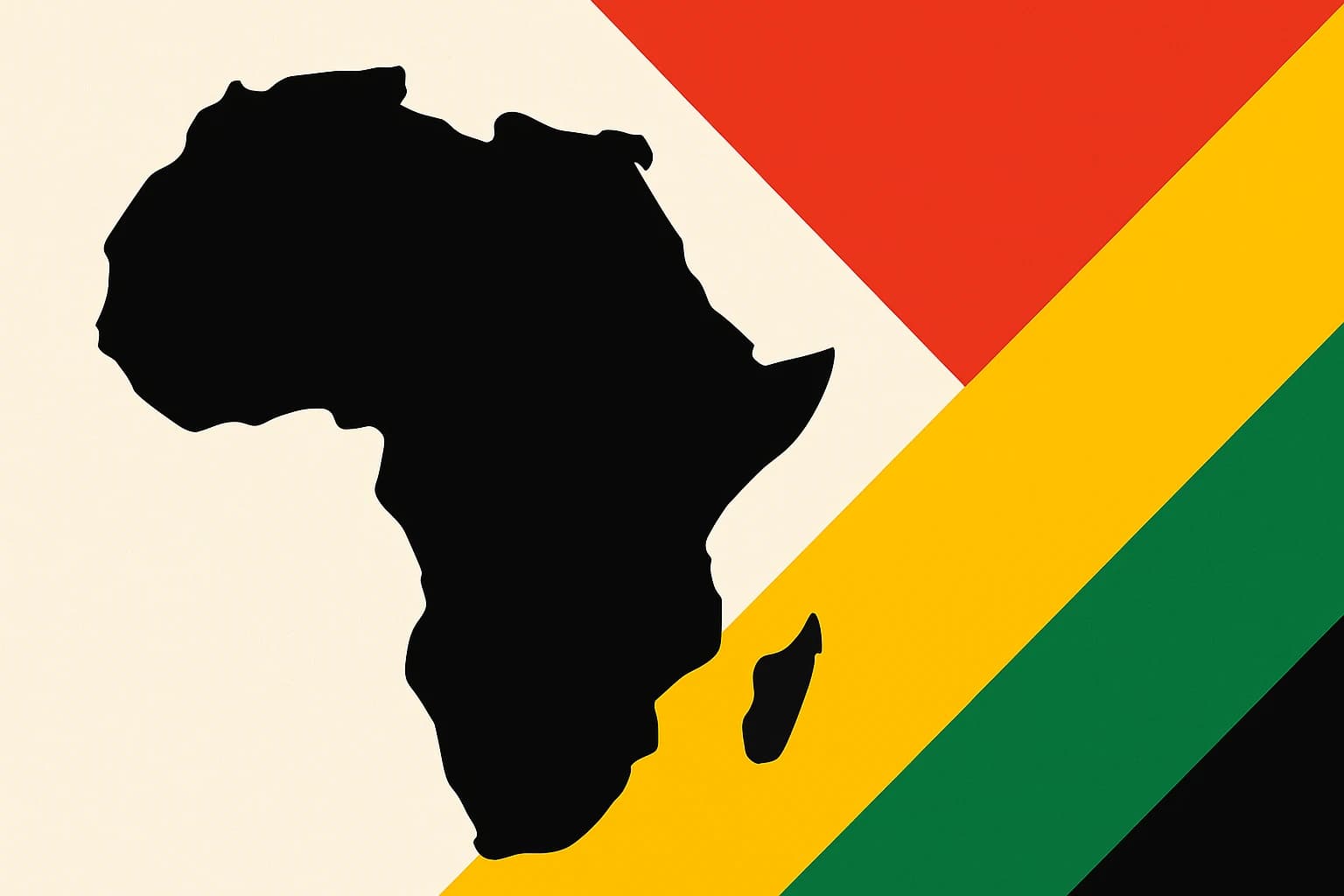
Borrowed Glory: How Ethiopia's Colors Became the Grammar of Black Liberation
Julio Song · · 8 min read
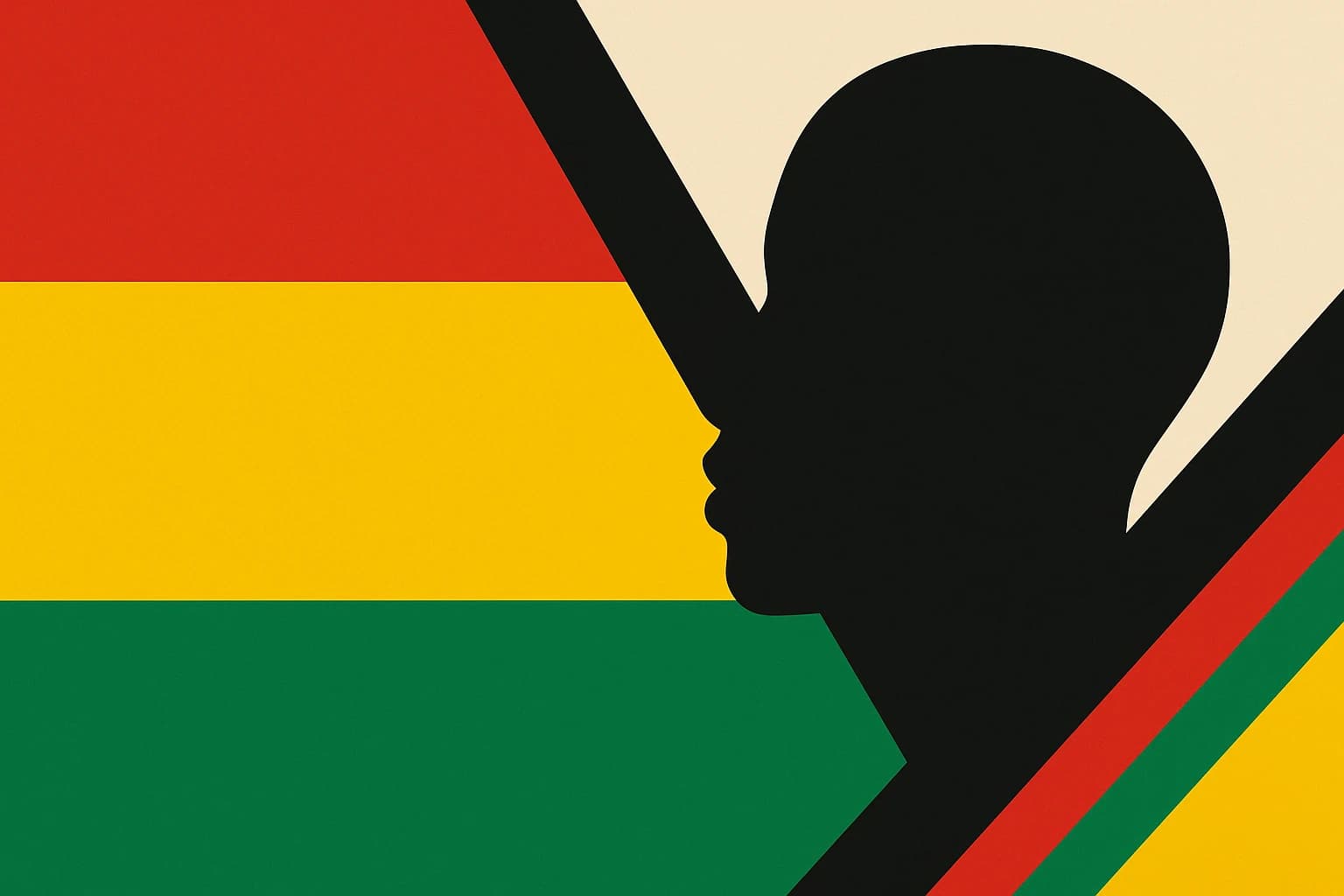
March 6, 1957, Accra. A new flag climbs a pole for the first time over a country that has existed for a matter of hours. The cloth is red, gold, and green with a black star at its center, and the crowd roars. Kwame Nkrumah, who made the moment happen, has never set foot in Ethiopia. No Ethiopian diplomat designed the flag, and no treaty connects the two countries. The colors are unmistakably Ethiopian anyway.
How does a symbol travel across a continent without its owner's permission?
The migration of Ethiopia's green, yellow, and red from the Horn of Africa to West Africa, the Caribbean, and beyond was not a vague process of inspiration. It was a deliberate project carried out by a specific network of Pan-African thinkers, writers, and activists between roughly 1900 and 1963, and Ghana's flag is the clearest proof that it worked.
Why Ethiopia and nobody else
On March 1, 1896, Emperor Menelik II's forces destroyed an Italian colonial army at the Battle of Adwa in northern Ethiopia, the first decisive defeat of a European power by an African nation during the colonial era. The news traveled fast. Black newspapers in the United States reported it within weeks, Caribbean churches debated what it meant, and European colonial ministries went through something close to a crisis of confidence.
Ethiopia's flag, a horizontal tricolor of green, yellow, and red, was not an arbitrary arrangement. The colors had roots in the Ethiopian Orthodox Church and imperial iconography, which gave them weight before anyone outside the country took an interest. And Ethiopia's position was unique: while the rest of the continent was carved up at the Berlin Conference of 1884 to 1885, Ethiopia stayed outside the partition, so its flag was the only African national flag that had never been subordinated to a European colonial banner.
Military victory plus sovereign continuity made Ethiopia singular. The odd part is that its power as a symbol came partly from distance. Most of the people who adopted the colors had never been there and never would go, and that gap made the symbol portable. You could project almost any liberation struggle onto a place you had never visited.
Garvey, Rastafari, and the wiring of a diaspora
The first major relay station was Marcus Garvey's Universal Negro Improvement Association, founded in 1914 in Jamaica and expanded to Harlem by 1916. In 1920 Garvey adopted red, black, and green for the UNIA flag, invoking Ethiopia as the symbolic homeland and citing Psalm 68:31: "Princes shall come out of Egypt; Ethiopia shall soon stretch out her hands unto God."
Note the difference, because it matters. Garvey's UNIA colors are red, black, and green. Ethiopia's flag is green, yellow, and red. Garveyism amplified Ethiopia as an idea of African sovereignty; a different circuit carried the specific palette.
That circuit ran through the Rastafari movement in Jamaica from the 1930s onward. When Emperor Haile Selassie I was crowned in 1930, Rastafari adherents took up Ethiopia's actual flag colors while venerating the emperor as a divine figure, which is the point at which the palette entered diaspora culture as a living visual language rather than a historical artifact.
The infrastructure carrying these images across oceans was the itinerant Black press. The Chicago Defender and W.E.B. Du Bois's The Crisis circulated photographs and editorials about Ethiopian sovereignty across the Atlantic world, and before television Ethiopia's flag became one of the most reproduced African images in Black households in America, Britain, and the Caribbean.
Then Mussolini's Italy invaded Ethiopia in 1935 and the network caught fire. Solidarity protests broke out in Harlem, London, Kingston, and Lagos, with Ethiopian flags in the crowds. The association between that tricolor and resistance stopped being abstract for an entire generation.
From London to Accra
If the Rastafari movement and the Black press wired the diaspora emotionally, the Fifth Pan-African Congress in Manchester in 1945 wired it politically. Kwame Nkrumah attended. So did Jomo Kenyatta. Running the organizational machinery was George Padmore, a Trinidad-born intellectual who became Nkrumah's closest advisor.
Padmore spent decades arguing that Ethiopia's undefeated status made it the only legitimate symbolic anchor for a continental liberation movement, and his 1956 book Pan-Africanism or Communism?, published the year before Ghana's independence, made the case explicitly. From London, his Pan-African Federation kept up correspondence with nationalist movements across British West Africa, French West Africa, and the Caribbean, promoting a shared symbolic vocabulary with Ethiopia's colors at the center of it.
Then there is the biographical link. Nkrumah studied at Lincoln University in Pennsylvania from 1935 to 1939, immersed in African-American intellectual culture at the exact moment Ethiopian solidarity peaked after the Italian invasion. The palette was part of his political formation long before he led anything.
So when Nkrumah's team designed Ghana's flag in 1957, the red, gold, and green was a citation rather than an aesthetic accident. The black star at the center was his addition, a direct reference to Garvey's Black Star Line shipping company, which stitched the two major strands of Pan-African symbolism into one piece of cloth.
Ghana's flag as the master template
The designer was Theodosia Salome Okoh, a Ghanaian artist and teacher. The horizontal arrangement mirrored Ethiopia's tricolor structure, the proportions echoed a continental tradition, and the black star pointed at Garvey. To a 1957 audience every element was legible.
Reception was immediate. Within hours international wire services carried photographs worldwide, and African nationalist leaders in neighboring territories still under French and British rule saw a working demonstration: the Ethiopian color grammar could be worn by a newly sovereign African nation.
That was what Ghana proved and Ethiopia by itself could not. Ethiopia was ancient, monarchic, and geographically remote from West Africa. Ghana was new, democratic, and sitting in the most densely networked colonial zone on the continent. Adopting the colors made them available to anyone prepared to claim sovereignty.
Replication came fast. Guinea adopted a red, yellow, and green tricolor at independence in 1958, a year after Ghana.
Mali followed with the same palette in 1961.
Senegal adopted green, yellow, and red in 1960.
Each of those choices traces back through Nkrumah's networks, through actual correspondence and personal relationships.
One detail sharpens the argument. Ethiopia's arrangement is green, yellow, red from top to bottom. Ghana's is red, gold, green. The reversal is not an error but evidence of reinterpretation: the colors were borrowed and the grammar was adapted. Faithful reproduction would have been copying. Reordering is a reply.
The colors cross the Atlantic again
The Caribbean had been primed by Rastafari for decades, and Ghana's independence confirmed what the movement already believed about the palette's political authority. Jamaica's own flag, adopted in 1962, breaks from it with a black, gold, and green diagonal cross.
Other Caribbean movements held to the palette, which appeared in the flags and emblems of independence and Black Power movements through the 1960s and 1970s.
Grenada, independent in 1974, is a clear case. Its flag uses red, gold, and green in a design directly influenced by Pan-African symbolism during Eric Gairy's independence negotiations, and the lineage runs straight back through Padmore and Nkrumah.
A useful counterpoint is the Bolivian Wiphala, the checkered flag of Andean indigenous peoples, which uses red, orange, yellow, green, blue, indigo, and violet. It shares yellow and green with the Ethiopian palette while belonging to an entirely independent tradition rooted in Andean cosmology. Ethiopian colors traveled through identifiable human networks: newspapers, congresses, mentorships. The Wiphala's overlap is coincidence, and the difference is the whole point.
The palette has held. Over a dozen flags on the African continent now use some variation of red, gold, and green, and newer political and cultural movements, from Afrobeats cultural nationalism to diaspora advocacy organizations, keep invoking it as shorthand for continental solidarity.
Why the meanings keep shifting
Ask Ethiopia what its colors mean and the answer comes from the Ethiopian Orthodox Church and imperial history. Green for the land, yellow for peace and natural wealth, red for sacrifice and power. None of it was ever formally licensed to anyone else. No document granted permission.
So adopting countries retrofitted their own meanings onto the same template. Ghana's official symbolism assigns red to the blood of independence martyrs, gold to mineral wealth, and green to forests, a Ghanaian reading laid over an Ethiopian structure.
The Rastafari reinterpretation went furthest, adjusting the order and adding black for the African people, and that variant has since circled back to influence African nationalist aesthetics. Ethiopia sent its colors out; the diaspora sent transformed versions home.
The portability came from that silence at the source. Because the originators never explained the colors to the people adopting them, each community filled the gap with its own liberation theology, and the palette ended up strong enough to hold whatever a newly independent people needed it to hold. That is not dilution. It is the mechanism by which people separated by an ocean built a shared identity out of three horizontal bands.
Julio Song
Writer
Julio is a staff writer at FlagDB. He studied Mathematics at the University of Madrid and has a passion for vexillology.
More from Julio Song →