The Herring Salad in the Corner: How Norway Passed a Flag Law Its King Refused to Sanction
Julio Song · · 9 min read
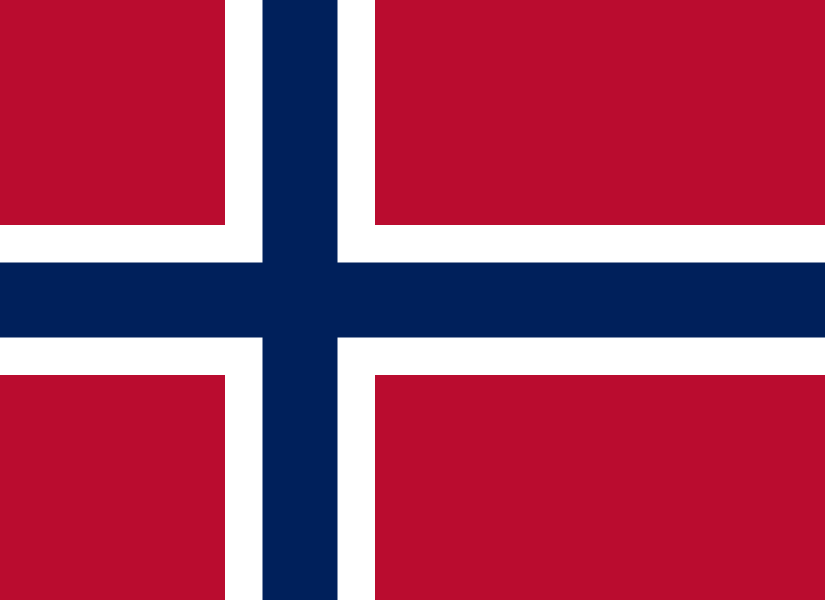
On 15 December 1899, on the last sitting day before Christmas, the Storting in Kristiania raised a red flag with a white-edged blue cross over its building. Nothing sat in the corner. Kristiania and Trondhjem celebrated with torchlight processions.
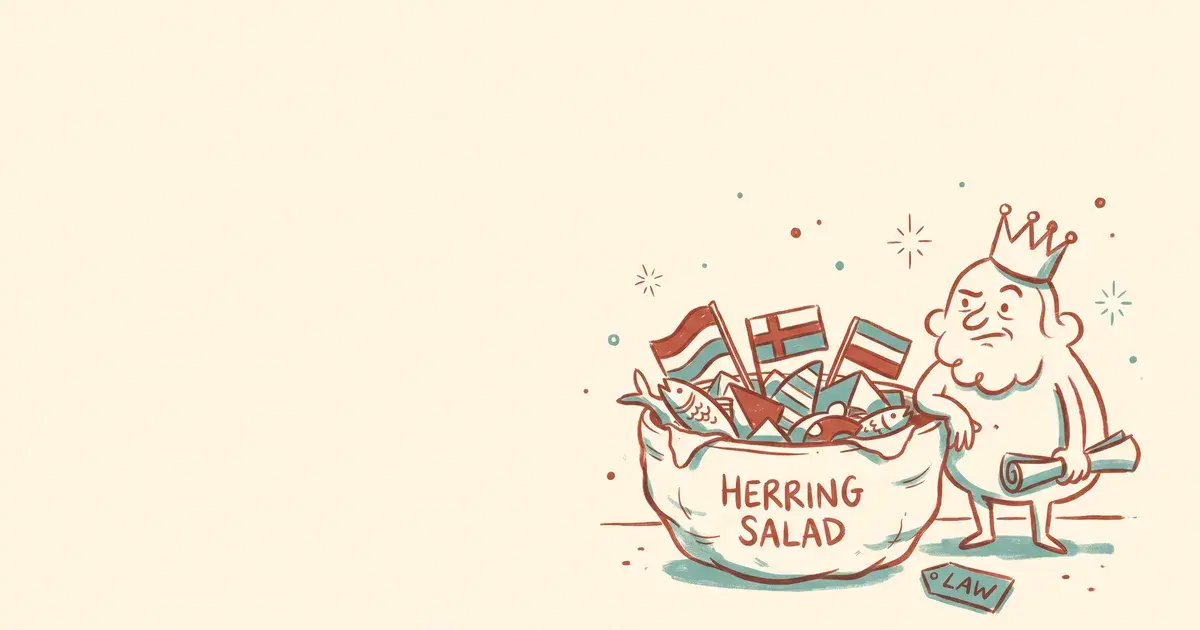
The fuss was about a small square of mixed colours that had been sewn into the canton for 55 years. Norwegians called it "the herring salad". Getting rid of it took twenty years of campaigning, three identical votes, two royal vetoes and a constitutional loophole. The result was the flag law that, according to the Storting's own chronology, is the only law since 1814 to take effect without royal sanction.
That's a lot of politics for a few square inches of cloth. Here's how it happened.
 NorwayView flag →
A flag that stopped at Spain
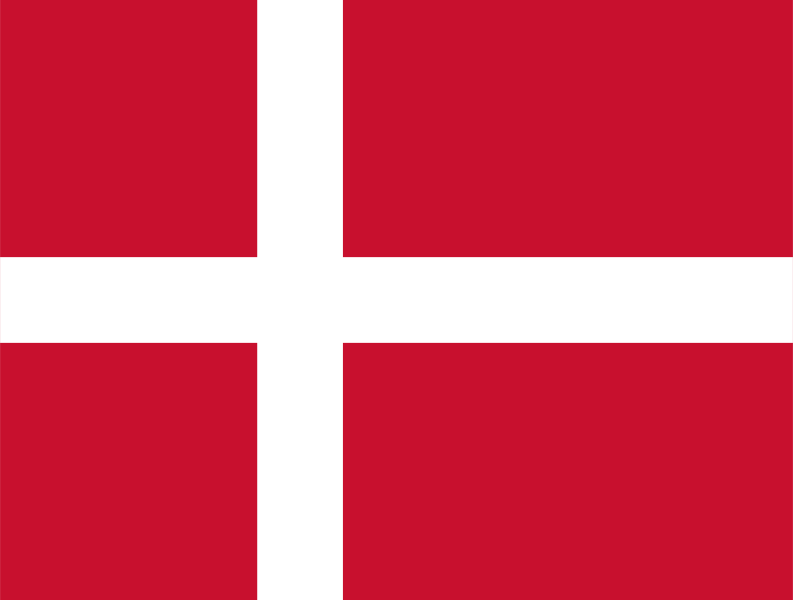
Norway spent centuries under the Danish flag. When it left Denmark in 1814 and entered a union with Sweden, it still had no flag of its own.
The design you know today came from Fredrik Meltzer, a member of the Storting. His tricolour cross reached the Odelsting on 4 May 1821. King Carl Johan refused to sanction a flag law, but he approved the design by royal resolution on 13 July 1821. That detail matters later. The king of the union had a veto, and he used it on flags.
 DenmarkView flag →
Meltzer's flag was a merchant flag, and it had a range limit. Until 1838 it flew only north of Cape Finisterre in Spain. In the Mediterranean, Norwegian ships sailed under the Swedish or union flag, because Norway didn't have the money to buy its way free of the Barbary corsairs.
So for its first seventeen years, the Norwegian flag was something a captain hauled down once he passed the northwest corner of Spain.
Hermann Foss pushed hard to change that, and in April 1838 the king agreed that Norwegian ships were free to fly their own merchant flag on every voyage, at their own risk. France had taken Algiers in 1830, which left it better placed to fight Mediterranean piracy. Norway took the gamble, and "at their own risk" tells you the king wasn't offering to help.
Oscar I's morning gift
Carl Johan died in 1844, and his son Oscar I settled a question that had been simmering for years. What should a union of two equal kingdoms look like on a flagpole?
His answer came on 20 June 1844. Each country got its own merchant and naval flags, and each carried a shared union mark in the canton. The Norwegian encyclopedia Store norske leksikon records that Oscar framed it as his "morning gift to the Norwegian people", the present a groom gives his bride after the wedding.
The mark itself combined the colours of both flags in equal distribution, Swedish blue and yellow sharing one square with Norwegian red, white and blue. It went into the canton of the Norwegian flag and the Swedish flag alike. On its own, the square served as the naval jack of both countries and the flag of their joint diplomatic missions.
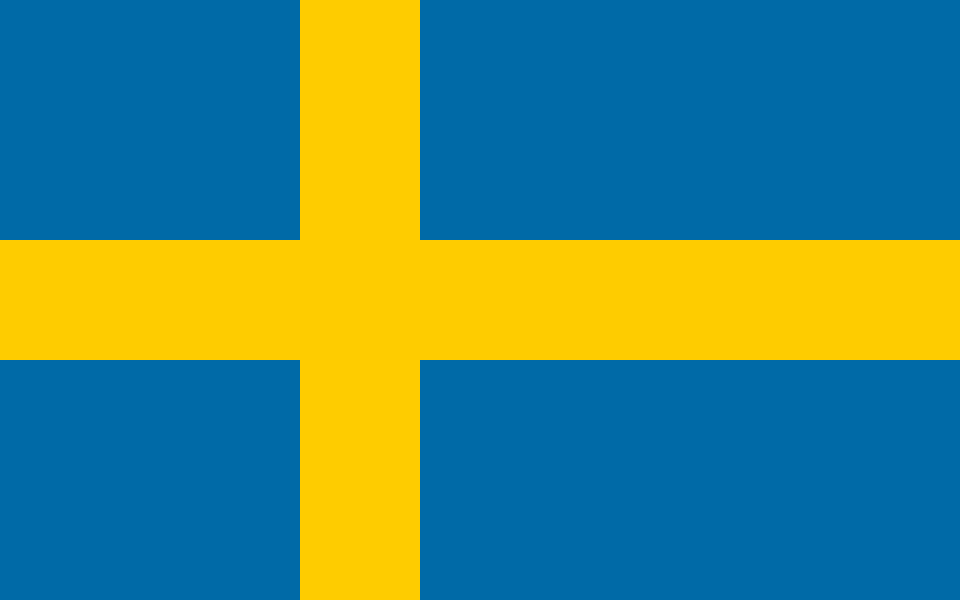 SwedenView flag →
Oddly enough, in 1844 Norwegians liked it. The Storting's history says the mark was seen as a victory for Norwegian equality in the union. Before it, forts and naval ships flew a union flag while only private ships used the Norwegian one. Now Norway's own flag had the same status as Sweden's, with the same badge in the same place.
Equality in 1844 felt different by 1879.
Who named a flag after a fish dish?
The nickname came from Sweden, not Norway. Swedes didn't love the mark either. It got called sillsallaten in Swedish and sildesalaten in Norwegian, after a pickled herring salad with beets and apples laid out in a radial pattern. The joke is usually credited to C. O. Brakel, a member of the Swedish House of Nobility, who used it as a jab during a debate.
It's a fair joke. Two flags' worth of colours crammed into one corner don't read well from across a harbour, and they don't look like either country.
A nickname sounds trivial. Still, once a symbol has a joke attached, defending it in public gets harder, and Norwegians who wanted the mark gone now had a word for it that did half the arguing.
Three votes, two vetoes
The campaign for a "pure" flag started in 1879. H. E. Berner, editor of the liberal newspaper Dagbladet, proposed through Johan Sverdrup a law restoring the 1821 merchant flag without the union mark. The Odelsting turned it down, according to Store norske leksikon, but it started a popular movement. The writer Bjørnstjerne Bjørnson became its loudest voice.
Not everyone signed up. In the Storting's account, shipping and seamen's associations lined up with the opposing side, and Store norske leksikon also lists seafarers among the opponents. That's an odd twist. The people who flew the merchant flag most were the least keen to change it.
Then came a long legal grind. The king held a veto, but only a delaying one. Under Article 79 of the constitution, a law passed unchanged by three successive Stortings became law without royal sanction. The flag radicals set out to use it. The Storting's chronology lays the sequence out date by date:
- 1893: Sigurd Blekastad and nine other members proposed a flag law on 4 May. Both chambers passed it, and on 20 July a royal resolution refused sanction.
- 1896: Ten members proposed it again on 5 February, seven of them signers from 1893. It passed. On 8 July the king refused again.
- 1898: Ten members proposed it a third time on 11 October. The Lagting finished with it on 17 November.
Between the votes, the fight spread. In 1895 the Storting's protocol committee dealt with refusals to approve local councils' decisions to fly a flag without the union mark. Towns were trying to go pure on their own. In May 1896, members Lindboe and Løvland proposed hoisting the tricolour on the Storting building from 17 May that year.
Why did King Oscar II dig in so hard? Part of it was personal. The Storting's history, citing the historian Einar Jansen, says the law would have changed a flag his father had given, one Oscar had worked on drawings for as a 15-year-old boy. He was also in Stockholm when the third vote went through, a long way from the Norwegian politics he was trying to hold back.
On 10 December 1898, a royal resolution refused sanction a third time and noted, in the same breath, that the law would be promulgated anyway under Article 79. On 15 December it appeared in the official law gazette. It would take effect one year later.
The law that still sits on the books
You don't need an archive to read it. Lovdata, Norway's legal database, lists it as Lov om Norges Flag, dated 10 December 1898, and it is still in force.
It's short. Section 1 describes the merchant flag as a red field with a dark blue cross edged in white. The proportions are 16 by 22. The two fields nearest the hoist are squares, 6/16 of the height and 6/22 of the length. The blue cross is 2/16 wide, and each white border is 1/16. Section 2 gives state buildings a swallowtailed version. Section 3 sets the start date a year after publication.
Notice what the text leaves out. The law that ended the herring salad never mentions it. It defines the flag so precisely that a union mark has no place to go. If you want to draw the Norwegian flag correctly, this 1898 text is still the place to start.
A year's delay gave everyone time to prepare. On 18 October 1899 the Foreign Ministry sent consuls a circular, with a colour plate, announcing the 15 December start date. Then the day came, and the Storting raised the pure flag over its building for the first time.
The salad stayed on the warships
The 1898 law covered merchant and state flags. It didn't touch the military. Norwegian forts and naval ships kept the union mark, and when the law took effect, representative Lindboe asked in December 1899 about flags on the fortresses and the use of the union flag.
The answer arrived with the union's collapse. On 7 June 1905, the Storting declared the union with Sweden dissolved, and the pure flag flew over the Storting building. Two days later, on 9 June, the union mark came off the Norwegian naval ensign.
Sweden took longer. Its flags kept the mark until Sweden formally recognised the end of the union, and a royal decree replaced it with plain blue from 1 November 1905. The herring salad had outlived its usefulness in both capitals.
One flag, kept in a box
The flag that flew over the Storting on 7 June 1905 still exists. The parliament keeps it in its archive and brings it out only for solemn occasions. It flew on 7 June in 1930, 1955 and 1980, for the constitution's 150th anniversary in 1964, and for King Olav's 80th birthday on 2 July 1983.
Then it went quiet. In 2005, on the centenary, the flag was judged too fragile to raise. A conservator checked it again in 2020 and found it in good condition, and on 7 June 2020 the Storting hoisted it for the first time in almost 40 years.
Same square, new meaning
The odd part of this story is that nobody redrew the union mark between 1844 and 1898. It went from "a victory for Norwegian equality" to a thing the Storting voted three times to remove, and the cloth stayed exactly the same. What changed was how Norwegians saw the union. By the 1890s, a badge that once put Norway level with Sweden looked like a reminder that Norway answered to a king in Stockholm.
The other lesson is about procedure. Bjørnson's speeches and Dagbladet's columns built the movement, but speeches didn't remove the mark. Ten members of parliament did, by passing the same text three times and waiting out a king. If you ever find yourself in a flag fight, the rulebook matters as much as the design.
Julio Song
Writer
Julio is a staff writer at FlagDB. He studied Mathematics at the University of Madrid and has a passion for vexillology.
More from Julio Song →Related articles
The Cross That Conquered the North: How Denmark's Dannebrog Became the Template for an Entire Continent
The Island That Designed Itself Into a Corner: How Greenland's Flag Quietly Broke Every Arctic Convention