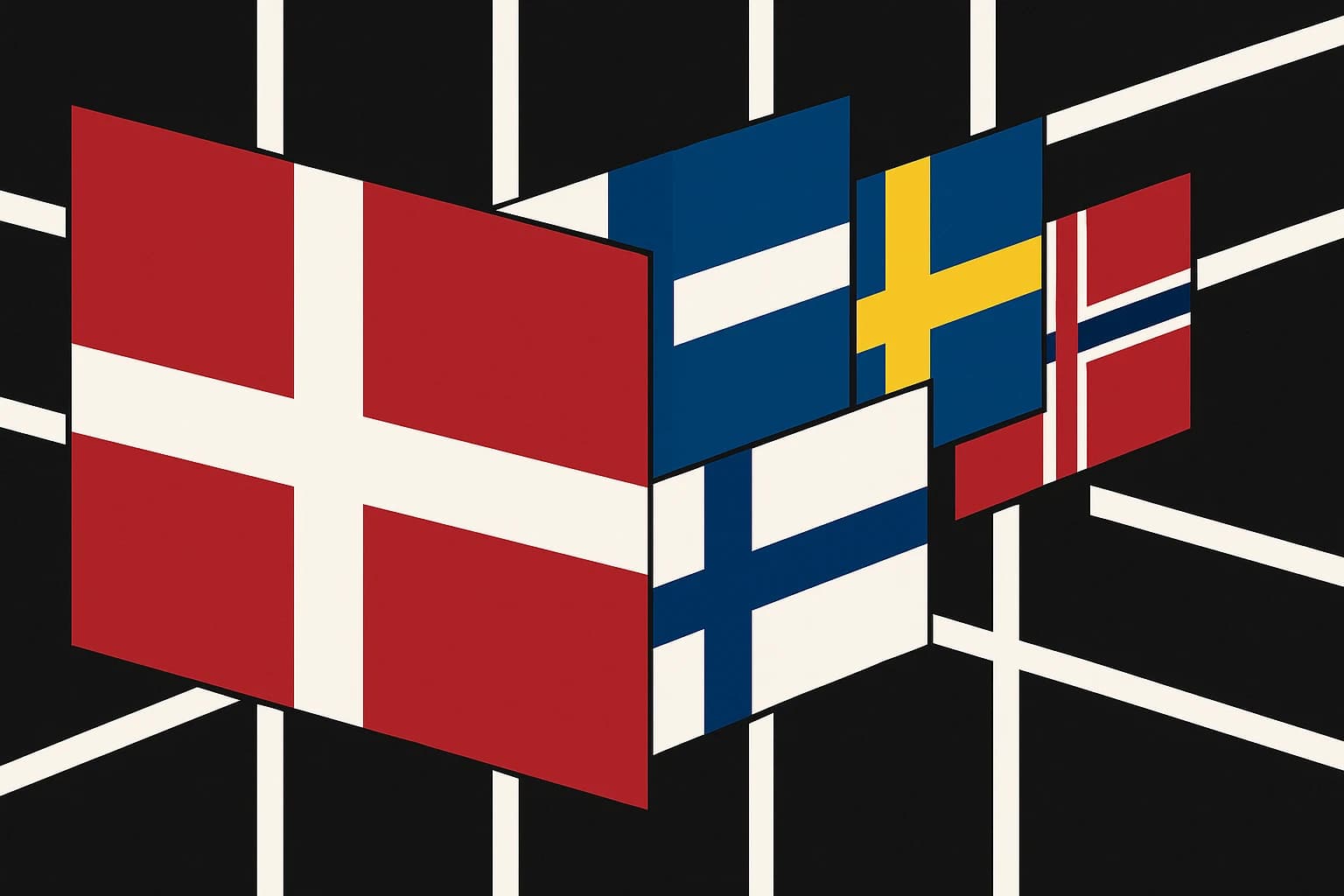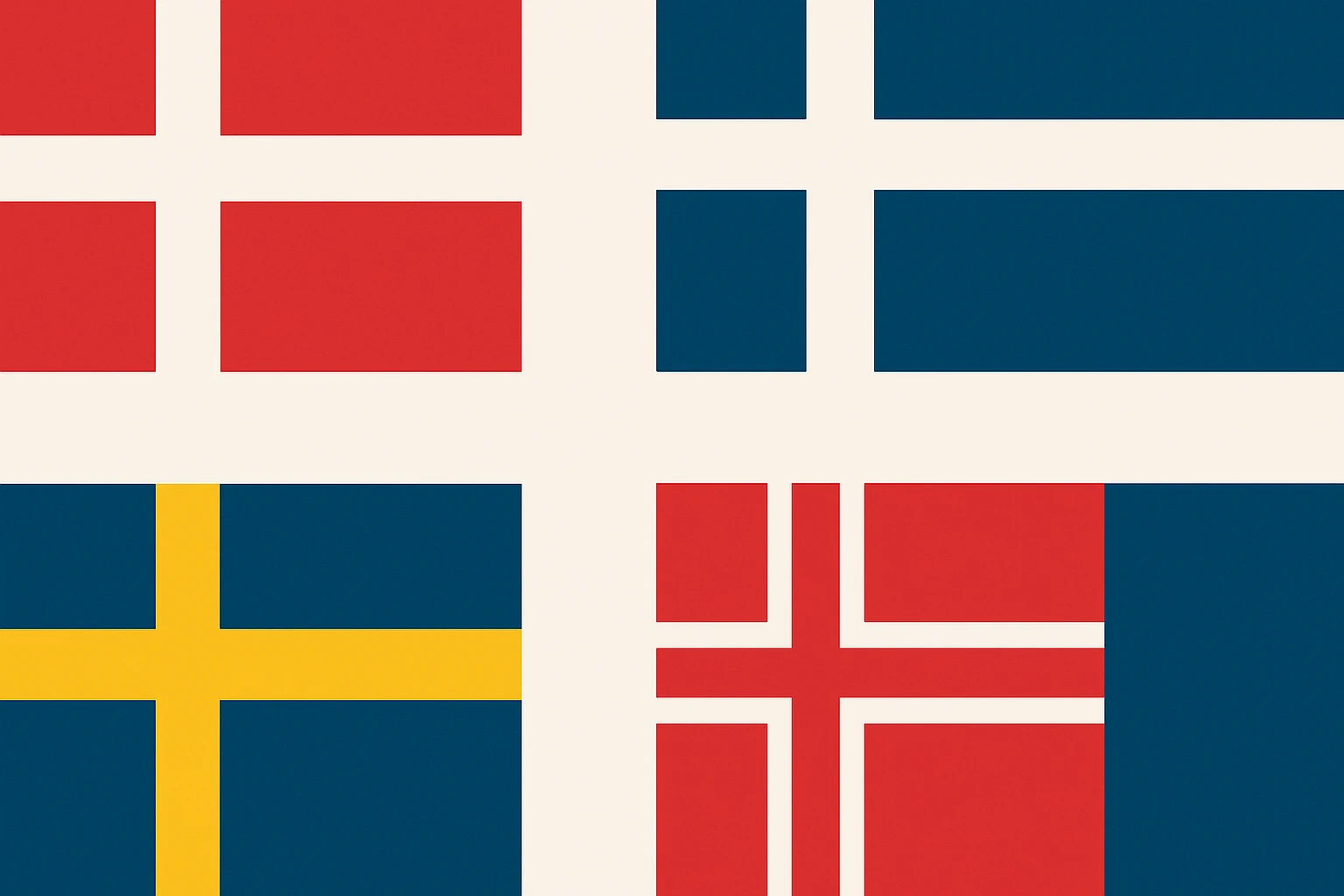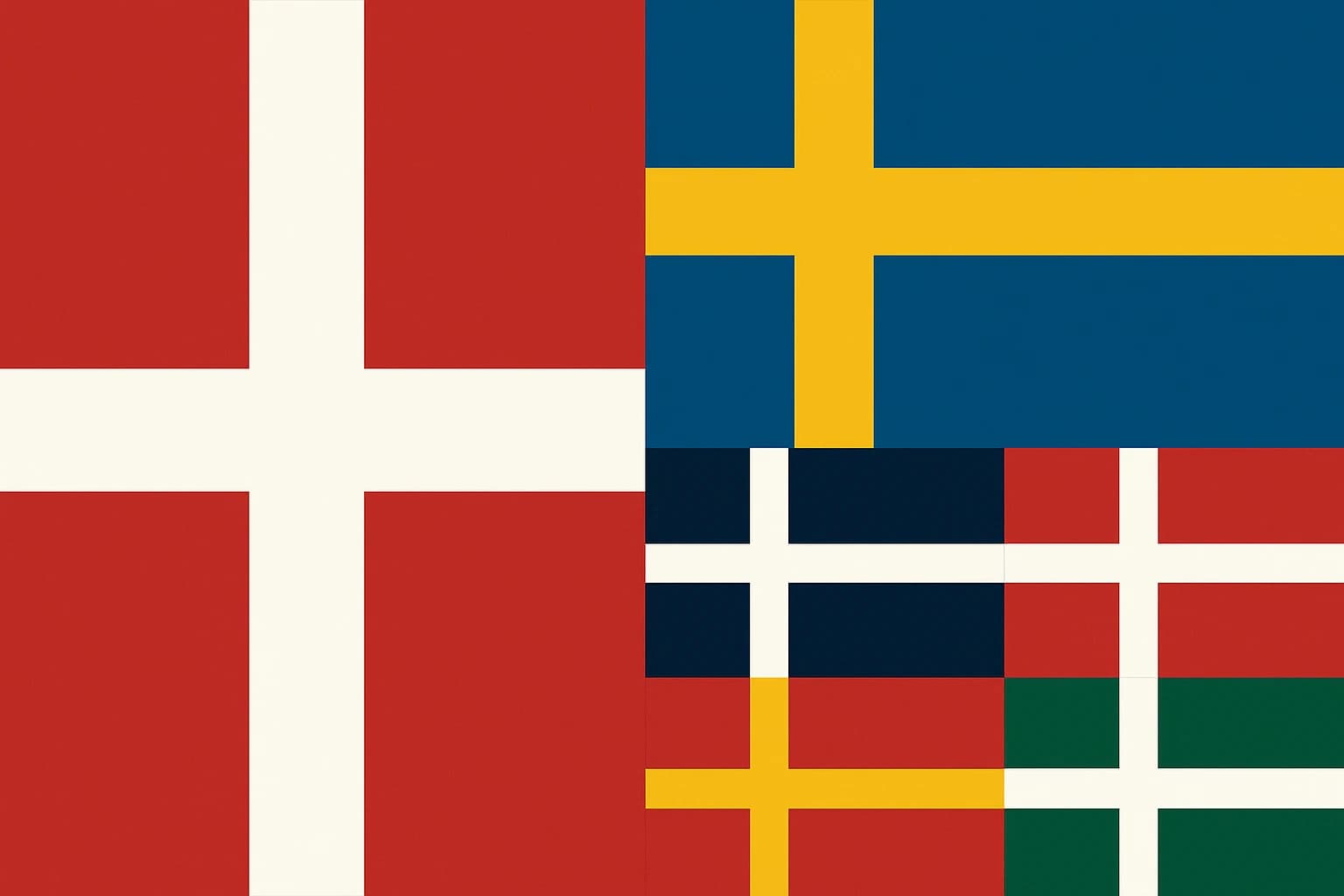
Of the roughly 200 sovereign and semi-sovereign flags on Earth, six share an almost identical structure, and all six come from the same cold corner of northern Europe. What makes that odd is the company. Norwegians voted 97% in favor of dissolving their union with Sweden in 1905. Finns fought two wars to stay out of the Soviet sphere. Icelanders declared independence from Denmark in the middle of the Second World War, while Denmark was under Nazi occupation and could not do a thing about it. Every one of those nations adopted a cross design pioneered by Denmark, in several cases the imperial power they were leaving.
The Nordic cross is not a badge of unity. It is a shared structure that each nation used to say something different, and it traces back to the Dannebrog, Denmark's white-on-red cross flag, which legend says fell from the sky over a battlefield in Estonia in 1219.
The flag that fell from heaven
The founding myth is a good one. On June 15, 1219, during the Battle of Lyndanisse in present-day Estonia, the Danes were losing badly. Then, according to the chronicle, a red banner bearing a white cross came down out of the sky. The Danes rallied, won, and the Dannebrog (literally "Danish cloth" or "cloth of the Danes") was born.
Myth and record do not quite shake hands here. The earliest confirmed depiction of the Dannebrog appears in a 1370 armorial, and its use as a royal and military standard was well established by the 14th and 15th centuries. Sky or no sky, it is one of the oldest continuously used national flags in the world.
What made it so easy to copy was one structural choice: the offset cross. Unlike the centered Greek cross or the Swiss cross of heraldic tradition, the Dannebrog's vertical bar sits toward the hoist, the side where the flag attaches to the pole. That creates two unequal rectangular fields, one narrow and one wide. The reason was practical. Flags on ships and poles spend most of their lives drooping near the staff, and a centered cross loses half its identity in low wind. Shifting the bar left keeps the intersection visible even when the fabric hangs limp. A solution from the age of sail turned into a regional aesthetic almost by accident.
By the 17th century Denmark controlled Norway, Iceland, and the Faroe Islands, and held influence across much of Scandinavia. The Dannebrog was not a local flag by then. It was the administrative visual language of a region. And the offset cross works as a container: pour in different colors and you get a different nation, with the form intact and the meaning entirely changed.
Red, white, and revolution: Norway and Sweden adapt the template
Norway's flag arrived in 1821 as a deliberate political act. Frederik Meltzer designed it during a period of intense Norwegian constitutional assertion. Norway had adopted its own constitution in 1814, only to be pushed into an uncomfortable union with Sweden. Meltzer's design, a blue cross outlined in white on a red field, kept the Danish red and borrowed blue from French revolutionary associations, encoding Norway's liberal constitutional ambitions in the palette. We share your structure, it said, and we are not you.
Sweden's flag runs in a different direction. It predates the formal Scandinavian cross tradition and has roots in the blue and gold of the Swedish coat of arms, the three crowns, and the cross associated with King Eric IX. By the 19th century Sweden had standardized a golden-yellow Nordic cross on a deep blue field. It is the only major Nordic flag where the cross is the lighter element against a darker background, an inversion that gives it a different visual weight entirely.
Norway's white field reads as open and aspirational. Sweden's deep blue reads as royal and established. Same skeleton, opposite register.
There is a political irony in the union period, from 1814 to 1905, when both the Norwegian and Swedish flags carried a "union mark" in the upper-left canton, a combined emblem that stitched the two cross designs together. When Norway voted to dissolve the union in 1905, removing that mark was among the first symbolic acts of independence. Nobody questioned the cross. The shared structure was never the problem; the shared sovereignty was.
From colony to cross: Finland and Iceland build new identities
Finland's flag was adopted in 1918, immediately after independence from Russia. The blue cross on a white field, designed by Eero Snellman and Bruno Tuukkanen, came out of a public competition. The colors are usually explained through landscape, blue lakes and white snow, which is pleasant enough but misses the urgency. Finland needed an internationally legible symbol of sovereignty and needed it quickly. The Nordic cross supplied instant regional credibility: a Northern European democracy, not a Russian province.
The exact shade of blue has been argued over for more than a century. The current flag uses a sky blue, Pantone 294 C, standardized in 2003, lighter than Sweden's navy. The distinction is guarded fiercely, since it is one of the few visual markers separating two flags that are otherwise structurally identical.
Iceland's is the most chromatically complex of the family. Designed in 1915 and officially adopted on June 17, 1944, on independence from Denmark, it has a red cross bordered in white on a blue field. The blue and white come from Iceland's own emerging identity. The red is a direct callback to the Dannebrog, an acknowledgment of the Danish heritage Iceland was leaving and keeping at the same time.
The date deserves attention. June 17, 1944 was chosen while Denmark was under Nazi occupation and unable to object. Iceland committed to the Danish cross template at the precise moment it broke from the country that invented it.
When one flag has to speak two languages: the Åland Islands
The Åland Islands are an autonomous, Swedish-speaking Finnish territory of about 30,000 people in the Baltic, between Finland and Sweden. Their status has been contested since 1917, when Finland declared independence from Russia and the islanders immediately petitioned to join Sweden instead. The League of Nations ruled in Finland's favor in 1921, granting sovereignty to Helsinki while guaranteeing Åland its autonomy, demilitarization, and protection of Swedish language and culture.
The flag carries all of that. Adopted in 1954, more than 30 years after the sovereignty question was supposedly settled, which tells you how long these negotiations simmer, it has a red Nordic cross outlined in yellow on a blue field.
Blue and yellow are Sweden's colors, and any Swede or Finn reads that instantly. The red outline then places the whole thing inside Finland. The design does not resolve the contradiction of being Swedish-speaking Finns. It records it.
The Faroe Islands flag, the Merkið, does something similar. Designed in 1919 and officially recognized in 1948, it uses a red and blue Nordic cross on white, echoing both Norway and Iceland. Like Åland, the Faroes are not fully sovereign, and the flag is where the distinct identity gets stated.
Both cases show that the template is not reserved for nations. It works for peoples who need a symbol before, or instead of, a state. In disputed territories a flag is often the most precise political document a community produces, more nuanced than a treaty and more immediate than a language law.
Why the cross shifted left
So why the offset, rather than the centered cross used in Switzerland, Georgia, or England's St. George's Cross?
The practical answer came first. Flags fly from poles and are almost always seen from the hoist side. A centered cross puts its vertical bar in the middle of the fabric, so in low wind half the design disappears behind the pole. The offset keeps the intersection visible in any conditions, which mattered when your flag had to be readable from another ship's deck.
The heraldic answer sits underneath it. In European heraldry the left side of a shield, the viewer's left and the bearer's right, is the dexter, the side of honor. Shifting the cross toward the hoist puts the primary intersection in that position. Not every designer calculated this consciously, but it fit the visual habits that 18th and 19th century flag designers had absorbed.
Then there is the symbolic effect, which is the interesting one. A centered cross belongs to everyone: the universal Christian symbol, the Red Cross emblem, the plus sign of neutrality. An offset cross belongs to someone. By moving the vertical bar left, the Dannebrog turned a universal religious icon into a proprietary national one, and every Nordic nation that adopted the template took that idea along with the geometry. A cross could be owned. It could be specifically theirs.
A visual family unlike any other
Other flag families exist. The pan-Arab colors of red, white, black, and green appear across more than twenty flags. The pan-African tricolor tradition spans a continent. Stars-and-stripes derivatives dot the Pacific.
The Nordic cross family is unusual in being geographically compact, traceable to a single source, and maintained by nations with real political agency who could have chosen differently at any point. Nobody forced Finland to use a Nordic cross. Nobody required Iceland to keep one. These are also nations that have repeatedly chosen cooperation frameworks, the Nordic Council since 1952, shared labor markets, coordinated welfare systems, while holding onto sovereignty tightly. The flags sit in exactly that position: coordinated to the point of near-identity, and never merged.
The template travels beyond the Nordic states as well. Orkney and Shetland, Scottish island groups with deep Norse heritage, both fly Nordic crosses. It spreads through diaspora and historical memory rather than political imposition.
Committing to it also closed doors. No Nordic country uses stars, animals, or a complex coat of arms on its national flag. The cross enforces a minimalism that has aged remarkably well in an era that prizes clean, scalable design. Nobody planned that part. It fell out of an inheritance that began with a design problem about wind and a wooden pole.