The Flag Nigeria Never Redesigned, and the Man It Nearly Forgot
Julio Song · · 8 min read
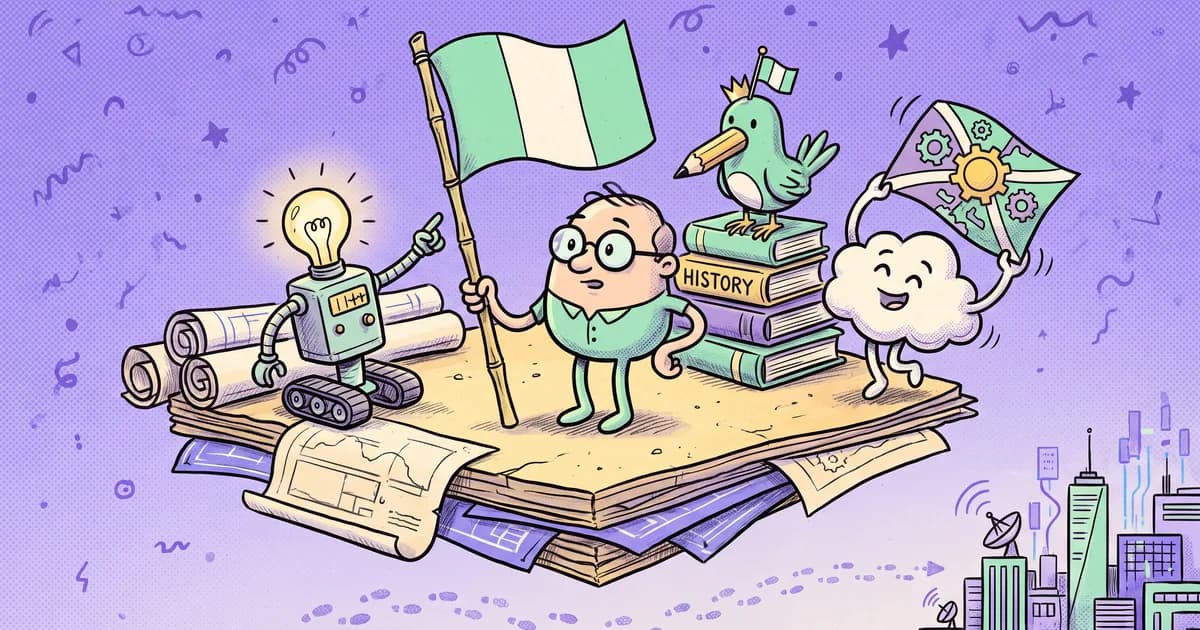
In 1959, a 23-year-old engineering student in London saw a small notice about a competition to design a new national flag. He mailed in a sketch, won against nearly 3,000 other entries, and gave his country the green-white-green banner it still flies today. In 2023, that same country left his body in a morgue for over a year because no government agency agreed on who should pay to bury him.
That contradiction sits at the center of the story of Nigeria's flag. The design itself is one of the simplest in the world: two green stripes around a white one, no coat of arms, no animal, no motto. But the story of how it got made, and what happened to the man who made it, says more about the relationship between a nation and its symbols than the symbols themselves ever do.
A flag for a country that did not exist yet
By 1958, Nigeria was heading toward independence from Britain, and the planning committee overseeing the transition needed a flag to fly on the day it happened. Rather than commissioning a designer or adapting an existing emblem, the committee opened the design to the public. The competition was open to anyone.
The response was enormous. Almost 3,000 designs poured in from across the country and from Nigerians studying abroad, each one a guess at what a brand-new nation should look like on a piece of cloth. Many of the entries were elaborate, packed with shields, mottos and coats of arms. Judges had to sort through all of it, hunting for a design that represented a country that did not exist yet.
The student who almost got it wrong
Michael Taiwo Akinkunmi was born in Abeokuta in 1936. He attended Baptist Day School Idi-Ikan and then Ibadan Grammar School before heading to London to study electrical engineering at Norwood Technical College, now known as Lambeth College. He was far from home when he came across the competition announcement, in a newspaper by one account, on a library noticeboard by another.
He sat down and sketched three vertical stripes, green on the outside, white in the middle. Then he added a red quarter sun with 16 rays, sitting on the white stripe. It was the kind of flourish a design competition tends to attract: a bold central symbol, something with visual weight, something that looked finished, and against nearly 3,000 rivals, most of them far busier than his, it was the plainness of his stripes that carried the day.
The judges liked the stripes. They did not like the sun.
Cutting the one part everyone remembers
Historians and flag scholars have offered various explanations for why the sun disappeared from the final design, from concerns that it echoed the naval ensign of Japan too closely to simple worries that it cluttered a flag meant to read clearly at a distance and on a pole. Either reason fits a country trying to avoid comparisons at the exact moment it wanted to be taken seriously as its own new nation, not a copy of anyone else's symbol. Whatever the precise thinking behind it, the planning committee stripped Akinkunmi's design down to its stripes and sent it forward without the sun.
What survived is about as minimal as a national flag gets. Green represents Nigeria's agriculture, and white stands for unity and peace, both wrapped into a plain 1:2 rectangle. Compare that to what neighboring newly independent states chose around the same period.
Ghana's flag, adopted in 1957, also came out of an open competition, one won by 34-year-old artist Theodosia Okoh. Her design kept red, gold and green bands and added a black five-pointed star at the center, a deliberate symbol of African emancipation that Nigeria's committee chose to leave out entirely. Ghana also honored its designer while she was still alive to enjoy it. In 1997, President Jerry Rawlings awarded Okoh the Grand Medal for her service to the country.
Kenya took a different route in 1963. Its flag was not the product of an open contest at all. Politician Tom Mboya adapted the flag of the Kenya African National Union, keeping its black, red and green and adding a Maasai shield and crossed spears. Red there marks the bloodshed of the independence struggle, a meaning far heavier than anything Nigeria's palette carries.
Akinkunmi's flag, stripped of its sun, ended up saying the least of the three. No shield, no star, no weapon, only two colors and a statement about farmland and peace. That plainness is likely why it has never been redesigned.
Independence day and £100
On 1 October 1960, Lieutenant David Ejoor commanded the guard that raised Akinkunmi's flag for the first time as Nigeria's official symbol, the moment Britain handed over control at midnight. Ejoor went on to a long military career, eventually becoming Chief of Army Staff in the 1970s. Akinkunmi's own path after that midnight ceremony looked nothing like Ejoor's. For his winning design, he received a £100 prize and a nickname that stuck for the rest of his life: Mr. Flag Man.
He returned to Nigeria in 1963 and went back to ordinary work, joining the agricultural department at the secretariat in Ibadan. He stayed a civil servant there until 1994, the same year the federal government finally recognized him with the Order of the Federal Republic. Decades passed between the moment his design went up a flagpole in Lagos and the moment the state gave him a formal honor for it.
He did get one more public moment. In June 2021, at 85, he took part in displaying what organizers billed as the world's largest national flag, a banner covering more than 3,275 square meters, laid out in Ibadan, the same city where he had spent most of his working life as an anonymous government employee. Fact-checkers later pointed out the record claim was wrong. Qatar had unfurled a flag more than 30 times the size back in 2013. Even his one moment of spectacle came with an asterisk.
The year nobody buried him
Akinkunmi died in Ibadan in August 2023 at 87. What followed says more about how Nigeria treats its own history than the design competition ever did.
His family expected a state burial. Officials had promised one, and Nigeria's National Institute for Cultural Orientation was reportedly tasked with organizing it. Beyond an initial phone call, nothing else came. Weeks turned into months while the family paid roughly ₦2,000 a day to keep his body at the morgue, waiting for a funeral the federal government kept promising and never delivered.
A Yoruba cultural group eventually petitioned President Bola Tinubu directly over the delay. Public pressure built through months of news coverage before the state government of Oyo, not the federal government responsible for the original promise, stepped in to fund the ceremony. Akinkunmi was finally buried in Ibadan 371 days after he died, more than a year spent in limbo for a man whose one contribution to public life still flies over every government building in the country.
None of this happened because Nigeria forgot who designed its flag. Everyone involved, from the family to the arts ministry to the newspapers covering the story, knew exactly whose body was sitting in that morgue and why it mattered. The delay came from something closer to bureaucratic drift: a promise made without a budget attached, passed from one office to another until public embarrassment finally forced someone to write a check.
What the flag knows that the country forgot
Nigeria's flag asks nothing of the people who see it. Nobody has to decode an animal or translate a motto to understand it. That was the point of stripping away the sun: a symbol so plain it belongs to everyone precisely because it demands nothing from anyone.
Akinkunmi's own story worked in the opposite direction. It demanded attention the state consistently failed to give while he was alive, and it demanded a decision the state took over a year to make once he had died. The flag he designed at 23 outlived his recognition by six decades, and briefly, it looked like it might outlive his burial too.
That gap between a symbol everyone recognizes and the person behind it, forgotten right up until public shame forces a government's hand, is not unique to Nigeria. But few flags carry the story quite this bluntly: a design that got simpler because a committee cut out its boldest feature, made by a man the country took over a year to bury after building its whole modern identity around what he sent in from a London library in 1959.
Compare that timeline to the flag's own record. Nigeria's stripes have flown unaltered since 1960, through a civil war, multiple coups and a return to democracy, never once redesigned or replaced. The man behind them waited 34 years for a state honor, then 371 days for a grave. The cloth kept its promise instantly. The country took considerably longer to keep its own.
Julio Song
Writer
Julio is a staff writer at FlagDB. He studied Mathematics at the University of Madrid and has a passion for vexillology.
More from Julio Song →