The Eagle Stood Alone: How Mexico's Flag Rewrote Its Own Founding Myth
Julio Song · · 9 min read
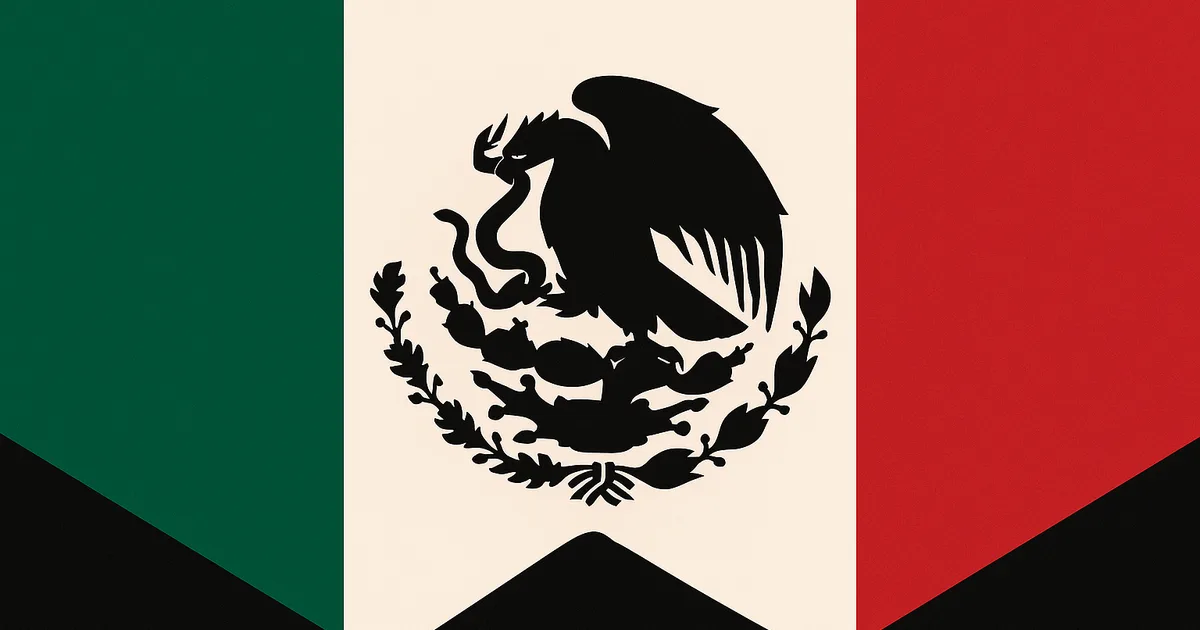
Look closely at the center of Mexico's flag and you'll find a golden eagle standing on a cactus, a snake caught in its beak. Almost every visitor to Mexico City recites the story behind it: the Aztec god Huitzilopochtli told his people to wander until they found that exact sign, and when they finally saw it on a swampy island in Lake Texcoco, they built their capital there. It's one of the most famous founding myths in the world, and it's stamped on a flag that flies over 130 million people today.
Here's the part almost nobody mentions. For two years after Mexico won its independence, the national coat of arms didn't have a snake at all. The eagle stood on the cactus alone, its talons empty. The serpent, the single most recognizable detail in the whole image, was a later addition, made by a government trying to figure out what an independent Mexico should look like.
That gap between the legend everyone knows and the flag's actual paperwork is where this story gets interesting.
A god, an eagle, and 175 years of walking
The myth itself comes from the Mexica, the people we usually call the Aztecs, and it predates the flag by five centuries. According to their own histories, Huitzilopochtli, god of the sun and of war, ordered his people to leave their homeland of Aztlán, somewhere to the north, and search for a sign: an eagle perched on a nopal cactus, devouring a serpent. Wherever they found it, they were to build their city.
The search took generations. Mexica accounts put the wandering at around 175 years before the sign finally appeared on a small island in the middle of Lake Texcoco. There, in 1325, the Mexica founded Tenochtitlan, the city that would grow into the capital of the Aztec Empire and, centuries later, into Mexico City.
That's the story every Mexican schoolchild learns, and it's a good one. It gives a wandering people a destination, a divine mandate, and a specific, paintable image. The trouble starts when you go looking for that image in the sources the Mexica themselves left behind.
The image that keeps changing its mind
The earliest visual record of the founding, the Codex Mendoza, was painted around 1541, two decades after the Spanish conquest. Its frontispiece shows the eagle on the cactus, flanked by conquered towns and a divided shield. It's gorgeous, and it's the version most modern retellings default to. But it's a colonial document. New Spain's viceroy, Antonio de Mendoza, commissioned it around 1541 to send to the Spanish king, and Indigenous artists produced it under Spanish supervision, working for new rulers with their own ideas about how a founding story should look.
Other pre-Hispanic and early colonial depictions of the scene are less consistent. Some show only the eagle on the cactus, no serpent anywhere in the frame. The bird alone was apparently enough of a sign for some scribes. Whether the serpent belongs in the original telling, or crept in later as artists and chroniclers reached for a more familiar image, an eagle defeating a snake reads instantly as good triumphing over evil in European heraldry, is a live question for historians, not a settled fact.
Mexico didn't inherit a fixed picture. It inherited a myth with a variable cast, and it would spend the better part of 150 years arguing over which version belonged on its flag.
Independence gets a flag, and the flag gets a crown
The first tricolor most people would recognize as a forerunner of today's flag flew in 1821, when Agustín de Iturbide's Army of the Three Guarantees marched into Mexico City. That earlier banner, adopted by decree on April 14, 1821, ran three diagonal stripes, white, green, and red, each carrying a gold star, with a crown and the motto "Religión, Independencia, Unión" stitched into the center. Those three words spelled out the deal Iturbide had struck to end the war: protect the Catholic Church, guarantee independence from Spain, and unite Spaniards and Mexicans as equal citizens.
Once independence was secured, the flag got a formal update. On November 2, 1821, the new government adopted vertical green, white, and red stripes with a crowned eagle on the white band, marking Iturbide's short-lived empire. And here's the detail that surprises people: that eagle stood on its cactus with nothing in its claws. No serpent. The empire's coat of arms left it out entirely.
Iturbide's empire didn't last two years. He was forced to abdicate in 1823, and the republic that replaced him needed a coat of arms that didn't look like it belonged to a monarch. On April 14, 1823, officials stripped the crown from the eagle, and it's at this point, not 1821 and not five centuries earlier, that the serpent officially joins the Mexican flag. The new design gave the eagle a lake, a stone, a wreath of oak and laurel, and, finally, a snake gripped in its beak and talon.
Put plainly: the single most iconic detail of Mexico's national emblem, the part every retelling of the Aztec myth leads with, was a republican addition made two years after independence, not a straight transcription of an ancient prophecy.
An eagle redesigned by every government that touched it
Once the snake was in, the fighting over the rest of the eagle never stopped. Mexico went through roughly six more redesigns of its coat of arms between 1823 and 1968, and each one tells you something about who was in charge.
When Maximilian I arrived as French-installed emperor in 1864, his government swapped in a European-style shield complete with a griffin, a sword, and a scroll reading "Equity in Justice." The pre-Hispanic eagle nearly vanished under imperial French heraldry. Maximilian was captured at the siege of Querétaro and executed by firing squad in June 1867, and once the republic was restored, Mexican designers spent the rest of the century pulling the emblem back toward its own visual language, though an 1880s revision still leaned on a distinctly French-styled bird.
The next real turning point came in 1916, under President Venustiano Carranza, in the thick of the Mexican Revolution. Carranza's government, working with artists Antonio Gómez and Jorge Enciso, turned the eagle from a frontal, almost decorative pose into a profile view and swapped the water snake for a rattlesnake, a species genuinely native to Mexico. It's a small technical change with a bigger point behind it: a revolutionary government wanted an eagle that looked like it belonged to the land it was fighting over, not to European heraldic convention.
The eagle that had to look angrier
The version flying today came from a specific presidential ask. In 1968, President Gustavo Díaz Ordaz brought in the painter Francisco Eppens Helguera, already well known for his stamp and mural work, to standardize the coat of arms once and for all. Eppens studied the historical codices and produced a careful, researched design.
Díaz Ordaz reportedly looked at the first version and asked for one change: make the eagle more aggressive. Eppens obliged, sharpening the bird's stance and expression into the dynamic, talons-forward pose you see on the flag today. That design was formally adopted by decree on September 16, 1968, published a month earlier on August 17, and it has anchored every Mexican flag since. It was locked in by law in 1984, when the Ley sobre el Escudo, la Bandera y el Himno Nacionales de México codified the exact proportions, colors, and dimensions, including the flag's distinctive 4:7 ratio, noticeably longer than the 2:3 ratio you see on flags like Italy's or Chile's.
Fifty-eight years, one presidential note about the eagle's attitude, and the image was finally settled.
Green, white, and red never got an official meaning
Ask most Mexicans what the flag's colors mean and you'll likely hear green for hope, white for unity, red for the blood of the nation's heroes. It's a lovely explanation, and it's genuinely the story most people grew up with. It's also not what the law says.
Article 3 of Mexico's flag law doesn't assign any official symbolism to green, white, and red at all. The colors trace back to the Army of the Three Guarantees, where white stood for the Catholic faith, green for independence, and red for the union between European and American-born populations, or, according to the Mexican historian Zárate, red nodded to Spain itself, echoing the red of Castile's own flag. Either way, the colors were political shorthand for a specific 1821 peace deal, not a fixed statement about hope or sacrifice.
That gap between folk meaning and legal text is common with national flags, but it's a little more striking here, given how precisely the same law spells out the eagle's proportions down to the angle of its wings.
A myth that earned a national holiday
Mexico eventually gave its flag a day of its own. Día de la Bandera falls on February 24, chosen because it's the anniversary of the 1821 Plan of Iguala, the document that first spelled out Iturbide's three guarantees. President Lázaro Cárdenas formalized the holiday in the late 1930s, and the annual ceremony still honors Vicente Guerrero, the insurgent general credited as the first person to swear allegiance to the Mexican flag.
It's a fitting way to mark a symbol that was never finished. The myth behind it is over 700 years old and still debated by historians over what belongs in the picture. The flag itself changed hands from empire to republic to French occupation to revolutionary government to a mid-century president who wanted his eagle to look tougher. Next time you see that eagle on the cactus, remember it's not a fossil. It's closer to a running argument, one that Mexico has been having with itself since before it had a flag to put it on.
Julio Song
Writer
Julio is a staff writer at FlagDB. He studied Mathematics at the University of Madrid and has a passion for vexillology.
More from Julio Song →