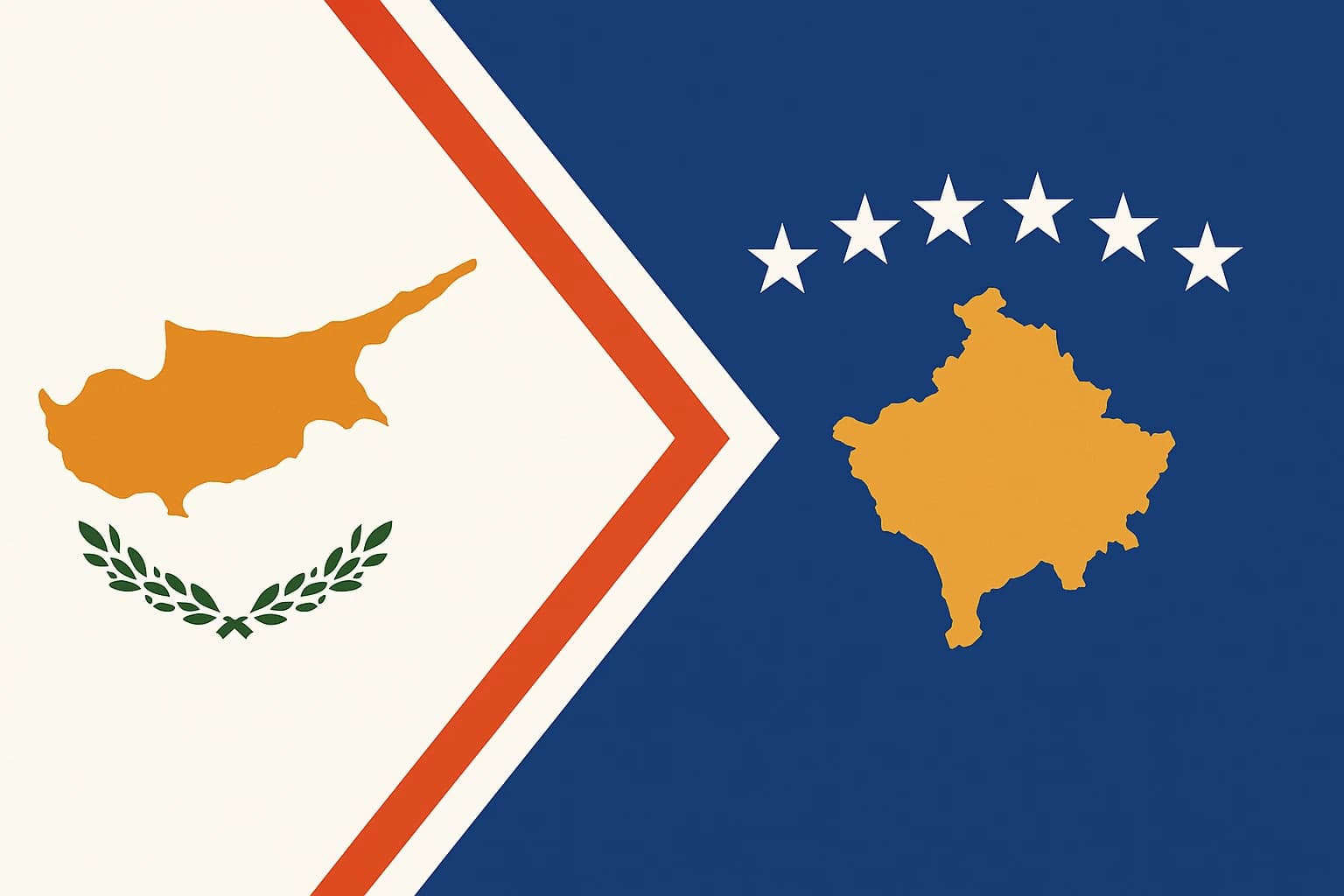
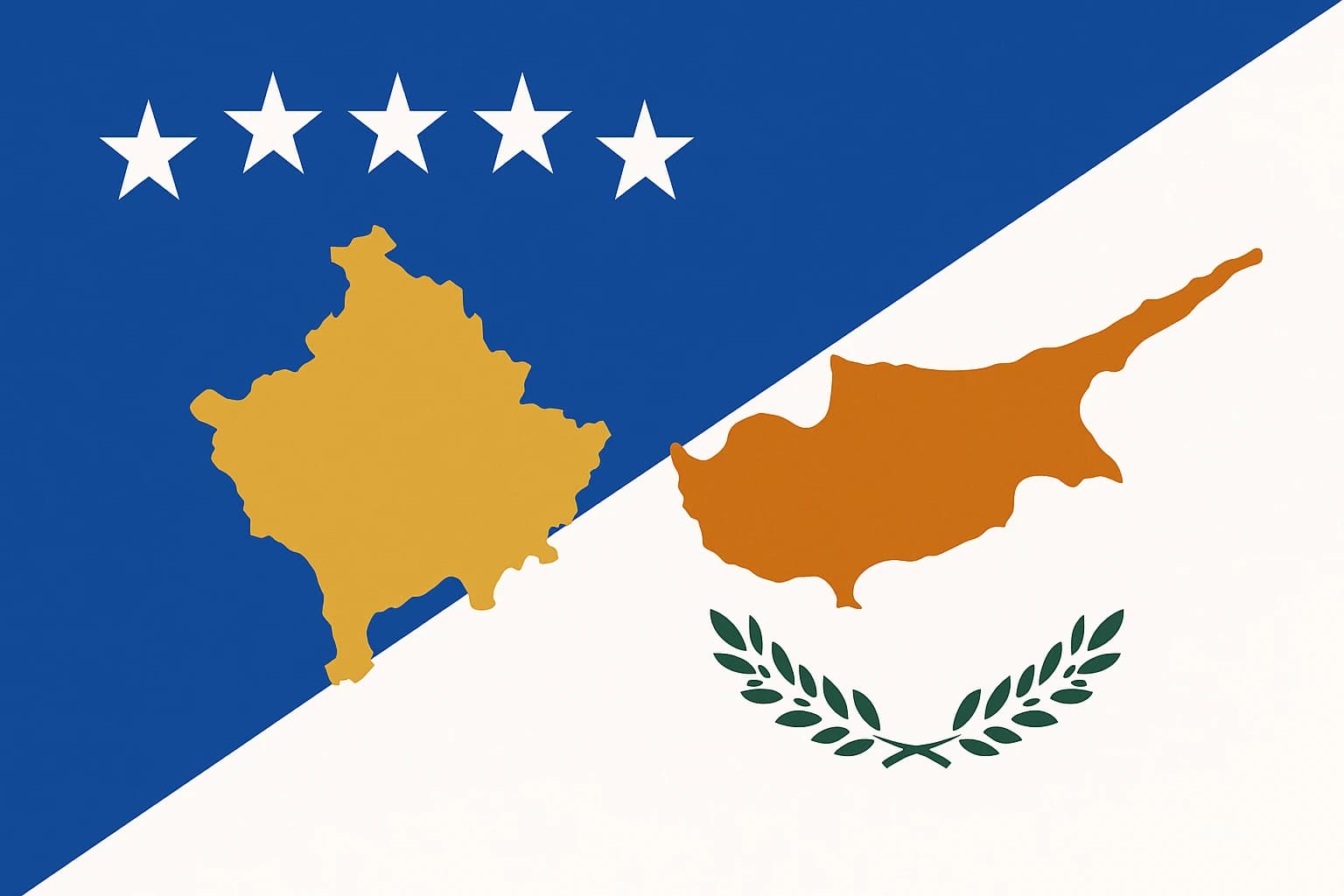
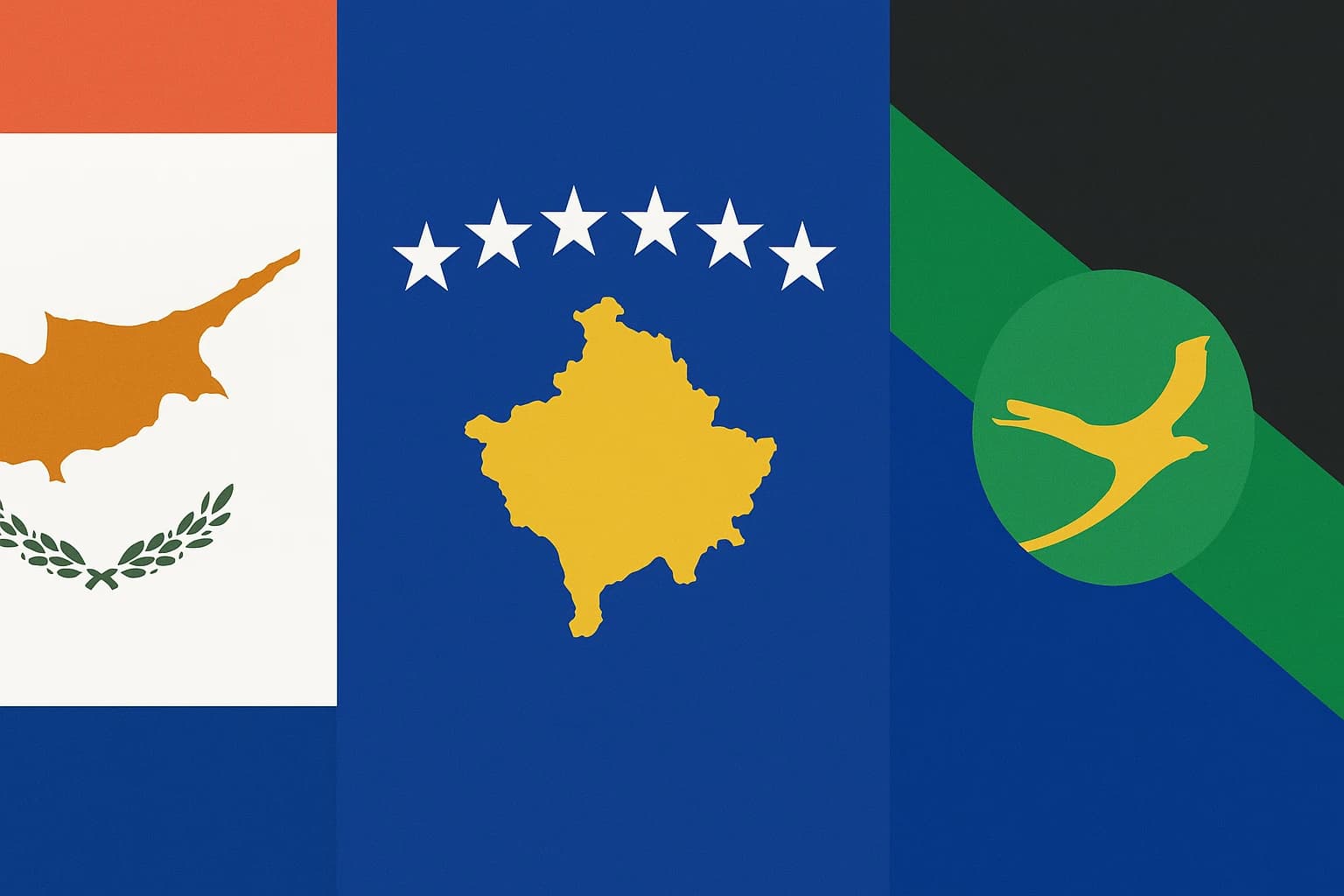
Maps on Flags: Why Cyprus, Kosovo, and Christmas Island Put Their Geography Front and Center
Julio Song · · 10 min read
Out of nearly 200 sovereign states and dozens of territories worldwide, fewer than ten have ever placed a map or silhouette of their own territory on their national flag. That makes it one of the rarest design choices in all of vexillology, the study of flags. And it's no accident.
Most nations reach for stripes, stars, crescents, or crosses. A small handful have made a different, more radical decision: to print the shape of their land on cloth and fly it from a pole.
Try a thought experiment. Picture the United States replacing the stars and stripes with a silhouette of the continental forty-eight. Or France swapping the tricolor for a hexagonal outline. It would feel strange. Almost aggressive. Less a symbol of identity and more a declaration of territory, a finger pointed at a map saying, "This belongs to us."
That discomfort explains why map-flags exist. They almost always come out of contested sovereignty, disputed borders, or the urgent need to build a national identity above ethnic or religious division. The three most prominent cases are Cyprus, Kosovo, and Christmas Island, and none of them chose a map neutrally. A map on a flag is a statement about who owns the land.
The rarest design choice in flag history
Of the 193 UN member states and roughly 60 dependent territories, only two current sovereign states have a map on their national flag: Cyprus and Kosovo. A handful of territories and sub-national entities have done the same, but at the national level the club is tiny.
Why so uncommon? Flags evolved as battlefield identifiers. They needed to be recognizable at a distance, in wind, in rain, in chaos. A map is inherently detailed, hard to reproduce by hand, and directionally ambiguous. Which way is up? Rotate a map 90 degrees and it becomes unrecognizable. Rotate a tricolor 90 degrees and you still know what you're looking at.
Compare the map approach to more common geographic symbols. Japan's red sun disc references the country's position as the "Land of the Rising Sun," but abstractly.
Nepal's flag is shaped like mountains, but it doesn't draw the Himalayas.
Brazil's starry sky represents the constellations visible from Rio de Janeiro on the night of November 15, 1889, but no one would call it a star chart.
These flags reference geography without becoming cartography. They gesture at the land without mapping it.
When a country breaks that convention and puts a literal map on its flag, it signals that territorial identity is the most pressing political question it faces. The shape of the land, its borders, its wholeness, matters more than any abstract ideal that colors or geometry could carry.
Cyprus, 1960: a flag designed to end a conflict
Cyprus gained independence from Britain in 1960 after years of EOKA guerrilla warfare and brutal intercommunal clashes between Greek Cypriots (who wanted enosis, union with Greece) and Turkish Cypriots (who feared subjugation as a permanent minority). The new republic needed a flag, and that flag needed to thread an impossible needle: represent one island shared by two communities who had recently been killing each other.
President Makarios III reportedly selected from a set of submissions. The winning design came from an unlikely source: İsmet Güney, a Turkish Cypriot art teacher. His design placed a copper-colored silhouette of the island on a white background, with two olive branches crossed beneath it.
Every element was deliberate. The copper color references the island's name, since "Kypros" comes from the Greek word for copper and Cyprus had been a copper-mining center for millennia. The white field stands for peace and the olive branches for reconciliation between the two communities. The critical detail is what's missing: no blue anywhere, and no red. Blue would evoke Greece and red would evoke Turkey, so both were kept out of the design.
The flag was designed to represent not what Cyprus was but what its founders hoped it would become, a unified post-ethnic state where geography outranked ancestry. The map said: we are not Greeks, we are not Turks, we are the people of this island.
Partition and dual identity
That hope lasted fourteen years.
In 1974, a Greek military junta backed a coup against Makarios, aiming to achieve enosis by force. Turkey responded with a military invasion of the island's north. The result: a de facto partition that persists to this day. The Republic of Cyprus controls the south. The self-declared Turkish Republic of Northern Cyprus (TRNC) controls the north, recognized only by Turkey.
The flag survived. Its meaning did not.
The Republic of Cyprus continues to fly İsmet Güney's design. The map still shows the entire island, including the northern territory the government does not control. What was once a peace symbol became, by default, a sovereignty claim. The flag now says not "one island, one people" but "this entire island is ours."
The TRNC, for its part, adopted its own flag in 1984: a white field with a red crescent and star, flanked by two horizontal red stripes. It's a deliberate visual echo of Turkey's flag.
It pointedly rejects the map-flag and the unified identity it represented.
And here's where the original design's failure becomes most visible. Walk through the Greek Cypriot south, and you'll see the copper island flag displayed alongside the Greek national flag.
Cross into the north, and you'll find the TRNC flag flying beside Turkey's. The ethnic dualism that İsmet Güney's design tried to prevent is now flagged on every public building. The map said "one island" and history disagreed.
Kosovo, 2008: contested borders in blue and gold
If Cyprus's map-flag came from hope, Kosovo's came from necessity.
On February 17, 2008, Kosovo declared independence from Serbia. The Kosovo Assembly approved a flag design by Muhamer Ibrahimi on the same day. The design: a blue field bearing a gold silhouette of Kosovo's territory, with six white stars arched above it.
Those six stars represent the country's six major ethnic groups: Albanians, Serbs, Turks, Gorani, Romani, and Bosniaks. It was a political choice throughout.
Many Kosovo Albanians wanted to fly the red-and-black double-headed eagle of Albania.
That's the flag many had rallied behind during the 1998-99 war. But Western diplomats, particularly those involved in Martti Ahtisaari's UN-brokered plan for supervised independence, insisted on a multi-ethnic symbol. An Albanian eagle would have signaled ethnic nationalism. It would have alienated Kosovo's Serb minority and made international recognition harder.
The parallel to Cyprus is close. Both flags came out of international pressure to create inclusive, non-ethnic national symbols, both used the map as a substitute for ethnic or religious iconography, and both arrived at the moment of independence when the stakes were highest.
The difference is what the map argues. Cyprus's was meant to unify two communities within one state. Kosovo's asserts independence against Serbia's insistence that Kosovo remains Serbian sovereign territory. The shape on the flag is the argument for statehood: this is a country, not a province.
Serbia has responded in kind. Serbian government maps routinely show Kosovo within Serbian borders, sometimes with the label "Kosovo and Metohija, Autonomous Province of Serbia." Maps themselves have become weapons in a competing sovereignty claim, a cartographic tug-of-war with no resolution in sight. As of 2024, roughly 100 UN member states recognize Kosovo's independence. Roughly 90 do not.
The flag, with its gold silhouette, keeps making the case every time it's raised.
Christmas Island and the outliers
Not every map-flag carries the weight of ethnic conflict. Sometimes a map on a flag is just a map.
Christmas Island's flag, adopted in 2002, belongs to an Australian external territory in the Indian Ocean. It has a green and blue background for land and sea, the Southern Cross constellation, a golden bosun bird (the island's seabird), and a gold silhouette of the island.
There's no sovereignty dispute here, no partition, no rival claim. Christmas Island is a small, remote Australian territory whose 1,800 or so residents wanted a flag for their own place in the ocean. The map marks local identity inside an uncontested political framework.
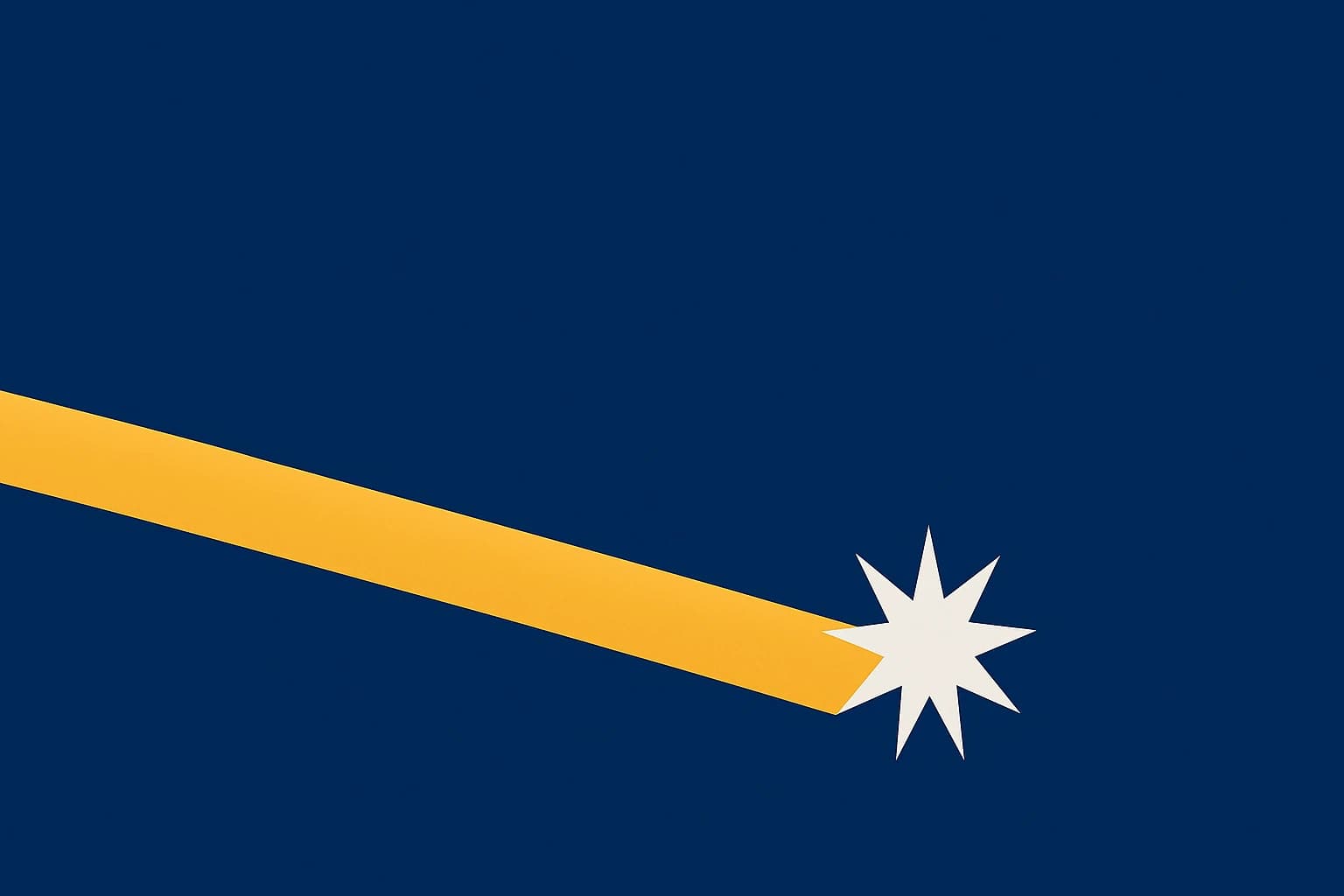
Nauru's flag uses a white star to mark the island's position below a gold stripe representing the equator, a minimalist way of locating the country in geographic space.
The British Antarctic Territory includes a map on its coat of arms, and several sub-national flags feature maps of their regions, from U.S. county flags to regional banners in Europe. These rarely carry the same charge. A county flag with a map says "here we are." A national flag with a map says "this is sovereign territory."
Why maps on flags will always be political
Map-flags cluster around a few specific scenarios:
- Newly independent states asserting territorial integrity (Cyprus in 1960, Kosovo in 2008)
- Territories emphasizing distinct local identity within a larger state (Christmas Island)
- States or entities whose very existence is disputed, where the map becomes the primary argument for legitimacy
The reason is straightforward. A map is a legal claim made visual, and it says "this land is ours" in a way a stripe or a star never does. A stripe is abstract, a crescent is symbolic, but a map draws a border and defines what is inside it and what isn't.
There's a design paradox in it. The specificity that makes map-flags politically powerful makes them weak by traditional vexillological standards. Good flag design follows a rough rule that a child should be able to draw the flag from memory. Try drawing Cyprus from memory, or Kosovo. Maps don't scale well on small pins or large banners, and they privilege one cartographic projection over others.
That weakness is also the point. A map-flag gives up design elegance for political clarity.
More could follow. If Scotland, Catalonia, Taiwan, or Palestine were to adopt new flags in the context of independence movements, the pull toward a map would be real. For any entity whose territorial claim is its primary political argument, a map says what a color scheme cannot.
The most enduring flags, though, tend to outgrow their political origins. The EU flag has become a symbol of European cooperation far beyond the institution it represents.
The rainbow pride flag symbolizes identity and community, not territory.
Map-flags stay anchored to a specific piece of earth. That's their power and their limitation.
The copper island on the white field
Go back to İsmet Güney's 1960 design. A Turkish Cypriot art teacher drew a copper island on a white field, hoping geography could unite what ethnicity had divided. More than six decades later, that flag still flies over a divided island, and the map means something its designer never intended: not unity, but a claim.
Kosovo's map-flag made that claim explicit from day one. Christmas Island's is a quieter assertion of local pride. In each case the land matters more than anything else that could go on the cloth, which is the most literal thing a flag can do.
Julio Song
Writer
Julio is a staff writer at FlagDB. He studied Mathematics at the University of Madrid and has a passion for vexillology.
More from Julio Song →