Somewhere in the vaults of the Museo Histórico Nacional in Buenos Aires hangs a faded silk banner carried through the streets during the May Revolution of 1810. Stitched into its center is a golden sun with a human face. That same face now watches over roughly 48 million people across two sovereign nations, Argentina and Uruguay, from their flags, coins, government seals, and passport covers.
No other symbol in world vexillology has quite this status: a pre-Columbian deity, filtered through colonial revolt, embedded in two national flags without sparking the kind of diplomatic friction that nearly identical tricolors have caused between Chad and Romania. The Sol de Mayo, the Sun of May, is one of the most arresting emblems on any flag anywhere. Yet its origin story, tangled in Inca theology, Río de la Plata politics, and the messy divorce of two sibling nations, stays remarkably obscure outside South America.
This is the story of how one ancient god burned its way onto two modern flags, and what it means that both countries are perfectly fine with sharing.
Inti's golden face: the pre-Columbian roots of the Sol de Mayo
Before it was a revolutionary emblem, the Sol de Mayo was a god.
Inti, the Inca sun god, stood at the apex of the Tawantinsuyu's spiritual hierarchy. He was the supreme deity of the Inca Empire, depicted as a radiant golden disc with a human face. That image, the direct visual ancestor of what you see on Argentine and Uruguayan flags today, wasn't decorative. It was political theology. The Inca emperor claimed descent from Inti, so sovereignty literally radiated from the sun's visage rather than from armies or constitutions.
The Coricancha, the Temple of the Sun in Cusco, housed a massive gold sun disc that filled an entire wall. Spanish conquistadors melted it down after 1533, converting sacred art into bullion. Destroying the gold did not destroy the image. When Spanish colonizers encountered Inca solar iconography across the Andes, they syncretized it rather than erasing it. Solar imagery persisted in colonial-era church architecture, folk art, and mestizo visual culture throughout the Andes and the Río de la Plata region for centuries.
By the late 18th century, Creole intellectuals in Buenos Aires and Montevideo, steeped in Enlightenment thought, began reclaiming indigenous symbols as markers of an American identity distinct from a European one. Inti's face was the most potent image available.
The connection between Inca sun worship and the Sol de Mayo is not merely aesthetic. Revolutionaries chose it to anchor their legitimacy in pre-Columbian sovereignty rather than in European monarchical tradition. They needed a symbol that said they belonged to this continent, and the face of a god who predated the Spanish Crown by centuries said exactly that.
The May Revolution and the birth of a revolutionary emblem (1810 to 1818)
On May 25, 1810, a crowd gathered in the Plaza de la Victoria in Buenos Aires to demand the removal of Spanish Viceroy Cisneros. According to popular legend, the sun broke through heavy clouds at the decisive moment, giving the revolution both its name and its symbol.
Is the story true? Probably not. Buenos Aires in late May sits deep in autumn, and overcast skies are the norm. But the story served its purpose so well that its literal truth became irrelevant. It fused a natural omen, Inca cosmology, and Enlightenment rationalism into a single revolutionary moment: the dawn of a new American order.
The Sol de Mayo first appeared not on a flag but on coins. The first silver coins minted in 1813 by the Asamblea del Año XIII carried the sun face, establishing it as a symbol of the new republic's economic and political sovereignty before it ever flew on a flagpole.
Manuel Belgrano, who designed Argentina's blue-and-white flag in 1812, did not originally include the sun. The Sol de Mayo was added officially in 1818 to distinguish the war flag, the flag of state, from the simpler civil flag. That hierarchy persists: Argentina maintains both a civil flag without the sun and an official flag with it.
One detail often gets overlooked. The Río de la Plata region in 1810 was a single political unit, the United Provinces of the Río de la Plata. The Sol de Mayo was initially the shared property of what would eventually become Argentina, Uruguay, Paraguay, and Bolivia. It was not yet anyone's sun in particular.
One sun, two nations: how Argentina and Uruguay split the symbol
Uruguay's path to independence was anything but straightforward. It was part of the United Provinces, then annexed by Portugal and Brazil as the Cisplatina Province from 1816 to 1825, then fought a war of independence aided by Argentina, and finally became a sovereign buffer state in 1828 through British-brokered diplomacy under the Treaty of Montevideo.
When Uruguay adopted its first flag in 1828 and its definitive version in 1830, it kept the Sol de Mayo, not as a borrowing from Argentina but as a claim to shared heritage. Uruguay was asserting that it was a co-heir of the May Revolution's legacy rather than a derivative of it. Both nations were born from the same political body, and both inherited the same face.
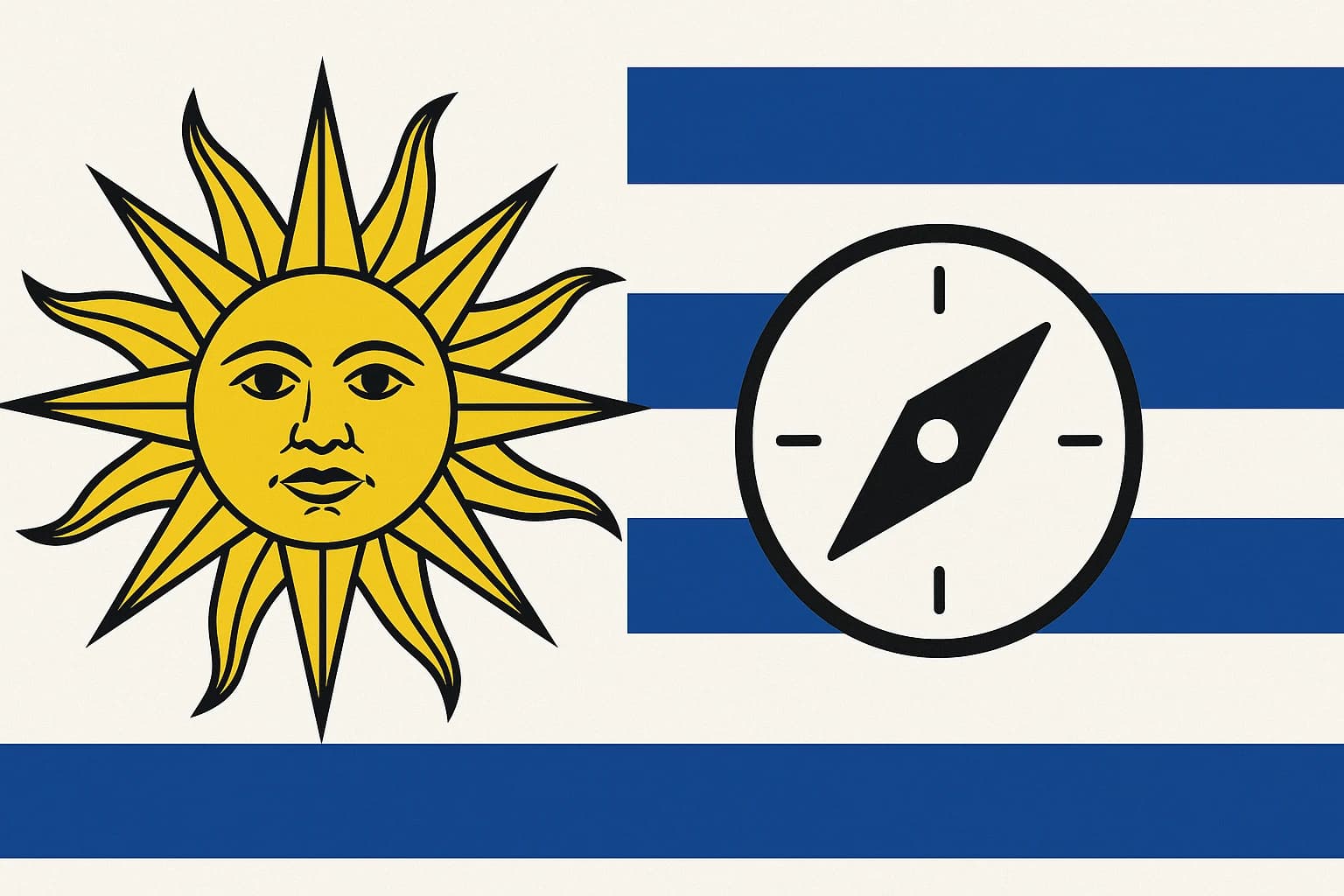
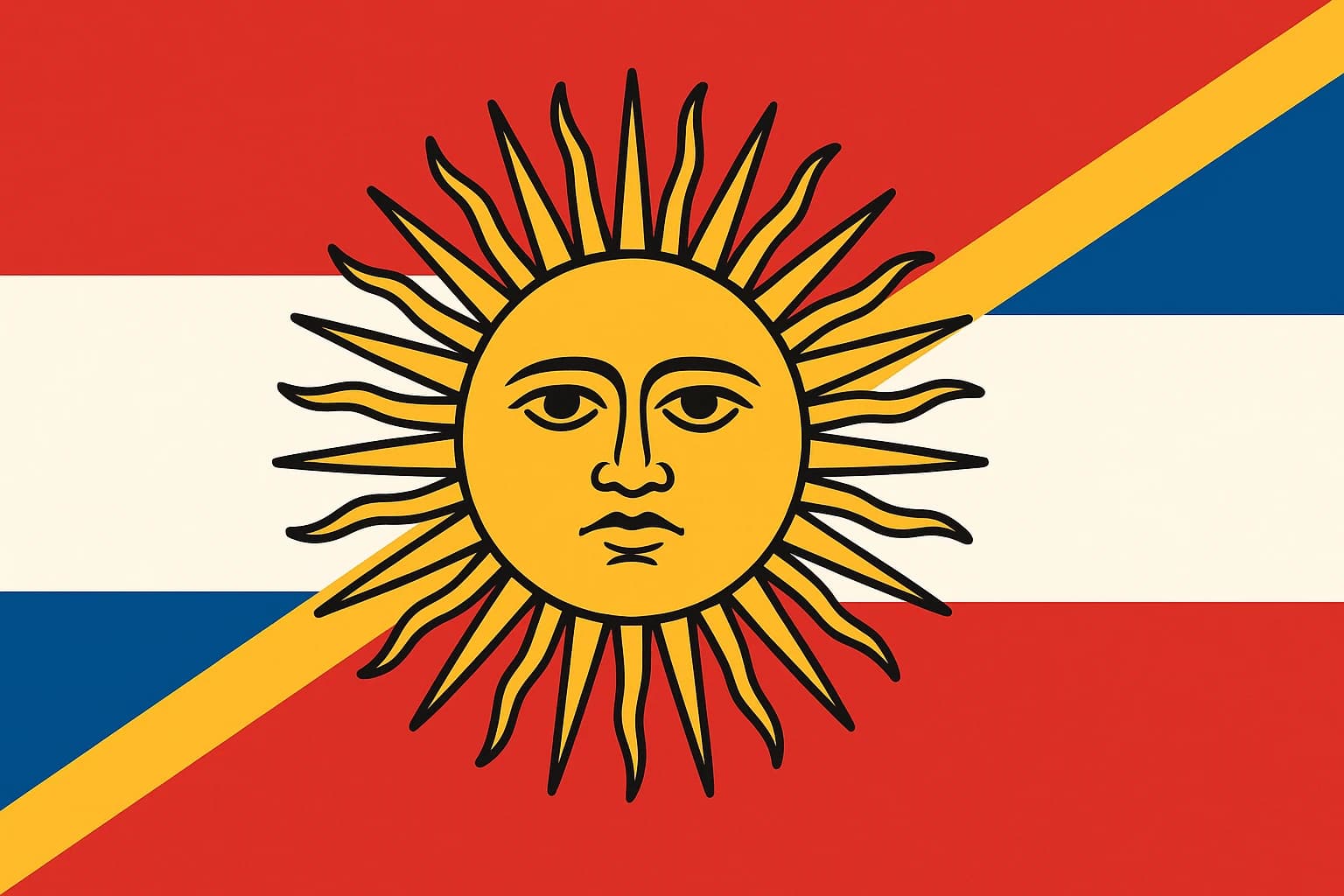
The two nations render the Sol de Mayo differently, in ways that reflect distinct national aesthetics. Argentina's sun has 32 rays alternating between straight and wavy, a relatively serene facial expression, and sits centered on the white band. Uruguay's sun has 16 rays alternating between straight and wavy, a slightly more intense or animated facial expression, and occupies the canton in the upper-left corner.
There is a subtle divergence in how each nation frames the symbol's meaning too. Argentina's sun is sometimes called "el sol incaico" to emphasize the indigenous connection. Uruguay's is more commonly linked to the May Revolution narrative specifically. Same face, different stories about that face.
The comparison to Chad and Romania is instructive here. Those two nations, with no shared history, accidentally ended up with virtually identical blue-yellow-red tricolors, and that has caused genuine diplomatic annoyance over the decades.
Argentina and Uruguay's shared Sol de Mayo is experienced as a bond instead. Both nations acknowledge the common origin, and there is no question of copying, only co-inheritance.
A tale of two suns: the design differences up close
The details are worth getting specific about, because they do more work than you would expect.
Argentina's Sol de Mayo has 32 rays, 16 straight and 16 wavy, alternating around a central face with relatively naturalistic features: almond eyes, a small nose, a neutral mouth. The overall effect is calm, almost contemplative, and resembles Enlightenment-era engravings of Apollo or classical solar allegories. Argentine government standards, codified in law 23,208 of 1985 and its 2010 amendments, specify particular Pantone values that tend toward a warmer, deeper gold.
Uruguay's Sol de Mayo has only 16 rays, 8 straight and 8 wavy, which makes each ray thicker and more prominent. The face is often rendered with slightly wider eyes and a more pronounced expression, sometimes described as watchful or alert. It occupies proportionally more of the sun disc than Argentina's version. Uruguayan color specifications lean slightly brighter.
Placement matters enormously. Argentina centers its sun on the flag, making it the focal point of a symmetrical design that reads as balanced and stately. Uruguay places its sun in the canton against nine horizontal stripes, four blue and five white, giving the flag a busier, more dynamic composition. If you squint, Uruguay's structural logic has something in common with the United States flag: a charged canton against a field of stripes.
Those differences are small on paper but strong in practice. Two siblings with a family resemblance, styling themselves completely differently.
Why Ecuador, Peru, and Bolivia chose different solar symbols
If the Sol de Mayo traces back to Inca sun worship, a fair question arises: why didn't other Andean nations, the actual heartland of the Inca Empire, adopt the same face-in-the-sun motif?
The answer lies in different revolutionary genealogies and deliberate visual differentiation.
Ecuador's coat of arms features a condor atop a shield, with a sun, no face, appearing behind it. Solar imagery is present but subordinated to republican symbolism drawn from Simón Bolívar's Gran Colombia project rather than from the Río de la Plata tradition.
Peru, the direct successor state to the Inca Empire's geographic core, chose not to put a sun face on its flag. It selected a coat of arms with a vicuña, a cinchona tree, and a cornucopia, symbols of natural abundance. Peru's sun imagery appears in other state symbols, but the flag's centerpiece was always different, partly to avoid appearing to claim exclusive Inca inheritance.
Bolivia uses a coat of arms with a condor and an Andean landscape. Its indigenous solar symbol, the Wiphala, a rainbow-checkered flag representing Andean peoples, operates alongside the national flag as a dual-flag system recognized in the 2009 constitution. That is a radically different approach to encoding pre-Columbian identity.
The divergence makes a point about flags in general. They are active political choices, not passive reflections of history. The Sol de Mayo landed on the flags of Argentina and Uruguay not because those nations were more Inca than Peru or Bolivia, but because the political moment of 1810 to 1830 in the Río de la Plata made Inca solar symbolism useful for a particular revolutionary argument about American sovereignty.
Sharing a symbol without sharing a fight
What makes the Sol de Mayo unusual is that it never became controversial.
Chad and Romania have engaged in periodic low-level diplomatic friction over their near-identical tricolors, with Romania occasionally pointing out that its flag predates Chad's by over a century. No analogous dispute has ever arisen between Argentina and Uruguay.
The difference is narrative. Both nations tell a shared origin story. The Sol de Mayo is understood by both as the inheritance of a common revolutionary moment in 1810 and a common colonial entity, the Viceroyalty of the Río de la Plata. There is no question of who had it first, because they both had it at the same time.
Cultural reinforcement helps. Argentina and Uruguay share tango, mate tea culture, the River Plate Spanish dialect, and a deep if sometimes rivalrous sense of kinship. The shared sun sits inside a much larger web of shared identity, which makes it feel natural rather than contested.
The visual differences between the two suns are also enough to prevent confusion in practice. At international sporting events, at UN flag displays, at embassy rows around the world, nobody mistakes Argentina's flag for Uruguay's. The ray count, the placement, and the facial expression all do quiet work.
As of 2026, the Sol de Mayo remains a living symbol. It appears on Argentine and Uruguayan currency, military insignia, sports jerseys, and public buildings, and it still functions as a statement about hemispheric identity, indigenous continuity, and the shared origin of two nations born from the same revolution.
The sun is big enough
The Sol de Mayo is a rare thing: a symbol strong enough that two nations claim it, well enough understood that neither fights over it, and distinctive enough to stay instantly recognizable worldwide. Its journey from the gold-plated walls of the Coricancha in Cusco, through the revolutionary ferment of 1810 Buenos Aires, onto the flags of two sovereign nations that were once a single political body, shows how tightly the historical, aesthetic, and political strands of a national symbol get braided together.
Argentina and Uruguay looked at the same ancient face and saw their own reflections. They continue to do so without conflict and without confusion, which suggests that a shared symbol does not have to be a contested one.