The Flag of Ecuador
Republic of Ecuador
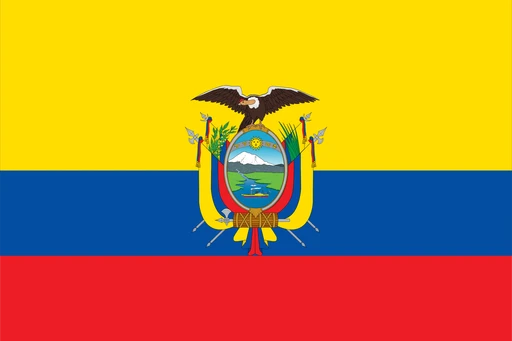
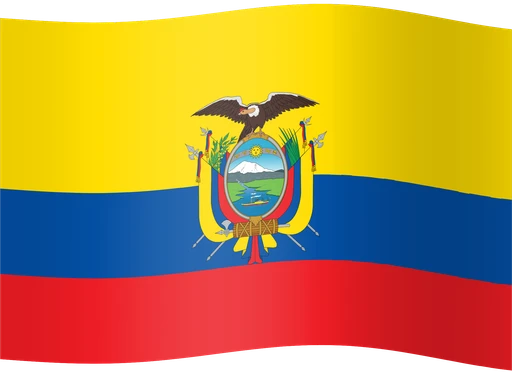
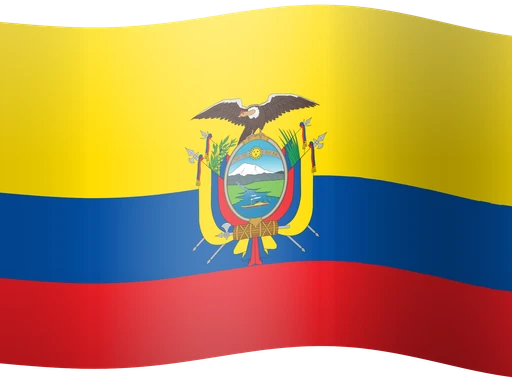
The flag of Ecuador consists of three horizontal stripes: yellow at the top, blue in the middle, and red at the bottom, with the national coat of arms placed in the center of the flag. The yellow stripe is twice the width of the blue and red stripes, which are equal. Ecuador shares the tricolor with Colombia and Venezuela, and the coat of arms is what tells them apart.
Ecuador's flag is a horizontal tricolor of yellow, blue, and red, with the yellow band twice the width of the others. It belongs to a family of flags that came out of the same revolutionary struggle, sharing its colors with Colombia and Venezuela in a line running back to Francisco de Miranda and the wars of independence against Spain. What sets Ecuador's apart is the elaborate coat of arms added to the center for official use: a condor perched atop an oval shield framing the snow-capped peak of Chimborazo, the country's tallest volcano and, measured from Earth's center, the point on the planet's surface farthest from its core. The current form dates to September 26, 1860.
Miranda's tricolor, shared by three nations
Francisco de Miranda, the Venezuelan revolutionary and restless dreamer who spent decades lobbying European courts for support, is widely credited with originating the yellow-blue-red tricolor. Where exactly the idea came from is still debated. Some scholars point to a conversation Miranda claimed to have had with Johann Wolfgang von Goethe about color theory. Others suggest he drew inspiration from the flag of the short-lived Republic of Haiti, or simply chose the three primary colors as a universal emblem of liberation. Whatever the origin, Miranda first flew the tricolor during his failed 1806 expedition to free Venezuela from Spanish rule.
The flag got a much bigger stage when Simón Bolívar adopted it for Gran Colombia (1819-1831), the ambitious republic that unified modern-day Ecuador, Colombia, Venezuela, and Panama under one government. When that union fractured in 1830, all three successor states held on to variations of the tricolor. Ecuador's flag is, in a real sense, a relic of a country that no longer exists.
Between 1830 and 1860, Ecuador cycled through several flag designs. Some featured lighter blue shades, others played with stripe proportions or swapped out emblems. The instability reflected the political turbulence of the era. It wasn't until President Gabriel García Moreno settled the matter on September 26, 1860, that the current design took hold. His choice was deliberate: restoring the original Gran Colombian proportions, with the yellow band occupying the top half, was a conscious tribute to the shared independence struggle. That decision has held for over 160 years.
Chimborazo, a condor, and a steamship
The coat of arms appears on the state and war flag but is left off the civil flag flown by private citizens. This distinction matters in protocol and is frequently confused, even within Ecuador.
At the heart of the arms sits an oval shield depicting Mount Chimborazo, its peak capped in snow, with the Guayas River flowing from its base toward the Pacific. Floating on that river is a steamship, said to represent the first steamship built in South America, constructed on the Guayas in 1841. It's a nod to commerce, navigation, and Ecuador's connection to the wider world. Above the shield, an Andean condor spreads its wings for power and the nation's readiness to defend itself. No bird carries more weight in Andean symbolism.
Flanking the shield are four national flags (two on each side) and pairs of weapons: lances, rifles, sabers, and bayonets. At the base rests a fasces, the classical Roman bundle of rods bound around an axe, borrowed as a symbol of republican authority. A laurel branch on one side and a palm branch on the other complete the frame, representing glory and peace.
One of the most intriguing details is the zodiac band running across the shield. It displays the signs for Aries, Taurus, Gemini, and Cancer, corresponding to the months of March through July 1845. Those months mark the Marcist Revolution, which overthrew General Juan José Flores and reasserted Ecuadorian self-governance. The sun at the center of the shield, meanwhile, reinforces ties to the Inca heritage of the Andean region, a connection that predates the republic by centuries.
Yellow for gold, blue for sea and sky, red for blood
The yellow band, taking up a full half of the flag, traditionally represents the abundance of gold and natural resources, the fertility of Ecuador's land, and the energy of the sun. Blue stands for the Pacific Ocean and the clear equatorial skies, a fitting association for a country literally named after the equator. Red commemorates the blood shed by soldiers and patriots who fought for independence.
Colombia and Venezuela assign broadly similar meanings to the same colors, but each nation has layered its own narrative onto them over time. The proportions are what give Ecuador's flag its distinctive visual weight: yellow occupying the top half, blue and red each filling a quarter. That 2:1:1 ratio, shared with Colombia, makes the two flags nearly indistinguishable at a distance. Up close, it's the coat of arms that tells you which country you're looking at.
Telling Ecuador's flag from Colombia's
Ecuador and Colombia share identical tricolor proportions, which makes them among the most commonly confused national flags on the planet. The main difference is Ecuador's coat of arms on the state flag. Colombia's flag usually flies without any emblem at all.
That only helps so much, because the civil flags of both countries, stripped of their coats of arms, are nearly identical. Ecuador's blue is sometimes described as slightly darker, but in practice, shade varies depending on the manufacturer. Venezuela's tricolor, by contrast, uses equal-width stripes and a different arrangement, so it's easier to pick out. All three read at a glance as belonging to the Bolivarian family, which is the point. Gran Colombia is gone, and its flag is still flying in three places.
Protocol and variants
Ecuador's Flag Day falls on September 26, marking the anniversary of the 1860 adoption. The state flag, with its coat of arms, is reserved for government institutions, the military, and international diplomatic settings. The civil flag, without the arms, is for general public use. A separate naval ensign exists for maritime purposes.
Ecuadorian law governs how the flag must be displayed. It must never touch the ground, it flies at half-staff during periods of national mourning, and its proportions and colors are set out in regulation rather than left to custom.
Beyond Ecuador's borders, the flag matters most in diaspora communities, particularly in the United States and Spain. During national holidays and cultural festivals it's everywhere: draped over balconies, waved at parades, pinned to jackets. In 2009, an enormous Ecuadorian flag was unfurled on the slopes of Chimborazo, putting the flag on the mountain it depicts.
References
[1] Constitución de la República del Ecuador (2008). Official constitutional provisions regarding national symbols. https://www.asambleanacional.gob.ec
[2] Smith, Whitney. Flags Through the Ages and Across the World. McGraw-Hill, 1975. Comprehensive vexillological reference covering the origins and evolution of national flags.
[3] Znamierowski, Alfred. The World Encyclopedia of Flags. Lorenz Books, 2001. Widely cited reference on flag design, symbolism, and protocol.
[4] Harvey, Robert. Liberators: Latin America's Struggle for Independence. Overlook Press, 2000. Historical context on Miranda, Bolívar, and the Gran Colombian period.
[5] Ministerio de Relaciones Exteriores y Movilidad Humana del Ecuador. Official government source on national symbols and flag protocol. https://www.cancilleria.gob.ec
[6] The Flag Institute (UK). Country flag profiles and vexillological research. https://www.flaginstitute.org
[7] Presidencia de la República del Ecuador. Decreto y simbolismo de la bandera nacional. https://www.presidencia.gob.ec
Common questions
- What do the colors of the Ecuador flag mean?
- Yellow symbolizes the richness of the land, blue represents the skies and oceans, and red stands for the blood shed for independence.
- What does the coat of arms on the Ecuador flag signify?
- It features the Andean condor for protection, Chimborazo volcano for strength, the river Guayas for commerce, and symbols of freedom and agricultural wealth.
- Why does the Ecuador flag look like those of Colombia and Venezuela?
- The similarities come from the shared history of Gran Colombia, where Ecuador, Colombia, and Venezuela were united, reflected in the tricolor design.
- Why does Ecuador's flag look so similar to Colombia's flag?
- They both come from the flag of Gran Colombia (1819-1831), the republic that once united Ecuador, Colombia, and Venezuela. That's why they share the same yellow-blue-red tricolor with identical 2:1:1 proportions. Ecuador's state flag has a coat of arms in the center, which helps tell them apart. But the civil flags, without any emblems, are nearly identical. They're actually among the most commonly confused flags in the world.
- Why do Ecuador, Colombia, and Venezuela all have similar flags?
- They all go back to Francisco de Miranda's yellow-blue-red tricolor, first flown in 1806. Simón Bolívar later adopted it for Gran Colombia, the republic that united all three nations. When Gran Colombia broke apart in 1830, each new country kept its own version of the tricolor. The resemblance isn't a coincidence. It's a shared nod to their common independence struggle and Bolivarian heritage.
- What's the difference between Ecuador's civil flag and its state flag?
- The state flag has the full coat of arms in the center and it's used by government institutions, the military, and in diplomatic settings. The civil flag is just the plain yellow-blue-red tricolor with no emblem, and it's the one private citizens fly. This distinction is defined by law, though even within Ecuador people mix them up pretty often.
Featured in these articles
Download this flag
Free in 12 styles, from 32px icons up to 2000px, as SVG, PNG, WebP and JPG.