Imagine you're a protocol officer at the United Nations, arranging 193 flags in alphabetical order for a General Assembly session. You pull out Indonesia and Monaco and realize you cannot tell them apart without a ruler. That is a real and recurring headache in international diplomacy and sport.
Most people assume every sovereign nation has a unique flag, as distinct as a fingerprint. At least half a dozen national flags are near-perfect duplicates of one another, designed centuries apart on opposite sides of the world with no knowledge of each other's existence.
The most famous case, Indonesia and Monaco, both horizontal bicolors of red over white, produced a formal diplomatic protest, raised unanswerable questions about who owns a color combination, and remains unresolved. This is the story of what happens when flags collide, and why, in a world of 200-plus nations drawing from the same small palette, it was always going to happen.
Two flags, one design: the Indonesia-Monaco collision
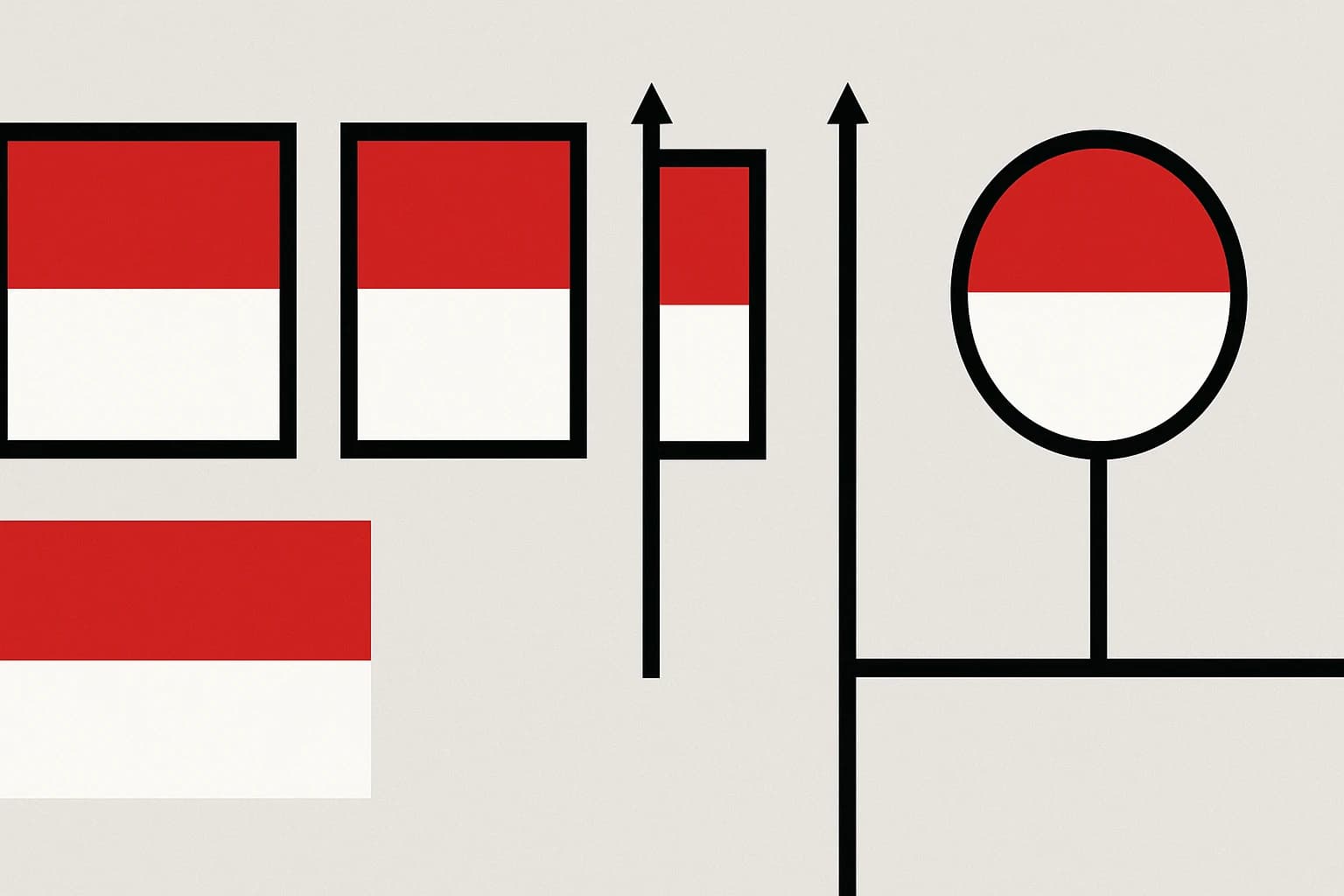
Place them side by side. Indonesia's Sang Saka Merah Putih is a horizontal bicolor: red on top, white on the bottom, with a 2:3 ratio.
Monaco's flag is a horizontal bicolor: red on top, white on the bottom, with a 4:5 ratio.
That's it. The only difference is the proportions, and when both flags fly on a pole in the wind, rippling and folding, that distinction vanishes entirely.
Monaco's flag was formally adopted in 1881 under Prince Charles III, but the red-and-white color scheme traces back to the heraldic arms of the House of Grimaldi in the 14th century. Monaco has a strong, well-documented claim to these colors.
Indonesia's claim is arguably even older. The red-and-white banner traces to the 13th-century Majapahit Empire, a sprawling maritime power across Southeast Asia. When Indonesia declared independence on August 17, 1945, the red-over-white bicolor became the national flag. It wasn't borrowed from Monaco. It came from a tradition predating Monaco's use by at least a century.
Neither country copied the other. Both arrived at the same design through independent cultural histories, separated by thousands of miles and hundreds of years. Nobody did anything wrong. They simply ended up in the same place.
The visual absurdity plays out regularly at international events, where the two flags get confused, mislabeled, or accidentally swapped. For a small piece of colored fabric, the diplomatic consequences are not small at all.
The 1949 protest: when Indonesia said "that's our flag"
After Indonesia gained international recognition in 1949, its diplomats entered the world stage and immediately noticed the problem. Indonesia formally protested to Monaco, arguing that the Principality should change its flag to avoid confusion.
Monaco's response was essentially no. The Principality pointed out that its modern flag predated Indonesian independence by decades and that its heraldic tradition stretched back centuries. Indonesia countered with its own centuries-old claim. Both sides had history. Neither had law.
That is the crux of it. No international treaty, UN resolution, or diplomatic convention requires national flags to be visually distinct. There is no registry, no application process, no review board. The closest analog is trademark law, but sovereignty doesn't work like intellectual property. You cannot file a cease-and-desist against a nation-state over color choices.
The dispute quietly fizzled. No resolution was reached, and both countries continue to use nearly identical flags. Diplomatic protocol relies on context to distinguish them: nameplates, alphabetical placement, the knowledge of the people in the room. It works, until it doesn't.
The protest is significant because it is one of the only known cases of a formal diplomatic objection over flag similarity. Nations take their visual identity seriously even when no mechanism exists to enforce uniqueness.
Poland's elegant inversion, and why it doesn't solve the problem
Now flip the design upside down. Poland's flag is white over red, the exact inversion of Indonesia and Monaco.
Adopted in 1919 upon the re-establishment of Polish sovereignty, the white-and-red combination dates to the 13th-century coat of arms of the Kingdom of Poland. Another deep, independent historical tradition. Another red-and-white bicolor.
You'd think inversion would solve the confusion. It doesn't. When a flag hangs limp on a windless day, or when an event organizer accidentally displays it upside down, Poland becomes Indonesia. This has happened repeatedly at international sporting events. At the 2016 Rio Olympics, Poland's flag was displayed inverted, turning it into the Indonesian flag on a global broadcast.
The underlying reason is mathematical. Red appears on roughly 75% of all national flags. White appears on about 70%. With only a handful of basic layouts, bicolors, tricolors, a canton with a field, duplication is close to certain.
Poland, Indonesia, and Monaco are three sovereign nations whose flags are permutations of the same two colors in the same basic layout. Add Singapore, which places a crescent and stars in the canton of its red-over-white field, and you have a whole family.
Even when countries differentiate through orientation, the human eye and the distracted event organizer frequently fail to notice. Inversion turns out to be a weak solution in practice.
The Chad-Romania problem: when even tricolors collide
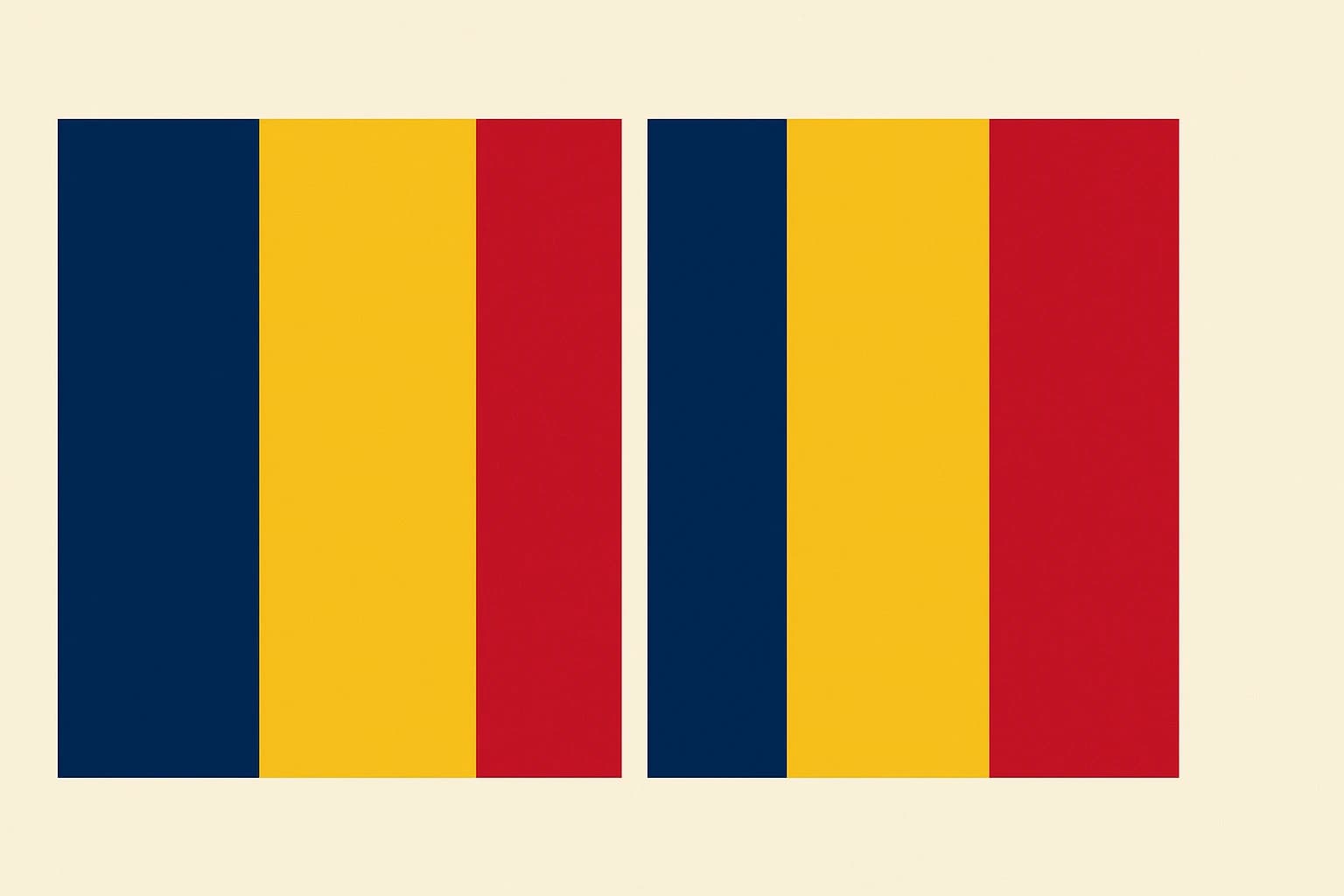
The Indonesia-Monaco case isn't unique. Chad and Romania both use vertical tricolors of blue, yellow, and red, in that order. The resemblance is so close that even vexillologists, the people who study flags professionally, struggle to tell them apart without precise color specifications.
Romania's tricolor dates to the 1848 revolution, with roots in Wallachian and Moldavian heraldic traditions. Chad adopted its flag in 1959, choosing colors that blended the Pan-African palette with France's tricolor influence. Over a century separates their origins, and the result is almost pixel-for-pixel identical.
The technical difference: Romania specifies cobalt blue, chrome yellow, and vermillion red. Chad uses a slightly darker indigo blue, roughly Pantone 281 versus Romania's 280. In practice, fabric dyes, printing variations, and sun fading make the distinction meaningless. A Romanian flag left in the sun for a few months and a fresh Chadian flag are indistinguishable.
In 2004, Romanian President Ion Iliescu raised the issue at the United Nations. Chad's response echoed Monaco's position against Indonesia: the flag was not changing. The matter was dropped.
The pattern repeats. Flag collisions get discovered after the fact, protested without legal standing, and left permanently unresolved. The international system has no mechanism, and apparently no appetite, for adjudicating visual identity disputes between sovereign states.
Can you own a color combination?
If no one copied anyone, and both flags emerged from legitimate independent traditions, who has the right to a particular color arrangement?
Legally and philosophically, nobody does, and so does everybody.
In commerce, identical branding gets resolved through trademark registration, priority dates, and market confusion tests. Nations are not brands. Sovereignty is not a marketplace. There is no first-to-file system for flags, and the Westphalian system treats each nation's sovereign symbols as inviolable.
Flags derive meaning from context rather than from visual uniqueness. The Indonesian flag means Indonesia not because its design is one of a kind but because Indonesians rally around it, display it on their territory, and attach their collective identity to it. The same cloth, flown in Monte Carlo, means something entirely different.
The linguist Ferdinand de Saussure would recognize this immediately. His concept of the arbitrary sign holds that the connection between a symbol and its meaning is conventional, not inherent. Two identical designs carry completely different meanings for different communities, the same way the word "gift" means "present" in English and "poison" in German.
The discomfort people feel about identical flags reveals an assumption we rarely examine: that national symbols should be as unique as the nations themselves. Uniqueness was never a design requirement. It was an expectation projected backward from the idea of national distinctiveness.
The math of 200 flags and a limited palette
There are roughly seven commonly used flag colors: red, white, blue, green, yellow, black, orange. There are four or five basic layouts, including bicolors, tricolors, a canton-and-field arrangement, and a central emblem on a solid background. With over 200 sovereign states, plus territories and subnational entities, overlap is arithmetic rather than accident.
Beyond Indonesia-Monaco and Chad-Romania, the list of near-twins is long:
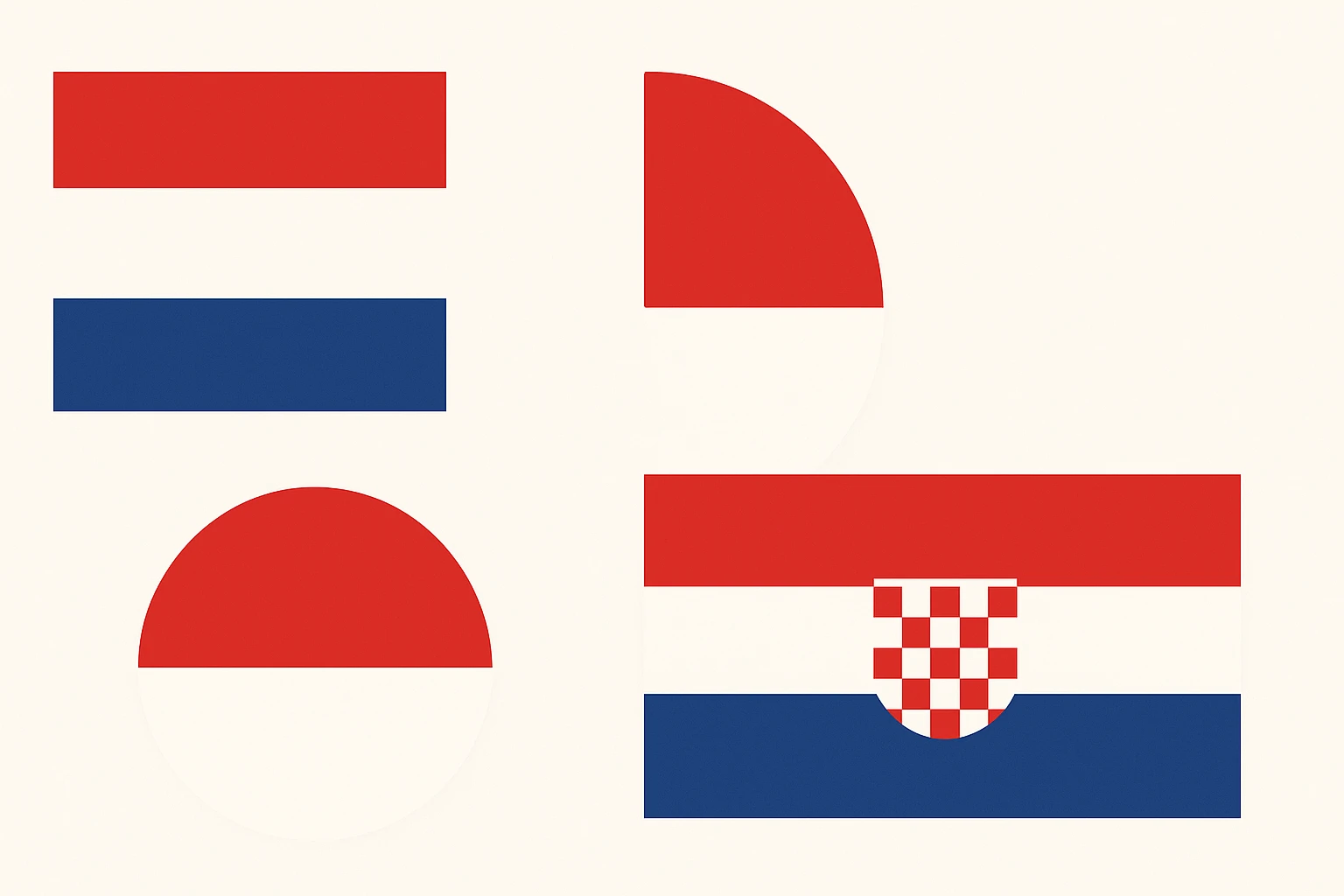
- The Netherlands and Luxembourg: both red-white-blue horizontal tricolors, distinguished only by shade of blue.
- Ireland and Côte d'Ivoire: green-white-orange versus orange-white-green, mirror images of each other.
- Australia and New Zealand: both blue ensigns featuring the Southern Cross constellation.
Some nations have tried to address this head-on. New Zealand held a $26 million flag referendum in 2015-2016, partly motivated by a desire to distinguish itself from Australia. After months of debate and two rounds of voting, New Zealanders voted to keep the existing flag anyway. People are attached to their flags precisely because they're theirs, duplication and all.
Technology has made the problem worse. Flags now appear as tiny digital icons: emoji, dropdown menus, profile badges. At 16 by 11 pixels, the difference between Chad and Romania is nonexistent. The need for visual distinctiveness at small scales has increased dramatically, yet the flags themselves remain frozen in pre-digital designs.
And the problem compounds. As new nations emerge, South Sudan in 2011 being the most recent example, the pool of available simple designs shrinks further.
New flags face a choice: add complexity, or accept similarity to something that already exists.
What the flag actually has to do
Return to that UN protocol officer. In practice, the Indonesia-Monaco problem gets solved every single day through context: nameplates, alphabetical order, the knowledge of the people in the room. But the fact that it must be solved tells us something about the limits of visual symbolism.
Flags were never designed as part of a coordinated global system. They emerged independently, from local histories and local meanings, and were thrown together into a shared international space only in the modern era. The surprise isn't that some flags are identical. It's that we ever assumed they wouldn't be.
Indonesia and Monaco. Poland's inversion. Chad and Romania. These are not design failures so much as evidence that national identity lives in the people who carry the cloth rather than in the cloth itself.