Grenada's flag holds a national record almost nobody notices: it is the only national flag in the world with a nutmeg on it. But the question people actually ask about it concerns the stars. There are seven of them, six small ones arranged around the red border and a larger one in the center, and what they stand for turns out to be less settled than most flag references let on.
The six stars: one for each parish
The six yellow stars set into the red border, three along the top and three along the bottom, represent Grenada's six parishes: Saint Andrew, Saint David, Saint George, Saint John, Saint Mark, and Saint Patrick. Parishes are Grenada's administrative divisions, a legacy of early colonial organization, and each one got a star when the flag was adopted at independence on 7 February 1974.
The design came from Anthony C. George, a Grenadian artist born in L'Esterre on Carriacou and later based in Soubise in Saint Andrew parish, who won the national competition to design the new nation's flag. Hold onto that birthplace; it matters in a moment. His layout is one of the busiest and most distinctive in the Caribbean: a red border framing four triangles of yellow and green, arranged around a central red disc.
The seventh star: the capital, or the sister islands?
The larger star in the middle, sitting on its own red disc, is where the disagreement starts.
Britannica and most flag references say the central star represents the borough of Saint George's, the capital, seat of government, and home of the national landmark Fort George. Under this reading the flag says: six parishes plus the capital that binds them.
But the state of Grenada is bigger than the island of Grenada. It includes the sister islands of Carriacou and Petite Martinique, a dependency with its own identity, its own boat-building tradition, and a population now under five thousand. A rival reading holds that the central star stands for the sister islands, the seventh part of the nation otherwise missing from the flag entirely, and it has better backing than most references admit: the Grenadian government's own description of the flag says simply that the seven stars represent "the seven parishes," a count that only works if Carriacou and Petite Martinique are the seventh. One encyclopedia carries the capital reading, another the sister-islands one, and the designer himself was born on Carriacou.
The two interpretations have coexisted, and occasionally collided, for fifty years. Islanders from Carriacou understandably prefer the version in which they appear on the national flag rather than being left off it. Grenadian public life has never fully settled the question; there have even been proposals to add a seventh border star for the sister islands and let the central star mean unity. It is a small, perfect example of how flags accumulate meaning after the fact: the cloth stays the same while the country argues about what it says.
The nutmeg: an economy on a flag
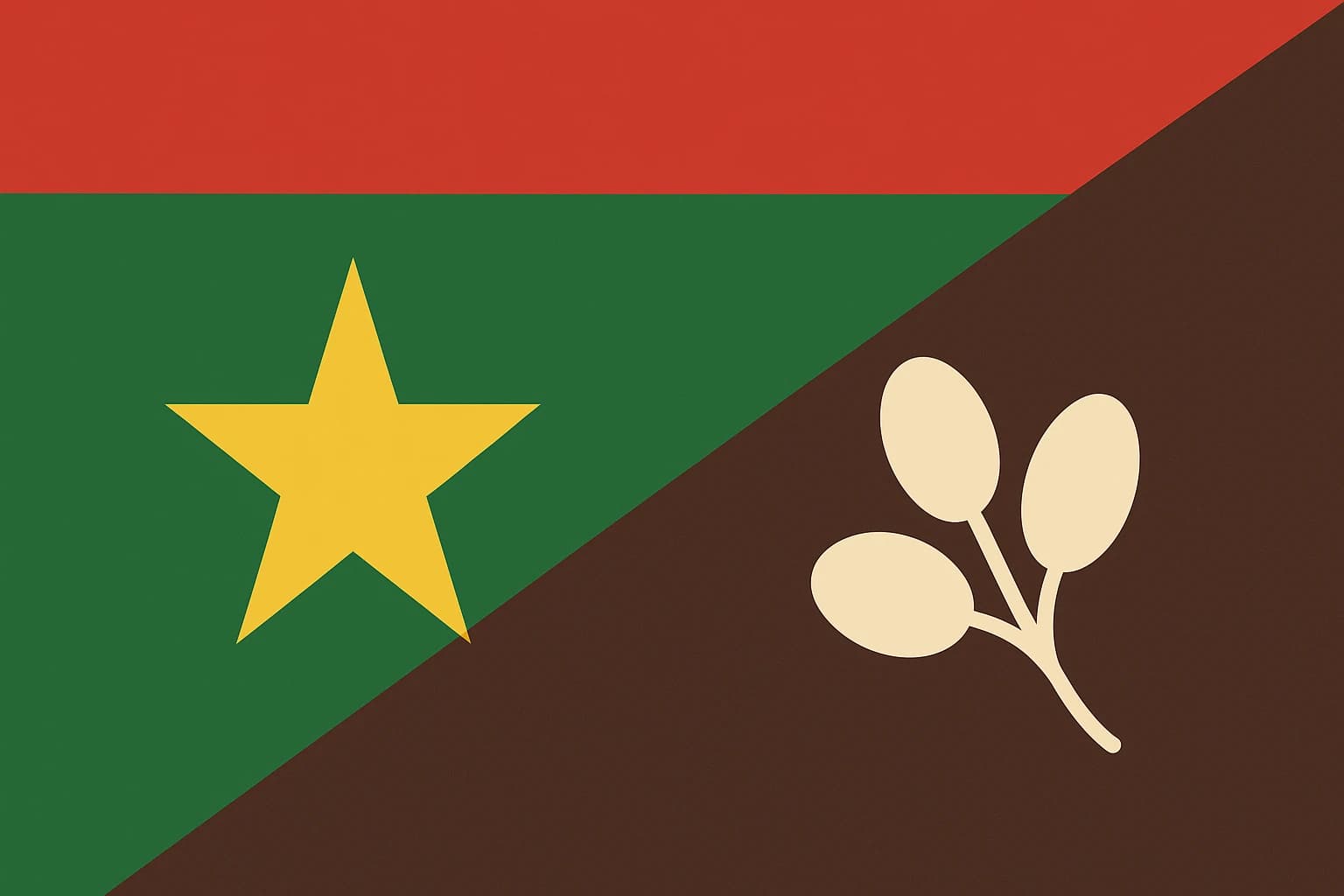
Tucked into the hoist-side green triangle is a nutmeg pod, split open to show the seed and its red mace covering. This is not decorative whimsy; the nutmeg was carried over from the flag of the 1967-74 Associated State, the only element to survive the redesign. When the flag was adopted, Grenada supplied roughly a fifth of the world's nutmeg, second only to Indonesia, and the spice remains central enough to national identity that the country markets itself as the "Isle of Spice." (Hurricane Ivan flattened over ninety percent of the nutmeg trees in 2004, and the industry has been rebuilding ever since.)
Putting the national cash crop directly on the flag places Grenada in a small club of flags with agricultural specifics: Sri Lanka's bo leaves, Belize's mahogany tree, Lebanon's cedar. But a spice is rarer still, and the nutmeg conveniently echoes the flag's palette, its red mace and yellow-brown seed matching the pan-African red, gold, and green of the design.
The colors
The colors follow the symbolic vocabulary shared across much of the post-independence Caribbean and Africa. Red stands for courage, vitality, and the fervor of the people. Gold is for wisdom, warmth, and the sunshine; green for agriculture and the lushness of the island's vegetation. The arrangement in alternating triangles, rather than the usual stripes, gives the flag unusual energy; nothing about it sits still.
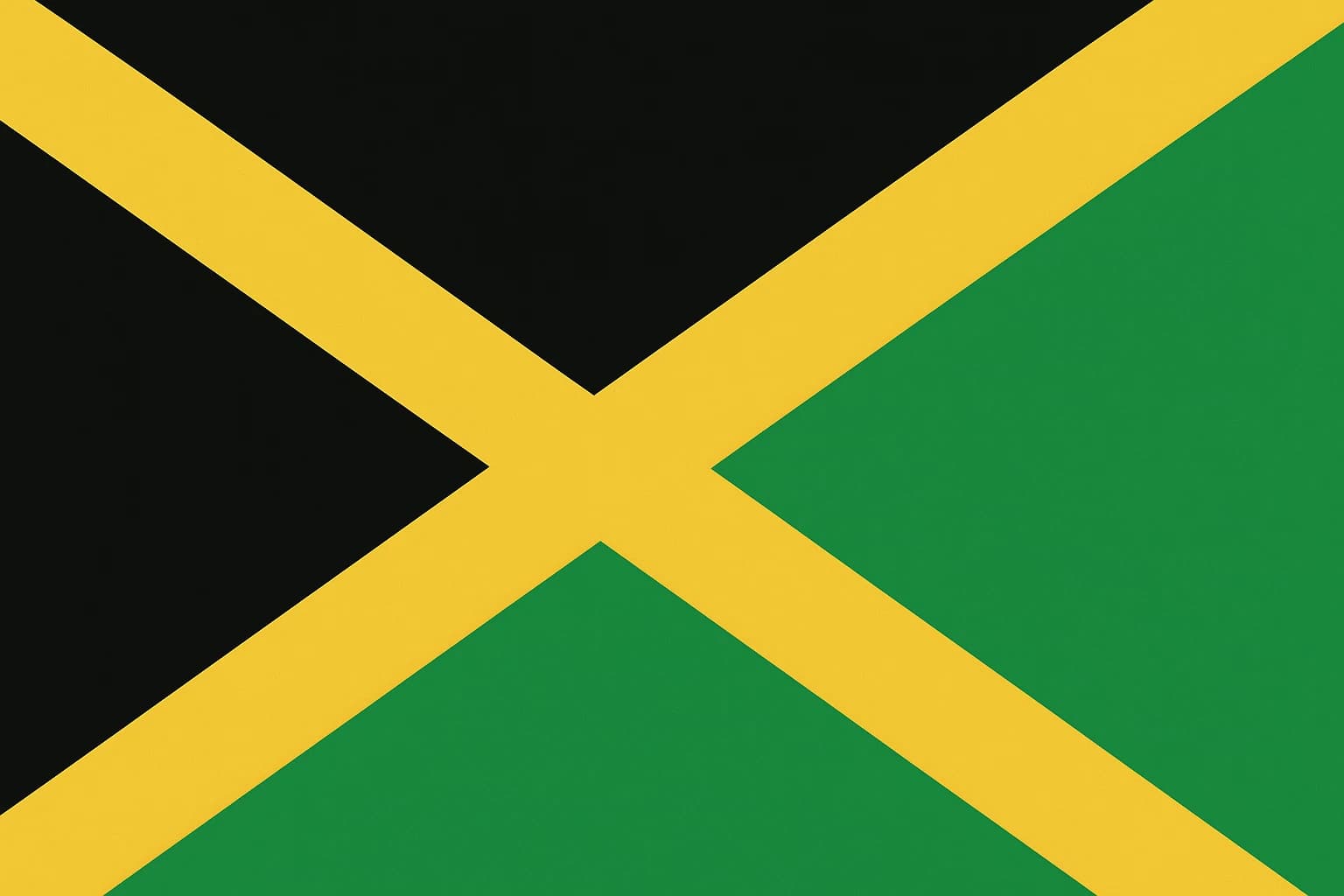
Jamaica's flag, adopted in 1962, is the region's other diagonal composition, in green, gold, and black. But where Jamaica went minimal, Grenada packed the frame: border, triangles, disc, seven stars, and a nutmeg, all in a 3:5 rectangle. (The civil ensign flown by merchant ships stretches the same design to 1:2, and it adapts surprisingly well.)
A flag that survived a revolution
One underappreciated fact about Grenada's flag: it outlived the most turbulent period in the country's modern history without alteration. Through the 1979 revolution that brought Maurice Bishop's People's Revolutionary Government to power, the 1983 crisis and U.S.-led intervention, and the restoration of parliamentary government, the flag never changed. Plenty of states redesign their symbols after upheavals of that scale. Grenada's seven stars kept their places through all of it, which suggests the flag had already stopped belonging to any government and started belonging to the country.
So the short answer, if you came here for it: the six outer stars are Grenada's six parishes, and the central star is either the capital town of Saint George's or the sister islands of Carriacou and Petite Martinique, depending on which reference you trust. The government's own "seven parishes" wording quietly leans toward the sister islands. The nutmeg is exactly what it looks like. And fifty years on, the flag remains what Anthony C. George made it in 1974: the busiest, spiciest, and arguably most self-assured flag in the Caribbean.