In 1865, Paul Bogle led hundreds of Black Jamaicans to the Morant Bay courthouse to protest poverty, injustice, and the stranglehold of the planter class. British colonial forces crushed the rebellion with extraordinary brutality: martial law, over 400 killed, Bogle and George William Gordon executed. A century later, the descendants of those same exploited workers across the Caribbean were designing national flags, and they made a choice their colonial rulers would not have predicted. They put the crops back on.
Grenada placed a nutmeg on its flag. Belize depicted two woodcutters flanking a mahogany tree. Dominica centered a parrot found nowhere else on Earth. These were arguments about economic identity, claims that the wealth extracted from these islands for centuries now belonged to the people who harvested it.
European flags grew out of royal coats of arms and battlefield standards. Caribbean flags came from somewhere else entirely: plantation economies reclaimed by the hands that built them.
Flags born from revolt, not dynasty
European flags emerged from medieval heraldry. Lions, eagles, crosses, all signaling conquest, royal lineage, and religious authority. Caribbean nations had no such tradition to inherit, and no desire to replicate one built on their oppression.
Under colonial rule, Caribbean territories flew British Blue Ensigns defaced with small colonial badges. Those badges often featured Britannia, sailing ships, or generic tropical scenes designed by London bureaucrats with no local input at all.
The Morant Bay Rebellion became a foundational trauma. It demonstrated something the planter class never wanted said aloud: that economic grievance, meaning landlessness and poverty wages on sugar plantations, was inseparable from political identity. You could not separate "who are we?" from "who profits from our labor?"
That connection ran through the independence movements of the 20th century. The wave of Caribbean independence from the 1960s through the 1980s (Jamaica in 1962, Barbados in 1966, Grenada in 1974, Belize in 1981, St. Kitts and Nevis in 1983) produced a burst of flag design. New nations needed symbols that were emphatically not British.
The process itself mattered. Flag design competitions were open to citizens, judged by committees, and debated in parliaments, so the resulting symbols came from the ground up rather than being handed down. When a Grenadian farmer saw a nutmeg on his new flag, he saw his own hands.
Grenada and the nutmeg
Grenada's flag, adopted at independence on February 7, 1974, has a nutmeg on its left hoist. It's the only national flag in the world to depict this spice.
The choice was economic. Grenada was, and remains, the world's second-largest nutmeg producer after Indonesia, and the spice accounts for a significant portion of export revenue. The history runs deeper than the trade numbers, though.
Nutmeg was introduced to Grenada by the British in 1843, cultivated first by enslaved laborers and later by workers paid barely enough to survive. By independence it had become something Grenadians owned and identified with. Putting it on the flag reclaimed the crop from its colonial origins: the thing the empire planted for profit became the thing a free nation chose to represent itself.
The designer, Anthony C. George, a Grenadian, used red (courage), yellow (wisdom and the sun), and green (agriculture and vegetation). The seven stars represent Grenada's seven parishes, and the nutmeg sits in a field of green.
The symbol survived turbulence that would have finished off weaker icons. Maurice Bishop's People's Revolutionary Government kept it after the 1979 revolution. The 1983 U.S. invasion didn't change it. It belonged to the people rather than to any political faction.
Grenada is now marketed internationally as the "Island of Spice," a brand that flows directly from the flag. The nutmeg appears on passports, currency, and tourism campaigns.
Two woodcutters and a mahogany tree
Belize's flag, adopted at independence from Britain on September 21, 1981, is arguably the most narratively complex national flag in the world.
Its coat of arms, centered on the flag, shows two men, one mestizo and one Creole, flanking a mahogany tree. They hold logging tools: a paddle and a beating axe. Beneath them runs the motto "Sub Umbra Floreo," which translates to "Under the Shade I Flourish."
The mahogany tree is not decorative. The entire colonial economy of British Honduras was built on mahogany logging. Baymen (British settlers) first arrived in the 17th century to harvest logwood and later mahogany, and the territory's identity was inseparable from its timber trade. The 1798 Battle of St. George's Caye, where Baymen and their enslaved workers repelled a Spanish fleet, remains the founding national myth.
The two woodcutters represent Belize's multiethnic identity, a deliberate gesture in a nation with Creole, Mestizo, Maya, Garifuna, Mennonite, and other communities. Their tools reference the manual labor that built the colony. The flag honors workers rather than owners, and that distinction matters.
Belize is one of very few countries to prominently depict human figures on its flag; the British Virgin Islands and Malta are among the others. That makes it a narrative image rather than an abstract symbol.
One more detail: the fifty leaves in the wreath surrounding the coat of arms reference 1950, the year the anti-colonial People's United Party was founded.
Beyond crops: sea, soil, and endemic species
Agricultural symbols are only part of the story. The rest involves the sea, the forests, and the creatures found nowhere else.
Anguilla's flag has three orange dolphins arranged in a circle on a white background with a blue ensign base. They represent friendship, wisdom, and strength, and they also represent the island's relationship with the sea that sustains its fishing economy.
Dominica's flag includes the Sisserou parrot (Amazona imperialis), found nowhere else on Earth. Putting an endemic species on your flag is an assertion of ecological uniqueness so specific that no other nation could copy it.
The parrot is encircled by ten green stars representing the island's ten parishes, set against a cross of yellow, black, and white stripes symbolizing the Trinitarian faith and the island's peoples.
St. Vincent and the Grenadines' flag has three green diamonds in a V-pattern, earning it the nickname "the Gems." The green represents vegetation and volcanic fertility, a direct contrast to the barren colonial badge it replaced.
Then there is Haiti. The oldest independent Black republic's banner, first raised in 1804, set the template for everything that followed. Its original design reportedly tore the white from the French tricolor. The coat of arms has a palm tree topped with a liberty cap, surrounded by cannons and anchors.
Where European nations used animals as heraldic abstractions, the English lion or the French rooster, Caribbean nations used real, specific, local species and resources. Things you could touch, harvest, eat, and sell.
What Caribbean flags deliberately left out
Understanding what's on these flags means looking at what was excluded.
Colonial badges frequently featured Britannia, the Union Jack canton, ships representing imperial trade, and generic tropical paradise imagery designed for a European gaze. All of it was systematically rejected.
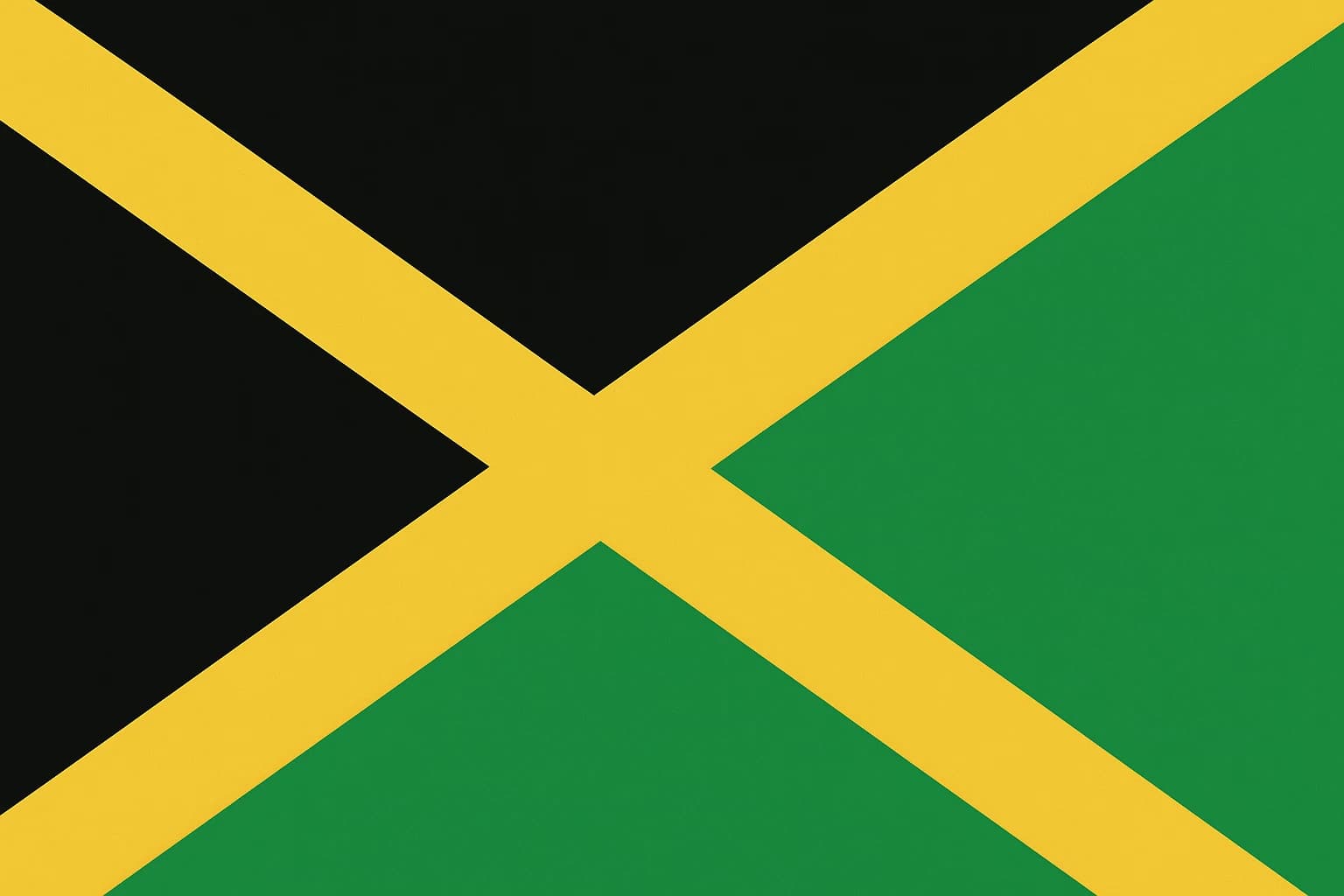
Jamaica's flag, adopted in 1962, is instructive for what it doesn't show. No crops, no coat of arms, no figurative imagery at all. Its black, green, and gold saltire was a radical abstraction, the only flag adopted that year without a representational emblem. The message was pointed: Jamaica's identity was not reducible to any single commodity, and the nation refused to be defined as a sugar island.
Trinidad and Tobago's flag, also from 1962 and designed by Carlisle Chang, made a similar choice. A black diagonal stripe edged in white on a red field. The design committee explicitly rejected proposals featuring cocoa pods, oil derricks, and steel pans, arguing that the nation was more than its exports.
So Caribbean vexillology runs across a spectrum. Grenada put the crop on the flag and reclaimed it. Jamaica wiped the slate clean. Each nation answered the same question differently: how do you symbolize yourself when the old symbols were tools of your oppression?
Even the colors carry agricultural resonance. Green appears on nearly every Caribbean flag, almost always officially defined as representing vegetation, agriculture, or the fertility of the land.
What the symbols do now
Grenada's nutmeg has become a model for agricultural nation-branding. The country's Nutmeg Processing Cooperative, its tourism campaigns, and its diplomatic identity all lean on the flag symbol.
Then Hurricane Ivan hit in 2004. It destroyed approximately 90% of Grenada's nutmeg trees, which created a crisis of national identity alongside the economic devastation. Rebuilding the industry became an act of patriotic restoration as much as an economic one.
Belize's mahogany faces comparable pressure. Illegal logging and deforestation threaten the species that anchors the national symbol, and environmental campaigns have invoked the flag directly, arguing that losing the mahogany means losing part of the nation.
In diaspora communities across New York, London, and Toronto, Caribbean flags with their agricultural symbols do double duty. A Grenadian nutmeg flag at Notting Hill Carnival or on a Brooklyn storefront communicates nationality, but it also communicates a specific relationship to land, labor, and history.
Contemporary Caribbean designers and artists keep reinterpreting these symbols in digital art, fashion, and album covers, updating the visual language for generations who may never have harvested a nutmeg or felled a mahogany tree.
The agricultural symbols on Caribbean flags are not quaint illustrations of tropical life. From Grenada's nutmeg to Belize's woodcutters to Dominica's Sisserou parrot, they encode the same claim: the wealth of these islands belongs to the people who work them, not the empires that extracted from them. They draw a line from the Morant Bay courthouse in 1865 to the independence ceremonies of the following century.