The Flag of Grenada
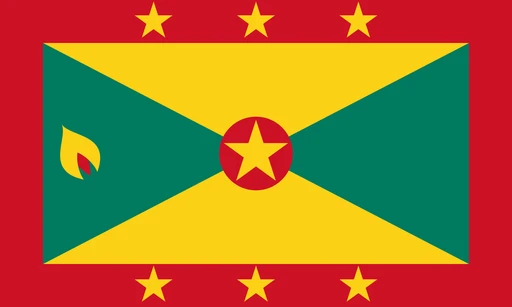
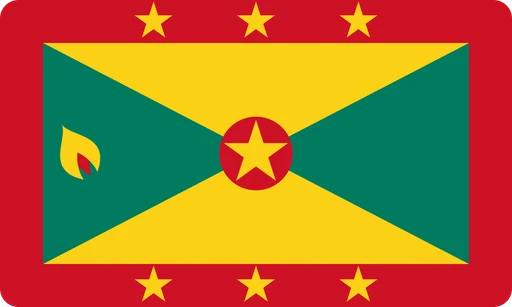
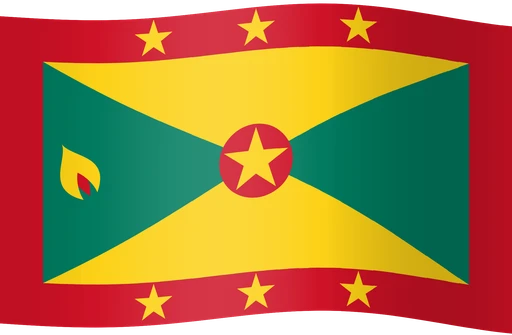
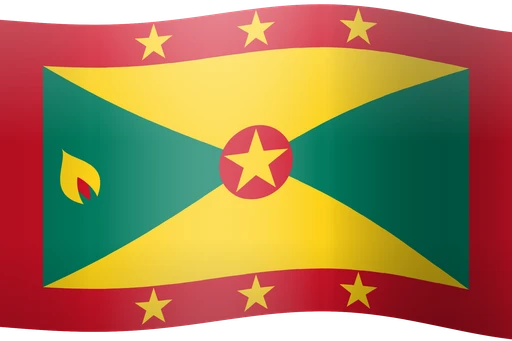
The flag of Grenada has a red border carrying six gold stars, three above and three below. Inside the border the field is divided diagonally into four triangles, yellow at the top and bottom and green at the hoist and fly, with a seventh gold star at the center. A nutmeg pod sits on the hoist-side green triangle, one of Grenada's most important exports. Green stands for agriculture, yellow for sunshine, and red for the courage of the people. The six border stars stand for the six parishes.
Grenada's is the only flag of a sovereign state to carry a nutmeg. That single detail does most of the work: it names the crop that shaped the island's colonial history, its economy, and the way Grenadians describe themselves. Adopted at independence in 1974, the flag is a gold, red, and green composition that tells you where it's from the moment you see it.
The nutmeg
Grenada is nicknamed "The Spice Isle." At its peak the island supplied roughly one-third of the world's nutmeg, a remarkable figure for a country smaller than most cities. The nutmeg on the hoist-side green triangle is a stylized cross-section of the fruit, showing the red mace wrapped around the dark seed.
No other sovereign state's flag carries a specific crop in this illustrated way. The Dutch colonial spice trade and the later British colonial economy were both built on nutmeg cultivation here, so the spice on the flag is a reckoning with that history as well as a source of pride.
The symbol has also proved durable. The New JEWEL Movement years and the 1983 U.S.-led invasion, Operation Urgent Fury, left it untouched. The nutmeg appears on Grenada's coat of arms too, which makes it the defining national symbol across all official heraldry.
Independence, 1974
Grenada gained independence from Britain on February 7, 1974, under Prime Minister Eric Gairy, and adopted the flag the same day. Anthony C. George, a Grenadian artist, won the national design competition, so the flag came from a public process rather than being handed down.
Before independence Grenada flew the British Blue Ensign with a colonial badge, a design it shared with many British Caribbean territories and which said nothing about the island. The switch was part of a wider wave of Caribbean independence through the 1960s and 1970s, shaped by Pan-African and Black Power thinking that shows up in color choices across the region.
Between 1979 and 1983 Grenada was governed by the People's Revolutionary Government. The flag stayed. Then came the counter-coup, the U.S. invasion, and a return to parliamentary democracy, and it stayed through all of that too.
Most countries that go through a coup, a counter-coup, and a foreign military intervention inside their first decade redesign their national symbols at least once. Grenada has flown George's design continuously for over fifty years.
Gold, green, and red
The layout is unconventional. A red border frames a central rectangle cut diagonally into four triangles: gold at top and bottom, green at left and right. It avoids the simple tricolor format most nations settled on.
Gold is for sunshine and the warmth of Grenadians, and also for agricultural wealth. Green is for the vegetation covering the island, from rainforest to spice plantations. Red is for courage and energy, and carries the resonance of Pan-African and Caribbean liberation movements.
The diagonal division gives the design a sense of movement that horizontal or vertical stripes cannot. The eye follows the lines outward from the center. Red, gold, and green are shared with several other Caribbean and African nations, which places a very small island inside a much larger political tradition.
The seven stars
The red border carries six gold five-pointed stars, three above and three below the central rectangle, and a seventh star sits at the center of the flag.
The six border stars are Grenada's six parishes on the main island: Saint Andrew, Saint David, Saint George, Saint John, Saint Mark, and Saint Patrick. The central star is Carriacou and Petite Martinique, the dependency islands. Placing them at the middle of the flag rather than the frame gives them equal standing with the parishes.
Using stars for administrative divisions is a common convention, seen in flags from Australia to the United States, but Grenada's arrangement of them around a border gives the design a wreath-like quality. The stars are also read more loosely as hope and unity.
Protocol and everyday use
The civil ensign, used by merchant and civilian vessels, adapts the flag for maritime use following conventions established after independence. On land, the coat of arms, which features the nutmeg prominently alongside a lion, a crescent, and other elements, appears on official government documents and on the Governor-General's flag.
Protocol requires the flag on all government buildings, and it is a fixture at national celebrations, especially Independence Day on February 7 and Emancipation Day. During Spicemas, Grenada's Carnival, held each August, it appears alongside the costuming rather than apart from it.
Beyond the island the flag turns up on tourism material worldwide and is now inseparable from the "Spice Isle" branding Grenada uses abroad. Official guidance puts the proportions at roughly 1:2, though the colors get reproduced with minor variations across official and commercial contexts. The design is distinctive enough to survive the inconsistency.
Grenada among its Caribbean neighbors
Grenada's red, gold, and green connects it visually to Ethiopia, the main source of Pan-African color schemes, and to several Caribbean and African neighbors.
The diagonal-triangle layout is what sets it apart. Trinidad and Tobago's diagonal black stripe and Guyana's Golden Arrowhead are the nearest comparisons, all of them departures from the horizontal and vertical tricolors that dominate the region. Unlike Barbados, Saint Lucia, and Saint Vincent, whose flags use blue for the sea, Grenada leaves blue out entirely and puts land, people, and agriculture first.
The nutmeg puts Grenada in a small group of flags carrying literal national symbols. Cyprus has the outline of the island. Mozambique has an AK-47.
Vexillologists often cite Grenada's flag as a post-colonial design that came out genuinely original rather than recombining stock symbols or borrowing a template.
References
[1] Government of Grenada, Official Government Website. National symbols including the flag and coat of arms. (https://www.gov.gd)
[2] Flag Institute (UK). Vexillological analysis of the Flag of Grenada, including design specifications and history. (https://www.flaginstitute.org)
[3] FOTW (Flags of the World). Detailed variant analysis, historical flag records, and contributor scholarship on Grenada's flag. (https://www.crwflags.com/fotw)
[4] Brizan, George I. Grenada: Island of Conflict (1984). Historical context for independence-era Grenada and the political atmosphere surrounding the flag's adoption.
[5] Grenada National Museum, St. George's. Primary source materials on independence, including flag design competition records and Anthony C. George's original submission.
[6] CIA World Factbook, "Grenada" entry. Standard reference for flag description and national symbols.
[7] Smith, Whitney. Flags Through the Ages and Across the World (1975). Foundational vexillological text providing comparative analysis of post-colonial Caribbean flag design.
[8] Payne, Anthony & Sutton, Paul (eds.). Grenada: Revolution and Invasion (1984). Scholarly analysis of the 1979-1983 political period during which the flag's continuity was tested.
[9] Caribbean Community (CARICOM) Secretariat. Regional context for Grenada's post-independence identity and flag use in multilateral settings. (https://www.caricom.org)
Common questions
- Why does the Grenada flag feature a nutmeg?
- The nutmeg marks Grenada as the "Isle of Spice." The crop has been central to the island's economy, and Grenada is the only sovereign state to put a specific spice on its flag.
- What do the colors of the Grenada flag represent?
- Red stands for courage and energy, yellow for wisdom and warmth, and green for fertility and the island's agricultural land.
Featured in these articles
- Seven Stars, Six Parishes, One Argument: What the Stars on Grenada's Flag Actually Mean
- Borrowed Glory: How Ethiopia's Colors Became the Grammar of Black Liberation
- The Parrot, the Sisserou, and the Rose: How Dominica Put a Rare Bird on Its Flag, and What It Cost
- The Frigatebird of Kiribati: How a Tiny Pacific Nation Put Navigation, Mythology, and Climate Change on a Single Flag
Download this flag
Free in 12 styles, from 32px icons up to 2000px, as SVG, PNG, WebP and JPG.