In 1983, Mozambique adopted a national flag featuring something no other sovereign nation had ever permanently displayed: an AK-47 assault rifle, complete with attached bayonet, crossed over an open book and a hoe. It wasn't a mistake. It wasn't temporary. Three decades later, the rifle is still there, on every government building, every embassy, every passport.
Most nations sanitize their founding violence into abstraction. Red stripes that "symbolize blood shed for freedom." Stars that represent "unity." Colors borrowed from pan-regional movements that soften the specifics of struggle into generality. But a handful of countries refused that sanitization. They put the weapons themselves on the flag, the spears, the shields, the rifles, the machetes, and dared the world to look.
That group is small, and the countries in it are not obviously more violent in origin than the neighbors who chose abstraction. What separates them is worth working out, as is what happens to a country whose permanent visual identity is inseparable from the instruments of its own liberation.
The unwritten rule of flag design, and the countries that broke it
Modern vexillology (the study of flags, for the uninitiated) follows a surprisingly rigid grammar. Most post-colonial flags rely on stripes, stars, and pan-regional color palettes. Pan-African green-yellow-red. Pan-Arab red-white-black-green. These palettes encode history through abstraction rather than depiction. They gesture toward shared struggle without showing the struggle itself.
This convention is a political choice. Abstraction allows a flag to mean different things to different citizens. It smooths over internal divisions. France's tricolor doesn't depict the guillotine. The U.S. flag doesn't show a musket.
But then there are the exceptions. A small club of nations that looked at the blank canvas of a new flag and decided abstraction wasn't enough.
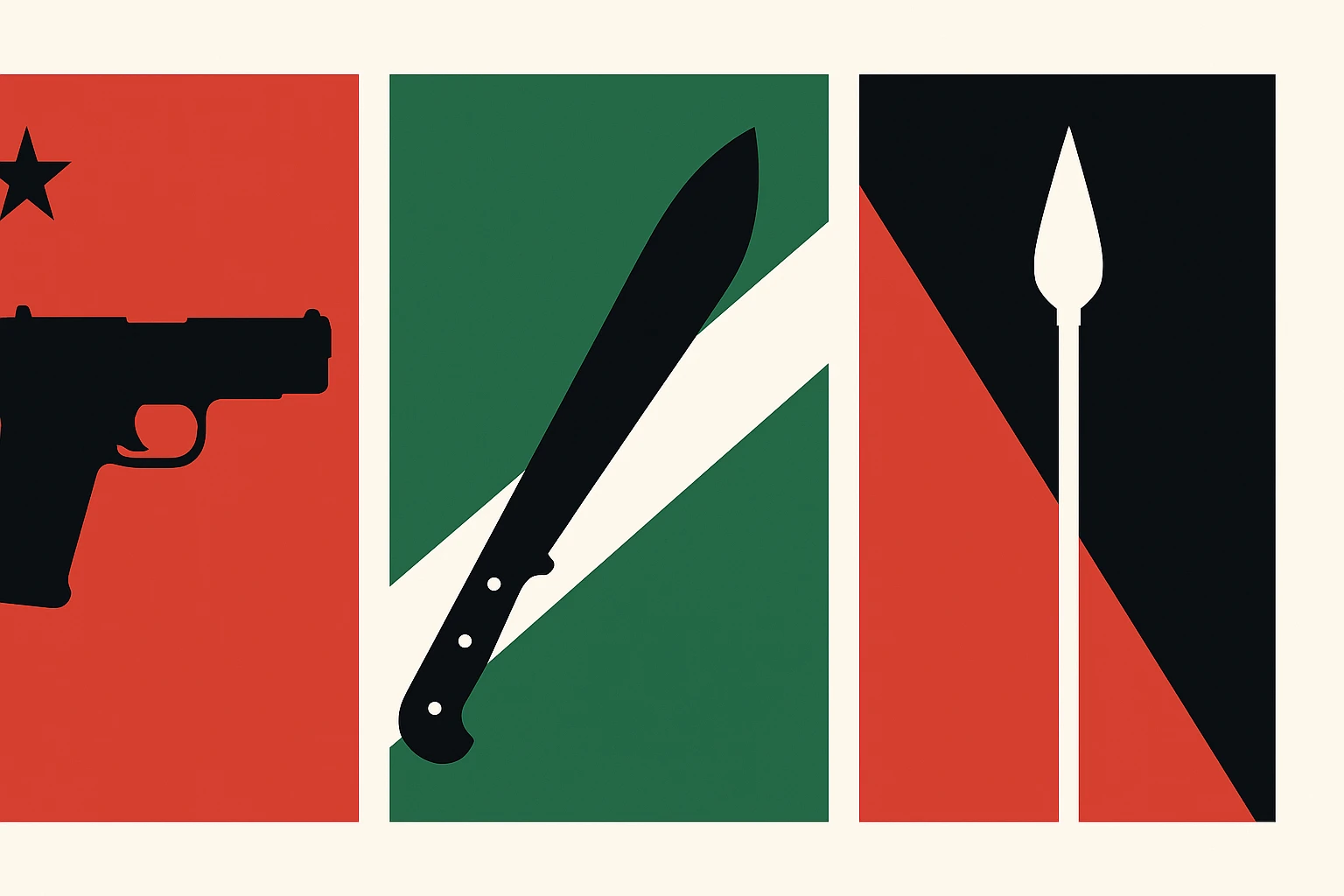
Mozambique put an AK-47, a hoe, and a book on its flag. Kenya placed a Maasai shield and crossed spears at the center of theirs. Zimbabwe perched the ancient Zimbabwe Bird above a red five-pointed star. São Tomé and Príncipe marked their two islands with black stars set against a pan-African palette and a red triangle symbolizing the fight for independence.
What ties them together is the same pair of questions. What does it mean to weave explicit symbols of armed resistance into a permanent visual identity, and why did these particular countries feel the need when others with equally violent histories did not?
Mozambique's AK-47: the most controversial emblem on any flag
Mozambique's flag derives from the banner of FRELIMO (Frente de Libertação de Moçambique), the Marxist-Leninist liberation movement that fought Portuguese colonial rule from 1964 to 1974. The symbols were deliberate and specific. The AK-47 represented armed resistance. The hoe represented agriculture and the peasantry. The open book represented education. Three pillars of the new nation, laid out in primary colors for anyone to read.
The choice of the AK-47 wasn't random, either. Soviet and Chinese weapons were supplied to FRELIMO fighters throughout the liberation war. The Kalashnikov was both a literal tool of freedom and a symbol of Cold War-era solidarity with socialist states. The rifle on the flag served double duty: a thank-you note to Moscow and Beijing, and a declaration of ideological allegiance, rolled into one.
The flag has been argued about ever since.
In 2005, Mozambique's ruling party proposed a new design that would remove the AK-47, replacing it with something more peaceful. Parliament rejected the proposal. Opponents argued the rifle was inseparable from national identity. A similar debate resurfaced in 2019, with the same result.
And here's the paradox nobody planned for. Mozambique has been ravaged by civil war (1977 to 1992) and an ongoing Islamist insurgency in Cabo Delgado since 2017. The AK-47 on the flag was meant to memorialize liberation. But it now also reads as an unintended symbol of the country's continuing relationship with gun violence, a meaning the original designers never imagined.
Mozambique remains the only UN member state with a modern firearm on its national flag. That fact makes it a perennial subject in vexillology discussions and internet listicles. But the deeper story is about a nation arguing with itself over whether revolutionary iconography has an expiration date.
Spears, shields, and pre-colonial warriors: Kenya's different kind of weapon
Kenya's flag was adopted at independence on December 12, 1963. It features a Maasai shield and two crossed spears in the center, set against horizontal stripes of black (the people), red (blood shed in the struggle), and green (natural wealth), separated by narrow white bands representing peace.
The contrast with Mozambique is striking. Kenya's weapons are pre-colonial and traditional rather than modern and industrial. The Maasai shield and spears evoke an indigenous warrior heritage rather than a specific 20th-century armed movement. The emotional resonance is different. Pride in deep cultural identity rather than commemoration of revolutionary guerrilla warfare.
What makes this choice even more interesting is what the flag's designers left out. Kenya's path to independence involved the Mau Mau Uprising (1952 to 1960), a brutal colonial war in which British forces detained over a million Kikuyu in concentration camps. The violence was staggering. And yet the flag's creators chose Maasai warrior iconography over any depiction of the Mau Mau struggle itself.
That was deliberate. Rooting nationhood in a timeless African warrior identity rather than anti-colonial trauma served a specific purpose. The Maasai are one of many ethnic groups in Kenya. By choosing their symbols, the flag reached for a pan-Kenyan warrior ethos that could transcend the Kikuyu-centric narrative of Mau Mau. It was a stitching tool, designed to hold a multi-ethnic nation together under one visual identity.
The weapons on Kenya's flag say that the country has always had warriors. Mozambique's say that it acquired them out of necessity. Both claims are true, and they are not the same claim.
Zimbabwe's coded violence: the bird, the star, and what lies beneath
Zimbabwe's flag, adopted in 1980 at independence, features seven horizontal stripes (green, yellow, red, black, red, yellow, green), with a white triangle at the hoist bearing the Zimbabwe Bird perched above a red five-pointed star.
No guns and no spears, but the absence of obvious weaponry is misleading. This flag is loaded.
The red star explicitly represents socialism and the revolutionary struggle. The Zimbabwe African National Liberation Army fought a guerrilla war against the Rhodesian regime from 1964 to 1979. That star is a direct echo of Marxist-Leninist revolutionary iconography, placed at the flag's most prominent position.
And then there's the bird. The Zimbabwe Bird is a soapstone sculpture from the ruins of Great Zimbabwe, the medieval Shona civilization that flourished centuries before European contact. The Rhodesian regime had used the bird on its own coat of arms, stripping it of African agency and treating it as a curiosity rather than a cultural inheritance. When Zimbabwe's new government placed the bird on their flag, they were taking it back. The bird was a reclamation, an assertion that this civilization belonged to its people, not to its colonizers.
Zimbabwe's flag is less overtly violent than Mozambique's but more ideologically layered. The star tells you who fought. The bird tells you what they fought for.
Under Robert Mugabe and now Emmerson Mnangagwa, the flag's revolutionary symbolism has been co-opted by ZANU-PF as a tool of regime legitimacy rather than collective memory. The liberation narrative has become party property, raising uncomfortable questions about who owns a flag's meaning over time.
Briefly, it's worth noting São Tomé and Príncipe, whose two black stars represent its two islands and the struggle of its people.
Their encoding of resistance operates through geometry and color, the stars, the pan-African palette, the red triangle symbolizing the fight for independence, rather than a single dramatic weapon. Subtler, yes. But the message is there if you know how to read it.
The roads not taken: countries that fought but chose peace on their flags
To understand why these flags are unusual, you need to look at the countries that made different choices under similar circumstances.
Algeria fought one of the bloodiest decolonization wars in history. From 1954 to 1962, over one million people died. But Algeria's flag features green, white, a red crescent and star. Islamic identity rather than revolutionary weaponry.
Vietnam fought colonial and imperial wars for three decades. Their flag is a single yellow star on a red field. Communist ideology distilled to its purest, most abstract form. No depiction of the weapons that won the war.
South Africa emerged from apartheid in 1994 and adopted a flag designed by Frederick Brownell that deliberately avoided any reference to armed struggle. The Y-shaped design (called a pall) symbolizes convergence and unity. A forward-looking choice by a nation that had every justification for revolutionary imagery but chose reconciliation instead.
The pattern is clear. The decision to put weapons on a flag is not simply a function of how violent the independence struggle was. It reflects specific ideological commitments. Marxist-Leninist movements were more likely to embrace martial imagery, because the armed struggle was central to their theory of liberation, not incidental to it. It also reflects the political power of the liberation army at the moment of flag adoption. And it reflects a strategic calculation about whether the new nation needed to project strength or reconciliation.
Mozambique needed to project strength and South Africa needed to project unity. Both choices were rational, and neither was the only option available.
When the revolution becomes the wallpaper
Nobody designing a revolutionary flag plans for the symbol to fade, and yet symbols do.
For Mozambicans born after 1992, the end of the civil war, the AK-47 on the flag is not a memory of liberation. It's the wallpaper. It's the background on their passport, the emblem on their school textbooks. The emotional charge that made the symbol powerful in 1983 has drained away for an entire generation. The rifle is still there. The feeling isn't.
The 2005 and 2019 flag debates in Mozambique expose this tension with precision. Older generations and FRELIMO loyalists see the rifle as sacred, a non-negotiable monument to sacrifice. Younger Mozambicans and opposition parties see it as an anachronism, or worse, a partisan symbol masquerading as a national one.
You see this pattern elsewhere. Think about the debate over Confederate imagery in the United States, or the hammer and sickle in post-Soviet states. Martial and revolutionary symbols on flags become battlegrounds for competing narratives about what a nation is and who gets to define it.
The deeper question is uncomfortable but necessary. Is it possible for a flag depicting a weapon to transition from a symbol of liberation to a symbol of peace? Or does the image always carry a latent threat, a reminder that the state was born in violence and retains the capacity for it?
This is not abstract philosophy. In Cabo Delgado province, where an Islamist insurgency has displaced nearly a million people, the AK-47 on Mozambique's flag takes on a grim double meaning. The weapon that once represented freedom from Portuguese colonialism now also mirrors the ongoing violence tearing the country apart. The 1983 designers could not have foreseen this. But symbols don't care about the intentions of their creators.
The flags that show their weapons
Mozambique, Kenya, Zimbabwe, and São Tomé and Príncipe form a minority tradition in modern vexillology: nations that declined to abstract their violent origins into palatable geometry. Their reasons were not the same. Mozambique honored a Marxist liberation army, Kenya invoked a pre-colonial warrior identity, Zimbabwe reclaimed a stolen cultural symbol and set it above a revolutionary star, and São Tomé and Príncipe marked its islands' struggle through stars and color.
What they share is a refusal to hide the thing most national flags are designed to conceal, which is that every nation-state is at some level a product of organized violence. Showing the weapon does not make a flag more honest than hiding it, but it does make the bargain harder to ignore. Mozambique, still arguing over whether to take the rifle off, is working out in public how long a symbol of liberation stays one.