Four revolutions, four flags, and in every case the flag arrived before the country did. The American Revolution, the French Revolution, the Latin American wars of independence and the Algerian war of independence each produced a banner that outlasted the fighting and became a national emblem.
Vexillology, the study of flags, is partly the study of that sequence. A flag marks a boundary and declares an allegiance, which is exactly what a movement needs before it has a state to point at.
The American Revolution and the Grand Union Flag
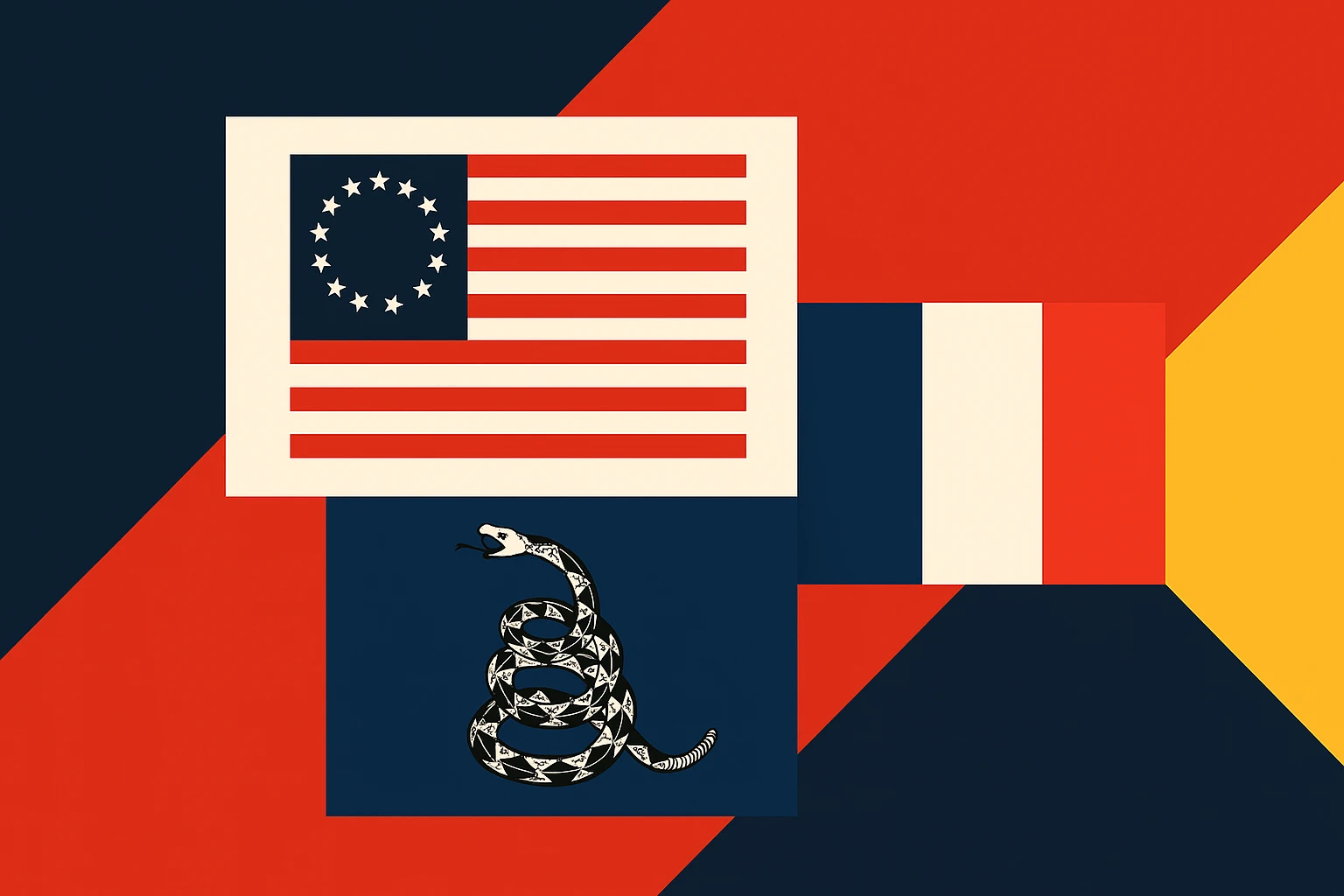
The Grand Union Flag of 1775 combined the British Union Jack with American stripes. It announced that the colonies were acting together, without yet announcing that they were leaving.
The Stars and Stripes replaced it, and the union it stood for was among the states rather than with Britain. Raising it at Fort Ticonderoga made the claim of independence physical in a way that a document could not.
Liberty, equality, fraternity
"Liberté, égalité, fraternité" is the phrase attached to the French tricolor, and its adoption marked the shift from monarchy to popular rule.
The tricolor did not stay French. Other countries took the format, and with it a claim on the same democratic vocabulary.
Latin America: new flags for new states
The Latin American wars of independence created states that needed emblems quickly, for populations whose history was both indigenous and colonial. Argentina, Mexico and Chile all adopted designs in this period that their modern flags descend from.
Each had to work as something new and as something with roots, which is a hard brief for a piece of cloth.
Algeria and the war against colonial rule
Green, white and a red crescent. The Algerian flag was carried through the fight against colonial rule and became the flag of the country that came out of it.
Its influence ran past Algeria's borders into other liberation movements.
Flags as propaganda
Flags work on people, which is why governments use them. At a parade or a protest they produce a sense of common purpose, and in wartime that effect is deliberately manufactured.
What the revolutionary flags left behind
Modern political movements still borrow from these designs, and the borrowing usually carries some of the original argument with it.