The Flag of Dominica
Commonwealth of Dominica
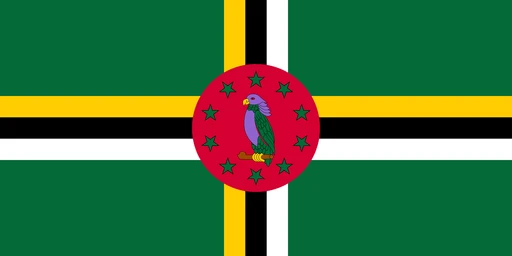
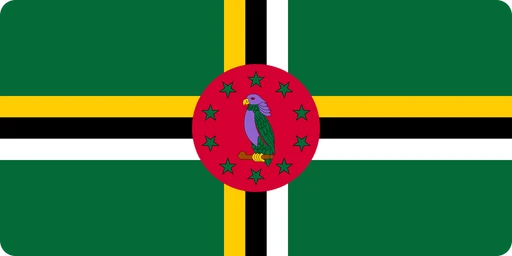
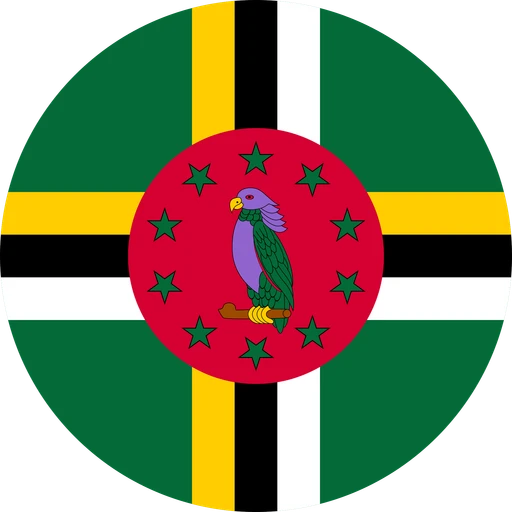
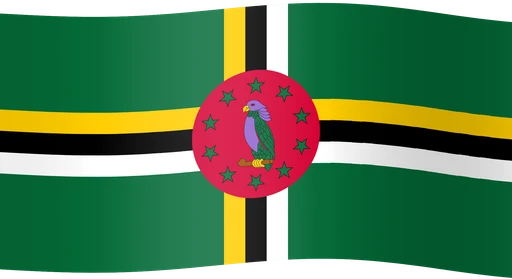
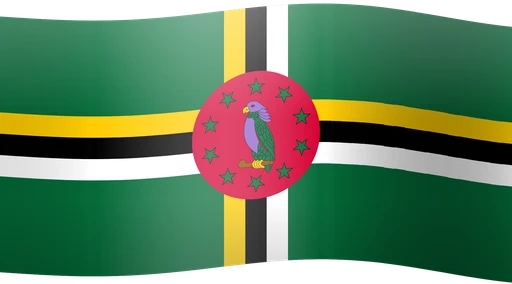
The flag of Dominica has a green field for the vegetation of the island, with a cross that stretches to the edges and divides the flag into four quarters. The cross is made of three colors: yellow, black, and white, for the indigenous people, the fertile soil, and the pure water. In the center of the cross is a red disk bearing a Sisserou Parrot, an endemic species and the national bird, ringed by ten green stars for the island's ten parishes.
Dominica's flag is one of the most distinctive national banners in the world, and the only current sovereign nation flag to feature the color purple. That purple comes from the plumage of the Sisserou parrot (Amazona imperialis), perched right at the flag's center. Adopted on November 3, 1978, the day the island gained independence from Britain, the flag has been through several redesigns while keeping its central image: a parrot encircled by ten green stars on a red disc, set against a background cross of yellow, black, and white stripes over a deep green field. Between them, those elements cover the island's wildlife, its Indigenous population, and the African ancestry of most Dominicans.
The only purple on any national flag
No other country on the planet puts purple on its flag. Dominica does, and it's not an arbitrary choice. The color comes directly from the breast and head feathers of the Sisserou parrot, a large, stocky Amazon parrot found nowhere else on Earth. Endemic to Dominica's mountainous rainforests, particularly the cloud forests around Morne Diablotin, the Sisserou is critically endangered. Estimates put the wild population at fewer than 300 individuals.
Placing this bird at the center of the national flag was a deliberate statement. The Sisserou symbolizes the nation's aspiration to soar to ever-greater heights, but it also grounds the flag in something real and local: a living creature that exists only on this one island. That connection between national pride and conservation has had tangible effects. The parrot's prominence on the flag, on currency, and in tourism materials has helped keep its endangered status in the public eye, both domestically and internationally.
The Sisserou's role as a national emblem didn't begin with independence. It appeared on the coat of arms granted by Britain in 1961, which means there's a thread of continuity running from the colonial era into the post-independence period. When Alwin Bully designed the flag in 1978, he was drawing on an already established symbol and moving it from a colonial grant onto the flag of a sovereign country.
Alwin Bully's design, and its four revisions
The man behind the flag was Alwin Bully, a playwright, visual artist, and cultural activist who would later serve as cultural director at the Organisation of Eastern Caribbean States. Bully designed the flag for Dominica's independence on November 3, 1978, and his core concept has survived every subsequent revision: a green field, a tricolor cross, a red disc bearing the Sisserou surrounded by ten green stars. The bones of the design have never changed. The details, though, have shifted several times.
In the original 1978 version, the parrot faced the hoist (left) side of the flag. A 1981 revision altered both the order of the cross stripes and the parrot's orientation. Further changes came in 1988 and again in 1990, each time refining the depiction of the bird and tweaking the arrangement of the stars. The current version, adopted in November 1990, has the parrot facing the fly (right) side, a deliberate choice meant to suggest a forward-looking nation.
Why so many changes? Mostly a desire to get the parrot right. Putting a real, specific bird on a flag is tricky. Too stylized and it loses its connection to the actual animal, too detailed and nobody can reproduce it consistently. The revisions worked at that problem until the depiction landed somewhere workable.
The cross, the disc, and the ten stars
Start with the green field. It covers most of the flag and it's the first thing you notice. Green represents the island's tropical vegetation and its agriculture. Dominica calls itself the "Nature Isle of the Caribbean," and the flag backs that claim up.
Cutting across the green field is a cross made of three colored bands. Yellow, the outermost, symbolizes the Kalinago (Carib) people, Dominica's Indigenous inhabitants, and the island's sunshine. White, the middle band, stands for the island's rivers and waterfalls, and the purity of the nation's aspirations. Black, the innermost band, honors the African heritage of the majority of Dominicans, descended from enslaved peoples brought to the island during the colonial era. The cross form itself reflects the Christian faith of most of the population and, more broadly, the intersection of the island's different cultural currents.
At the center sits the red disc. Its color symbolizes social justice and the blood shed in the long struggle for independence and equality. And encircling the Sisserou on that disc are ten green stars, each one representing one of Dominica's ten parishes: St. Andrew, St. David, St. George, St. John, St. Joseph, St. Luke, St. Mark, St. Patrick, St. Paul, and St. Peter. Very few national flags encode administrative geography so directly. The stars are arranged in a circle to signify equality among the parishes, a small but pointed democratic gesture.
Kalinago and African heritage in the design
Dominica is one of the few Caribbean islands where the Indigenous Kalinago population has maintained a continuous, recognized presence. The Kalinago Territory, on the island's east coast, remains a self-governing area. That the yellow stripe in the flag explicitly honors the Kalinago is notable. Many Caribbean nations don't directly acknowledge Indigenous heritage in their national symbols at all.
The black stripe carries a different but equally significant weight. Most Dominicans trace their ancestry to enslaved Africans, and the flag doesn't shy away from that history. It places African heritage at the literal center of the cross, acknowledging it as foundational to national identity. Dominica's path to independence was relatively peaceful compared to some Caribbean neighbors, but the red disc still honors the broader regional struggle against colonialism. The flag ends up holding several histories at once, Indigenous, African, European and Christian, without picking one of them to stand for the rest.
Protocol, usage, and the flag in Dominican life
The flag flies at all government buildings, schools, and official functions. It's especially prominent during Independence Day celebrations on November 3 and during Creole Day festivities, when Dominican cultural identity takes center stage. The national coat of arms reinforces the flag's themes: it features the Sisserou flanked by two Kalinago parrots (Amazona arausiaca), another species endemic to the island.
One practical challenge deserves mention. The flag's detailed parrot makes it one of the harder national flags to reproduce accurately, putting it in the company of Belize, Turkmenistan, and the former Afghan flags. Simplified versions inevitably circulate, but the official specification calls for a recognizable, naturalistic Sisserou. Variants exist for the President and certain government officials, typically featuring the flag's elements on different colored backgrounds.
The Sisserou motif shows up everywhere in Dominican life: on currency, in tourism branding, on school uniforms. It's become shorthand for the nation itself.
Among Caribbean flags
Several Eastern Caribbean nations adopted new flags around the same independence era. Grenada, St. Vincent and the Grenadines, and St. Kitts and Nevis all chose designs built around agriculture, African heritage, and Caribbean identity. None of them put a realistic animal at the center of the design the way Dominica did. That choice, and the purple that came with it, leaves Dominica's flag without a real match in the region.
The use of a parrot connects Dominica to a broader tradition of island nations featuring endemic fauna on national symbols. But few do so as centrally or as colorfully. Among vexillologists and flag enthusiasts, Dominica's flag is a perennial favorite, regularly appearing on lists of the world's most unusual or beautiful national banners.
One final note: Dominica's flag is sometimes confused with that of the Dominican Republic, thanks to the similar names. The two flags couldn't be more different. The Dominican Republic's flag features a white cross on red and blue quarters with a central coat of arms. The two countries are separated by hundreds of miles of Caribbean Sea and share no political or cultural history. If the flag has a purple parrot on it, it's Dominica.
References
[1] Government of the Commonwealth of Dominica. Official flag specifications and national symbols documentation.
[2] Znamierowski, Alfred. The World Encyclopedia of Flags. Lorenz Books, 2001.
[3] Honychurch, Lennox. The Dominica Story: A History of the Island. Macmillan Caribbean, 1995.
[4] BirdLife International. Species factsheet: Amazona imperialis (Imperial Amazon). https://www.birdlife.org
[5] Smith, Whitney. Flags Through the Ages and Across the World. McGraw-Hill, 1975 (and subsequent editions covering post-1978 flags).
[6] Flag Institute (UK). Flag registry and protocol reference for the Commonwealth of Dominica.
[7] Caribbean Community (CARICOM) Secretariat. Member state national symbols compendium.
Common questions
- Why is the Sisserou Parrot on Dominica's flag?
- The Sisserou Parrot is on the flag because it lives nowhere else. It is endemic to Dominica's mountain rainforests, and putting it at the center of the flag ties the national emblem to the island's own wildlife.
- What do the stripes on Dominica's flag mean?
- The stripes symbolize Dominica's African roots (black), the purity of its rivers (white), and its sunshine and agriculture (yellow).
- Why is there a parrot on the Dominica flag?
- That's the Sisserou parrot (Amazona imperialis), a critically endangered bird that only exists in Dominica's mountain rainforests. It was picked as the national emblem to reflect the island's one-of-a-kind biodiversity and its goal to "soar to greater heights." The Sisserou was already on Dominica's coat of arms before independence, so putting it on the 1978 flag was a no-brainer.
- Is Dominica the only country with purple on its flag?
- Yep! Dominica is the only sovereign nation in the world with purple on its national flag. The purple comes from the Sisserou parrot's plumage in the center of the flag. It's a pretty unique detail, and flag enthusiasts love it for exactly that reason.
- What do the ten stars on the Dominica flag represent?
- Each of the ten green stars around the Sisserou parrot represents one of Dominica's ten parishes: St. Andrew, St. David, St. George, St. John, St. Joseph, St. Luke, St. Mark, St. Patrick, St. Paul, and St. Peter. They're arranged in a circle to show equality among them.
- What do the colors on the Dominica flag mean?
- The green field represents the island's lush vegetation. The cross has three colored bands: yellow for the Indigenous Kalinago people and sunshine, white for rivers and waterfalls, and black for the African heritage of most Dominicans. The red disc in the center represents social justice and the fight for independence. And the purple on the parrot? That's just the Sisserou's actual coloring.
- Is the Dominica flag the same as the Dominican Republic flag?
- Nope, totally different flags from totally different countries, separated by hundreds of miles of Caribbean Sea. Dominica's flag has a green background with a parrot on a red disc. The Dominican Republic's flag has a white cross on red and blue quarters with a coat of arms. Easy rule of thumb: if there's a purple parrot, it's Dominica.
Featured in these articles
- The Parrot, the Sisserou, and the Rose: How Dominica Put a Rare Bird on Its Flag, and What It Cost
- The Broken Trident: How Barbados Snapped a Colonial Symbol in Half and Made It a Declaration of Independence
- Nutmeg, Mahogany, and Defiance: How Caribbean Nations Turned Plantation Crops into Flags of Liberation
- The Dragon on the Flag of Bhutan and Wales: Two Ancient Creatures, Two Completely Different Meanings
Download this flag
Free in 12 styles, from 32px icons up to 2000px, as SVG, PNG, WebP and JPG.