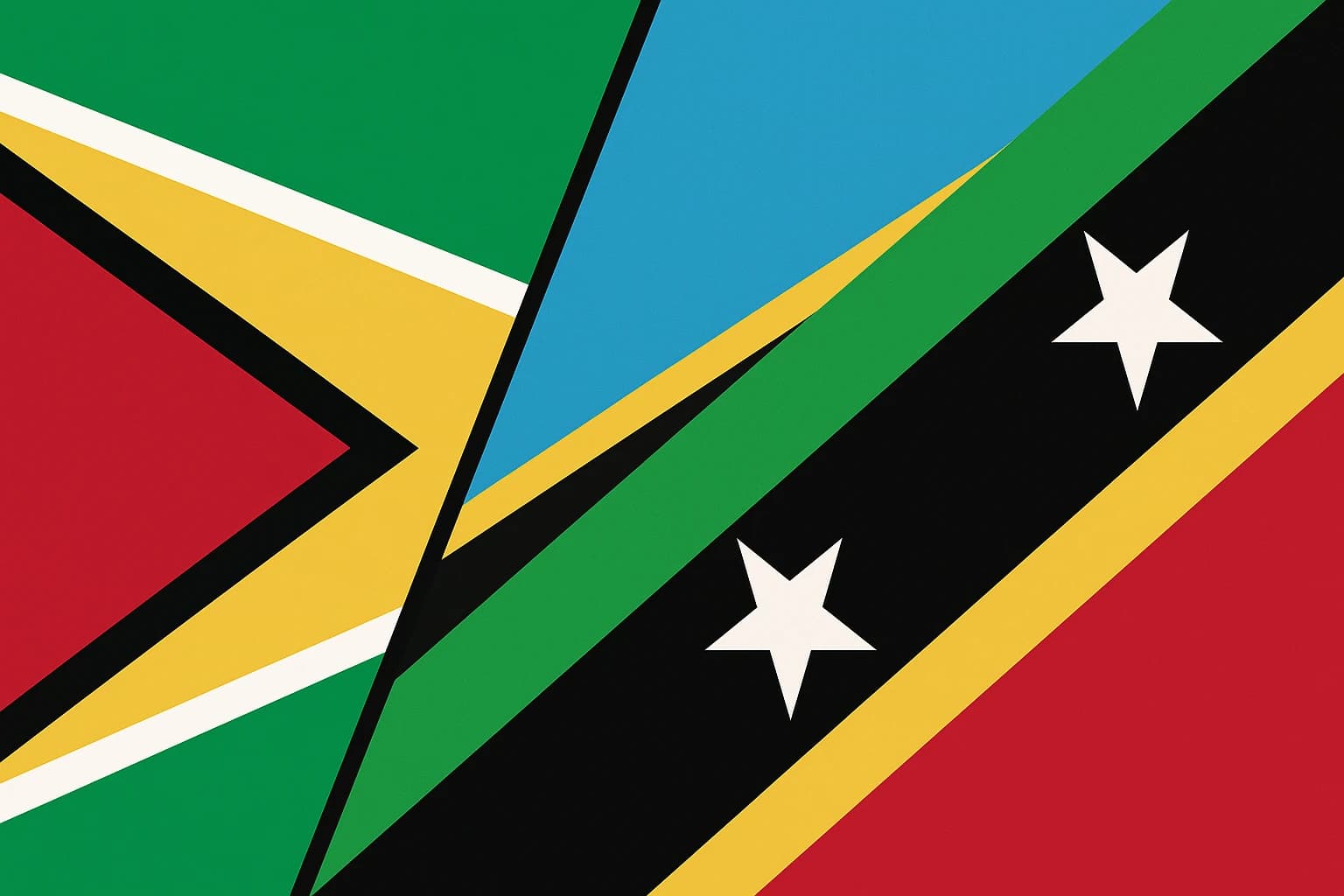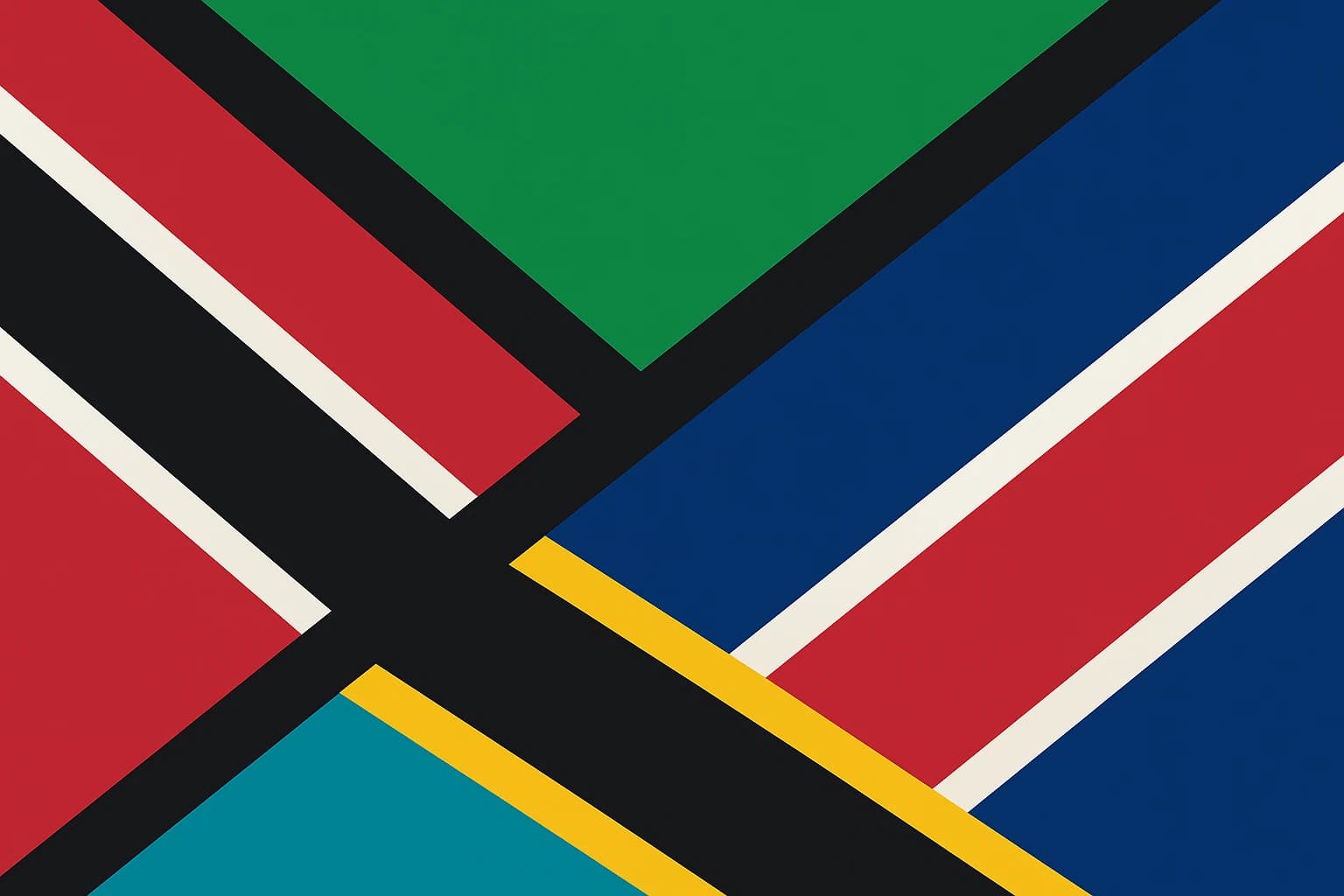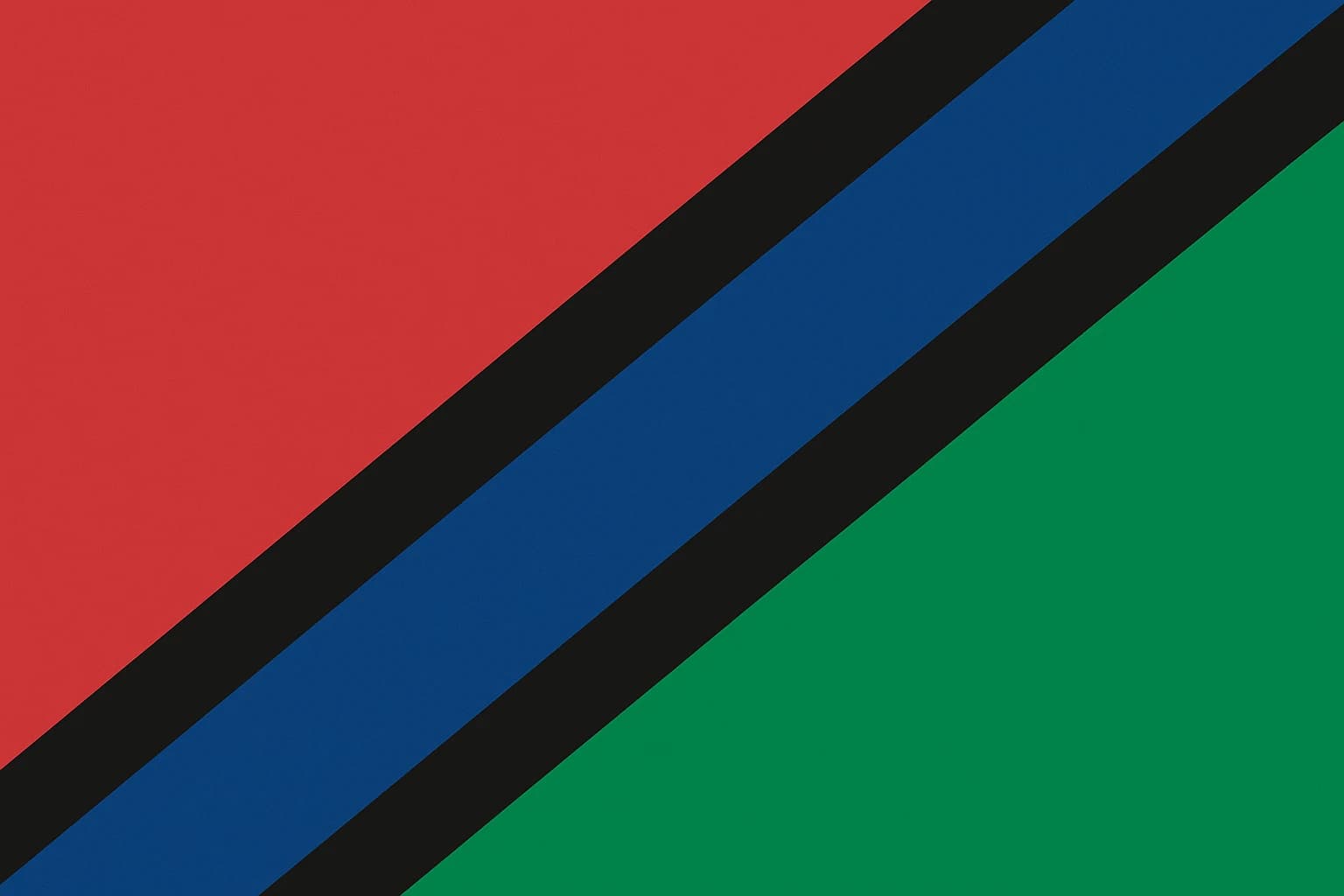
Picture a national flag. Odds are you imagined horizontal or vertical stripes, because that is the default. Of the 193 UN member states, the overwhelming majority use horizontal bands. France's vertical tricolor is the famous exception, and even that sticks to straight, axis-aligned lines.
A small subset went another way entirely. Trinidad and Tobago, Namibia, Tanzania, Guyana, the Solomon Islands, and the Seychelles all cut their flags on the bias, slashing lines from corner to corner or fanning them out from a single point. Diagonal composition in flag design is almost always deliberate: a visual refusal to fit into the geometric conventions European colonial powers left behind.
Why horizontals and verticals dominate
Flags have to work at a distance, in motion, on a pole, in wind. That is the central problem of vexillology, and horizontal and vertical stripes solve it with brutal efficiency. They are simple to manufacture, easy to identify, and they scale from postage stamps to stadium banners.
The template goes back to the Dutch Prince's Flag of the 1570s and the French Tricolore of 1794. Those two designs spread globally through colonialism and revolution, and most nations adopted the resulting grammar without much argument. When African and Caribbean nations became independent in the mid-twentieth century, most reached for the horizontal triband. New colors, new meanings, same geometry.
There is a logic to it. Horizontal stripes suggest stability, echoing the horizon, implying social layers arranged in order from top to bottom. Vertical stripes suggest equality among groups standing side by side rather than stacked. Both are legible and time-tested.
Which raises the question of what it means to break the grid on purpose. A diagonal is unstable by nature. It grabs the eye in a way the other two do not, and a handful of nations chose it for exactly that reason.
Trinidad and Tobago: the black stripe that changed everything
Trinidad and Tobago became independent from Britain on August 31, 1962, and needed a flag. The Independence Committee oversaw the design process, and Carlisle Chang, a prominent Trinidadian artist, is often credited as a key influence on the result.
What came out was a red field bisected by a black diagonal stripe edged in white, running from the upper hoist to the lower fly.
Put it beside any Caribbean neighbor and the difference is immediate. Jamaica uses a diagonal saltire, an X shape, which is unusual in its own right, but the single slash is starker and more modern.
The official symbolism is tidy. Red for vitality, warmth, and the courage of the people. Black for dedication, strength, and the wealth of the land. White for the sea, purity, and equality. The geometry carries its own message on top of that, creating a sense of movement no horizontal triband can reproduce. Dividing the field asymmetrically makes the whole thing feel restless. Trinidad and Tobago was not picking new colors for an old format. It was discarding the format.
The flag has not changed since 1962, and over sixty years later it still looks new. It ranks consistently among the most distinctive flags in the Americas, and no redesign has ever been needed, because the original was confident enough to age.
Namibia and Tanzania: diagonal division as a pan-African statement
Two African flags share the same geometric instinct.
Namibia's was adopted on March 21, 1990, the day of independence from South African administration. A diagonal band runs from the lower hoist to the upper fly, dividing the flag into two triangles, blue and white above, green and red below, with a gold sun in the upper-left corner.
The design came out of a national competition, and the committee deliberately avoided anything resembling the flag of a single political party. That mattered. SWAPO had led the independence movement, but the flag had to belong to all Namibians, and the diagonal was a structure no faction had already claimed.
Tanzania's flag, adopted in 1964 when Tanganyika and Zanzibar merged, does something comparable. A black diagonal stripe bordered in gold runs from the lower hoist to the upper fly, with green above and blue below.
The composition is remarkably close to Trinidad and Tobago's, though the symbolism differs: green for the land, blue for the Indian Ocean, black for the people, gold for mineral wealth.
In both cases the diagonal does something politically useful. Stack colors in horizontal bands and you produce a top and a bottom, with somebody above somebody else. A diagonal removes that reading entirely. No color sits above another; they meet across the divide instead.
The chronology is worth noticing. Trinidad and Tobago in 1962, Tanzania in 1964, Namibia in 1990. All flags of newly independent nations, made at the moment of political self-invention.
The wider family: Guyana, the Solomon Islands, and the Seychelles
Several other post-colonial nations pushed angular composition further.
Guyana's Golden Arrowhead, adopted in 1966, is about as aggressive as national flag design gets. A nested triangle-and-arrow shape points from the hoist to the fly, breaking most conventional rules of flag geometry. Whitney Smith, the American vexillologist who coined the term "vexillology," designed it.
The Solomon Islands, independent since 1978, uses a thin yellow diagonal from the lower hoist to the upper fly, dividing blue and green fields, with five white stars in the upper triangle. It stands out among Pacific Island flags, most of which use horizontal or vertical layouts, often with British-influenced cantons.
The Seychelles takes the idea to its limit. The current flag, adopted in 1996, has five bands of blue, yellow, red, white, and green radiating from the lower-left corner. No horizontal lines, no vertical ones. It may be the most visually dynamic national flag anywhere.
Every flag in this group belongs to a post-colonial state that became independent between the 1960s and the 1990s, and every one chose a composition that set it apart from both its former colonial power and the triband tradition.
The obvious objection is that not every diagonal flag is post-colonial. The Republic of the Congo uses one. Bhutan's dragon is spread across a diagonal divide. The exceptions exist, but the trend holds: diagonal geometry correlates with a deliberate departure from colonial design norms.
The design psychology of breaking the grid
Why do diagonal lines carry so much visual weight? In graphic design and art theory they create tension and imply movement, where horizontal lines suggest rest and verticals suggest permanence. A diagonal says something is happening.
Wassily Kandinsky and the Bauhaus school theorized about the emotional properties of line direction in the early twentieth century, and Kandinsky associated diagonals with dynamism and conflict. Those qualities map onto the political moment of independence closely enough that the correlation stops looking accidental.
There is a practical dimension as well. Diagonal flags are harder to make. Fabric has to be cut on the bias or pieced together from multiple sections, so the choice always costs more time and money than a triband would. Nobody arrives at a diagonal by drifting.
That expense is part of the message. By choosing a rarer and more disruptive geometry, these nations signaled that they were not content to occupy a slot in an existing order. It is why Trinidad and Tobago's flag catches your eye in a lineup of Caribbean flags, why Namibia's stands out among its southern African neighbors, and why the Seychelles flag is nearly impossible to confuse with anyone else's.
What the geometry says about the moment
The choice of layout encodes a nation's relationship to convention and to the political moment of its founding. Horizontal stripes place a country inside an established tradition. Diagonals announce that something is being made. That is a simplification, but it tracks a real pattern.
When New Zealand held its flag referendum in 2016, the proposed alternatives mostly stuck to conventional layouts and lost anyway. Flag discussions elsewhere tend to cycle through the same safe geometries. The diagonal stays available to nations signaling renewal, and established states almost never take it, which keeps the association with foundational moments intact.
The strange part is that these flags are aging into tradition themselves. Trinidad and Tobago's is over sixty years old. Tanzania's diagonal has flown for six decades. What was once a radical geometric choice is now a familiar national symbol in each case, which is about the best evidence you could ask for that breaking a convention with real intent produces designs that last.