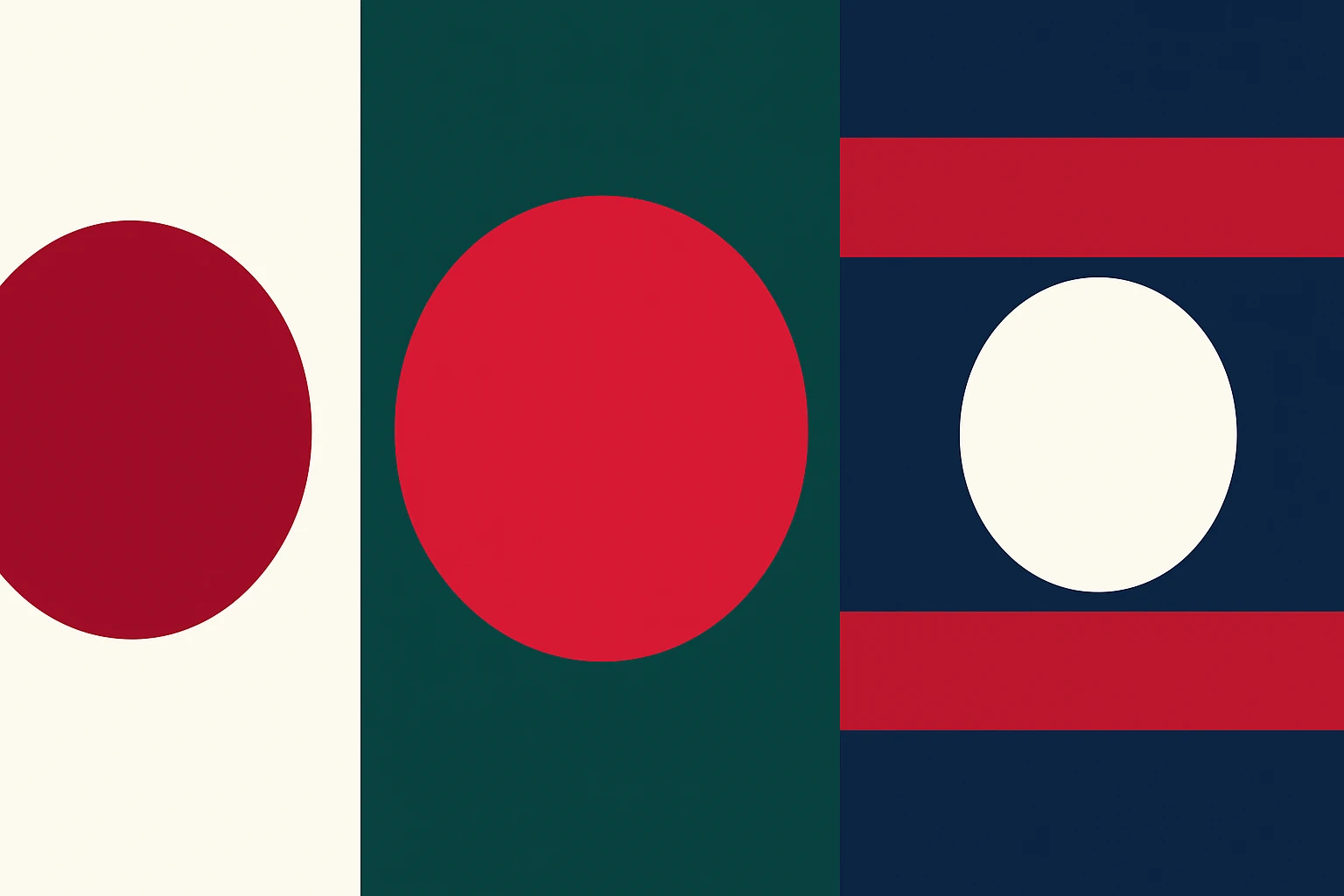
Three flags, three circles. A red disc on white. A red disc on green. A white disc on blue and red. No eagles, no crossed swords, no coats of arms. Yet the flags of Japan, Bangladesh, and Laos mean wildly different things by the same shape: the rising sun in one, the blood of martyrs in another, the moon over a river in the third.
The simplicity is what makes that possible. Strip a flag down to a single disc on a contrasting field and the shape has to carry the entire weight of national identity, with no decorative flourishes to spread the load. And the three circles were chosen under very different pressures: imperial Japan, a 1971 liberation war, and a 1975 communist revolution.
Why nations keep reaching for the circle
The circle-on-field flag is rarer than you'd expect. Most national flags lean on stripes, crosses, stars, or heraldry. A centered disc on a solid or banded background is flag design at its irreducible minimum.
Look across the world's flags and the motif turns up in a handful of places: Japan, Bangladesh, Laos, Palau, Greenland, North Macedonia. Each of those choices was made independently, under different circumstances.
The North American Vexillological Association codified five principles of good flag design: keep it simple, use meaningful symbolism, use two or three basic colors, no lettering or seals, and be distinctive. Circle flags score near-perfectly on all five. They're recognizable from a distance, they reproduce cleanly at any scale, and a child can draw them from memory.
So if the circle is neutral as a geometric form, why do these three nations' meanings diverge so completely? The answer is in the historical moment of choosing, not in the shape.
Japan's Hinomaru
The Hinomaru, a red disc centered on a white field, is one of the most recognized flags anywhere.
Its roots reach far deeper than modern Japan. Documented use on Japanese warships dates to the 1600s, and the mythological connection goes back further, to Amaterasu, the sun goddess from whom the imperial line claims descent. Solar divinity and political legitimacy have been intertwined in Japan for centuries, and "Land of the Rising Sun" started as a cosmological claim rather than a slogan.
The turning point came during the Meiji Restoration. In 1870, the Hinomaru was formally adopted as the national merchant flag, a deliberate choice by a modernizing government that wanted the world to see Japan as ancient, unified, and celestially ordained. The red disc was not new, but its official elevation was a calculated act of nation-branding.
During World War II, the Hinomaru and its rayed variant, the Rising Sun flag, became synonymous with imperial expansion across Asia.
In South Korea and China the flag still provokes deep resentment, a controversy that persists into 2026.
Japan itself struggled with the legacy for decades. It wasn't until 1999 that the Law Concerning the National Flag and Anthem officially codified the Hinomaru as the national flag, and that legislation was contentious. Teachers and public officials protested mandatory display in schools. Some still do.
Japan's circle is explicitly solar, explicitly hierarchical (the emperor as descendant of the sun), and explicitly ancient. It does not represent the Japanese people as such. It represents an imperial order the people exist within.
Bangladesh's red disc
Between March and December 1971, the Bangladesh Liberation War tore through what was then East Pakistan. Estimates of the dead range from 300,000 to 3 million, figures that remain bitterly disputed. A nation was born out of one of the 20th century's most brutal conflicts.
The flag's origin is charged with that violence. The original 1971 design, by Shib Narayan Das, put the red disc over a yellow map of Bangladesh. In 1972, Sheikh Mujibur Rahman's government removed the map for a practical reason: a map on a flag is notoriously hard to reproduce correctly on both sides of a textile, and the shape of Bangladesh, with its rivers and deltas, was too complex for consistent manufacturing.
What remained was the red disc on a green field, and the official symbolism carries a deliberate double meaning. The red circle stands for both the sun rising over Bengal and the blood shed by the Mukti Bahini, the freedom fighters who died for independence. The green field stands for the river-rich landscape of Bangladesh, one of the most densely vegetated countries on Earth.
The contrast with Japan is sharp. Japan's red circle is ancient and top-down, decreed by imperial authority. Bangladesh's is modern, born in 1971 out of mass death, and functions as a memorial as much as a symbol.
The white moon of Laos
Laos's flag is the outlier here, and the one most people know least about.
It is the only communist national flag in the world without a star. No five-pointed red star, no gold star, nothing from the standard Soviet or Chinese visual playbook. That omission was deliberate.
The flag traces its origins to the Pathet Lao resistance movement of the 1940s and 1950s, designed in opposition to both the French colonial tricolor and the royalist government's flag, which featured a three-headed white elephant on red. When the Pathet Lao won and proclaimed the Lao People's Democratic Republic in December 1975, this flag became official.
The white circle represents the full moon over the Mekong River. Officially it also stands for national unity and for the bright future of the nation under communism. All three meanings are endorsed at once.
The Mekong reference is not incidental. The river is the geographic and cultural spine of a landlocked country defined by river communities, which makes the circle-as-moon a local, landscape-rooted symbol rather than a cosmic one. By rejecting the communist star in favor of a moon, Laos signaled a nationalism rooted in its own geography and Buddhist cultural memory even while adopting a Marxist-Leninist government, and that tension has never been fully resolved.
The 1972 redesign
The moment Bangladesh's government removed the yellow map is worth dwelling on, because it left the red disc carrying the full symbolic weight alone.
The practical problem was real. A map on a flag is a headache for manufacturers. Vexillologists point to Kosovo's flag, which features a map of the country's territory, as a contemporary example of the same weakness: maps don't render well as two-sided textiles and are hard to reproduce at different scales.
The unintended symbolic consequence turned out to be more interesting than the fix. Without the map, the flag became more abstract. The red disc no longer pointed to a specific territory; it pointed to sacrifice, sunrise, nationhood without borders. Bangladeshis anywhere in the world could see themselves in it.
Compare Japan's 1999 codification. Both nations made a bureaucratic, legalistic decision about their circle, and in both cases the administrative act deepened the symbol rather than diminishing it.
Minimalism as a cultural language
In a world of increasingly complex national heraldry, flags crowded with coats of arms, weapons, buildings, and text, the plain circle is a radical act of restraint.
That restraint feels familiar in 2026. The same minimalist thinking behind flat UI design, corporate rebranding (dozens of major companies have simplified logos to geometric forms through the 2020s), and digital iconography echoes what these flags did decades or centuries ago. A circle reads at any resolution. It works at 16x16 pixels on a phone screen, on a lapel pin, and on a massive banner at the United Nations or the Olympics.
The trade-off is that a simpler form has to carry more meaning per square inch than a complex one, which makes it both more vulnerable to being misread or emptied out and harder to ignore.
There's an asymmetry worth noticing too. Japan's circle is the oldest and most recognized, yet Bangladesh's, younger by centuries, is arguably the most emotionally charged, and Laos's is the most politically nuanced. Age has little to do with it.
Three circles, three ideas of nationhood
Japan's circle says: we are ancient and cosmic. Bangladesh's says: we were reborn through blood. Laos's says: we are rooted in this river and this land. Those are three different theories of what a nation is, encoded as divine lineage, collective sacrifice, and geographic community respectively.
The shared formal solution, same shape, same centered placement, similar simplicity, isn't coincidence. Some ideas resist decoration.
What happens when the intended meaning gets contested or forgotten is a live question. Younger Japanese citizens see the Hinomaru without its imperial context, or mostly through sports nationalism. Diaspora Bangladeshis fly the red disc as cultural pride, detached from the mourning of 1971. Laotian youth live under a government that has suppressed political opposition since 1975, and the flag's bright future carries a different weight for them than it did for the Pathet Lao generation.
A circle on a flag is only as stable as the story told about it, and all three nations are still negotiating that story with a new generation.