The Flag of Laos
Lao People's Democratic Republic
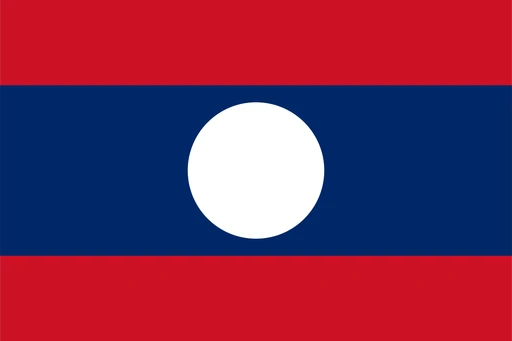
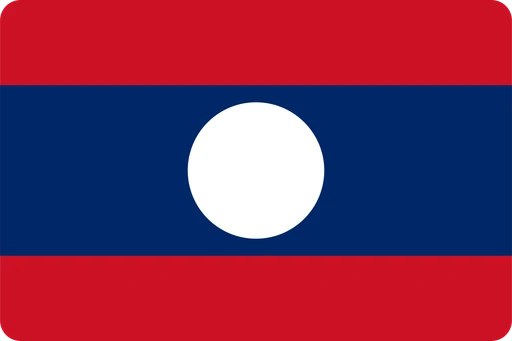
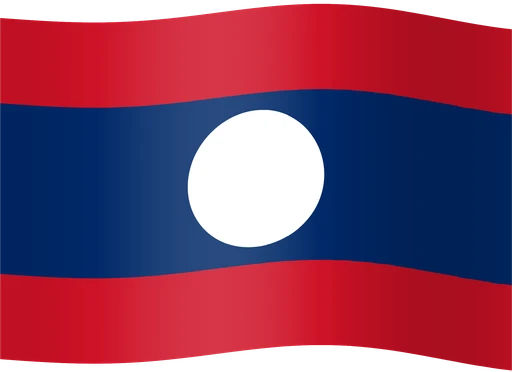
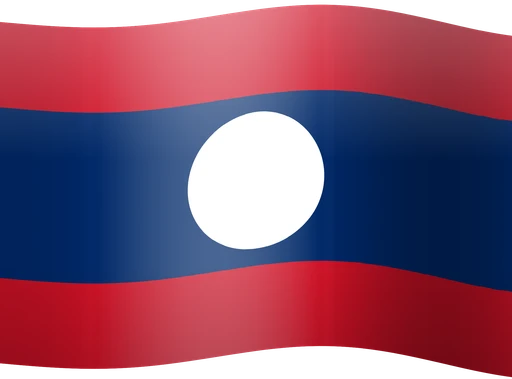
The national flag of Laos has red stripes at the top and bottom, a blue stripe in the middle at double the height of the red ones, and a white circle centered on the blue. The red stripes stand for the blood shed for freedom and independence, the blue for wealth and prosperity, and the white circle for both the unity of the people under the communist government and the full moon over the Mekong River.
Laos is the only communist nation in the world whose flag has no star. In its place is a white circle, the full moon rising over the Mekong River, set against bands of red and deep blue. The flag was adopted in 1975, when the Pathet Lao movement abolished the monarchy and established a socialist state.
The moon over the Mekong
The flag flies at a 2:3 ratio, built from three horizontal bands: red on top, deep indigo blue at double width in the center, and red again on the bottom. The white circle sits perfectly centered on the blue band.
Officially, the circle is the full moon rising over the Mekong River, which feeds, connects, and defines the nation. There's a second, more political reading: the circle stands for the unity of the Laotian people under the socialist state and the future the revolution promised. Both interpretations sit comfortably alongside each other.
Red speaks to the blood shed in the long struggle for independence, first against the French and then during the civil war. The indigo blue carries a double meaning as well: national prosperity and wealth, and the Mekong itself, painted across the flag's widest stripe.
Why no star? The Pathet Lao leadership chose a symbol rooted in Laotian geography and culture rather than borrowing the five-pointed star from Soviet, Chinese, or Vietnamese tradition. The moon over the river is something every Lao person has seen.
Even the proportions are legislated. The circle's diameter equals four-fifths the width of the blue band, a specification codified in national flag law to keep reproductions consistent.
From the royal elephant to the Pathet Lao banner
Pre-colonial Laos had no standardized national flag. Regional kingdoms like Lan Xang flew royal banners and ceremonial standards, each tied to a specific dynasty or city. When France absorbed Laos into Indochina in 1893, the French tricolor went up over Vientiane, accompanied by local administrative flags with the three-headed elephant, or Erawan, beneath a parasol.
After independence in 1953, the Kingdom of Laos adopted a flag steeped in Buddhist-royal tradition: a red field bearing the white three-headed elephant on a five-tiered pedestal beneath a ceremonial umbrella. It was ornate, deeply symbolic of the monarchy's spiritual authority, and almost impossible to draw from memory. The Pathet Lao, active as a revolutionary force since the early 1950s, rejected all of it. Their banner was the red-blue-red design with the white moon, and it flew over liberated zones for more than two decades before it became an official national flag.
December 2, 1975 was the turning point. King Savang Vatthana abdicated, the monarchy was dissolved, and the Lao People's Democratic Republic was proclaimed. That same day, the Pathet Lao flag rose as the national flag. It's one of the few instances in modern history where a revolutionary movement's wartime banner became a nation's permanent flag almost entirely unchanged.
The design hasn't been altered since. That kind of stability is unusual in Southeast Asia, where neighboring countries like Myanmar and Cambodia have cycled through multiple flags in the same period.
The only communist flag without a star
Line up the flags of the world's communist and socialist states and a pattern emerges fast: China's five yellow stars on red, Vietnam's single gold star, Cuba's lone white star, North Korea's red star on a white disc. Laos breaks the pattern with its moon.
Where Vietnam chose ideological directness (red field, gold star, unmistakable political message) and Cambodia placed Angkor Wat at the center of its flag as an architectural and historical statement, Laos went with nature. A river and a moon. The choice feels less like propaganda and more like landscape painting.
Within ASEAN the flag holds its own visually. Thailand's flag, with its red-white-blue horizontal bands, looks superficially similar in palette, a coincidence that becomes interesting given the deep ethnic and linguistic ties between the Lao and Thai peoples. The proportions, meanings, and histories diverge sharply, though. Thailand's blue honors the monarchy; Laos's blue honors the river that separates and connects the two nations.
The Mekong flows through six countries, from China to Vietnam, yet only Laos places it at the center of its national banner. Vexillologists frequently cite the Lao flag for its clean geometry and its departure from socialist conventions.
Protocol and variants
The flag flies over the Presidential Palace in Vientiane, the National Assembly, government ministries, embassies abroad, and official border crossings. On December 2, National Day, it's displayed everywhere from government buildings to shopfronts. You'll also see it during the That Luang Festival and Pi Mai, the Lao New Year.
There's no separate civil ensign or naval flag. The national flag handles all official duties. The Lao People's Armed Forces use the same flag, sometimes paired with additional military insignia on unit banners, but the national design stays unaltered.
Laotian law takes flag etiquette seriously. Defacement or disrespectful use is prohibited, and the national flag statute sets out proper disposal and handling protocols.
In the diaspora things get more complicated. Laotian communities in the United States, France, and Australia display the current flag at cultural festivals and New Year celebrations. Some expatriate groups, particularly those with ties to the pre-1975 monarchy, still fly the old royal elephant flag as a symbol of political identity and lost heritage. Both flags sometimes appear at the same community event.
At the Southeast Asian Games and other international competitions, the flag appears on uniforms, banners, and broadcast graphics, and its bold design scales well from stadium displays to small digital icons.
Why the imagery resonates
The Mekong, called Nam Khong in Lao, isn't just a geographic feature. It's a spiritual and economic lifeline. Theravada Buddhist festivals are held on its banks. Fishing communities depend on its rhythms. Trade has flowed along its current for centuries. Putting the river at the center of the national flag was an acknowledgment of what actually holds the country together.
The full moon carries its own weight in Lao Buddhist tradition, where the lunar calendar governs religious life. Major festivals like Boun That Luang and Boun Ok Phansa, which marks the end of Buddhist Lent, are tied to the full moon. So the central white disc isn't only a political idea. It echoes something Lao people watch in the sky every month.
That is the odd thing about the flag as a cultural object. It was born of a communist revolution, yet its central image speaks to a pre-revolutionary, spiritual relationship with the natural world. The tension between socialist ideology and Buddhist tradition runs through modern Laotian life, and the flag sits right at the intersection. The moon and river imagery cuts across political lines in a way that a hammer and sickle or a red star could not in a deeply Buddhist society.
After 1975 the government used the flag heavily in nation-building campaigns: literacy drives, murals, and propaganda posters, all meant to project unity among Laos's more than fifty ethnic groups. The moon and river, shared by all of those communities regardless of language or highland-lowland divides, worked as unifying images.
Younger Laotians and international observers often describe the flag as one of the most elegant in the region.
References
[1] Lao PDR Government Portal (gov.la). Official flag specifications and national symbols legislation.
[2] Flag Law of the Lao People's Democratic Republic (1991). Legal dimensions, color specifications, and usage protocols.
[3] Smith, Whitney. Flags Through the Ages and Across the World. McGraw-Hill, 1975. Historical context for Southeast Asian flags.
[4] Stuart-Fox, Martin. A History of Laos. Cambridge University Press, 1997. Comprehensive historical background on the Pathet Lao movement and the 1975 revolution.
[5] Flags of the World (FOTW) database (crwflags.com). Technical specifications, historical variants, and vexillological analysis of the Lao flag.
[6] Evans, Grant. The Last Century of Lao Royalty: A Documentary History. Silkworm Books, 2009. Source material on the royal flag and the abolition of the monarchy.
[7] Znamierowski, Alfred. The World Encyclopedia of Flags. Lorenz Books, 2014. Vexillological description and regional comparisons.
[8] ASEAN Secretariat (asean.org). Comparative flags and emblems of ASEAN member states.
[9] Ngaosrivathana, Mayoury and Breazeale, Kennon (eds.). Breaking New Ground in Lao History. Silkworm Books, 2002. Essays on national identity and symbolism in modern Laos.
Common questions
- What prompted the change in the Laos flag in 1975?
- Laos changed its flag in 1975 when it became a socialist republic. The new design dropped the monarchic and colonial symbols in favor of imagery the new government felt better represented unity and independence.
- What does the white circle represent on the Laos flag?
- The white circle is the full moon rising over the Mekong River, which is central to Laotian life. It also stands for the unity of the Lao people and the nation's future under the socialist state. Both readings are officially recognized.
- When did Laos adopt its current flag?
- Laos adopted the current flag on December 2, 1975, when the Pathet Lao movement took over, ended the monarchy, and created the Lao People's Democratic Republic. The same design had already served as their revolutionary flag for more than 20 years before that.
Featured in these articles
Download this flag
Free in 12 styles, from 32px icons up to 2000px, as SVG, PNG, WebP and JPG.