Five Flags, One Dead Country: How Central America Kept the Stripes of 1823
Julio Song · · 8 min read
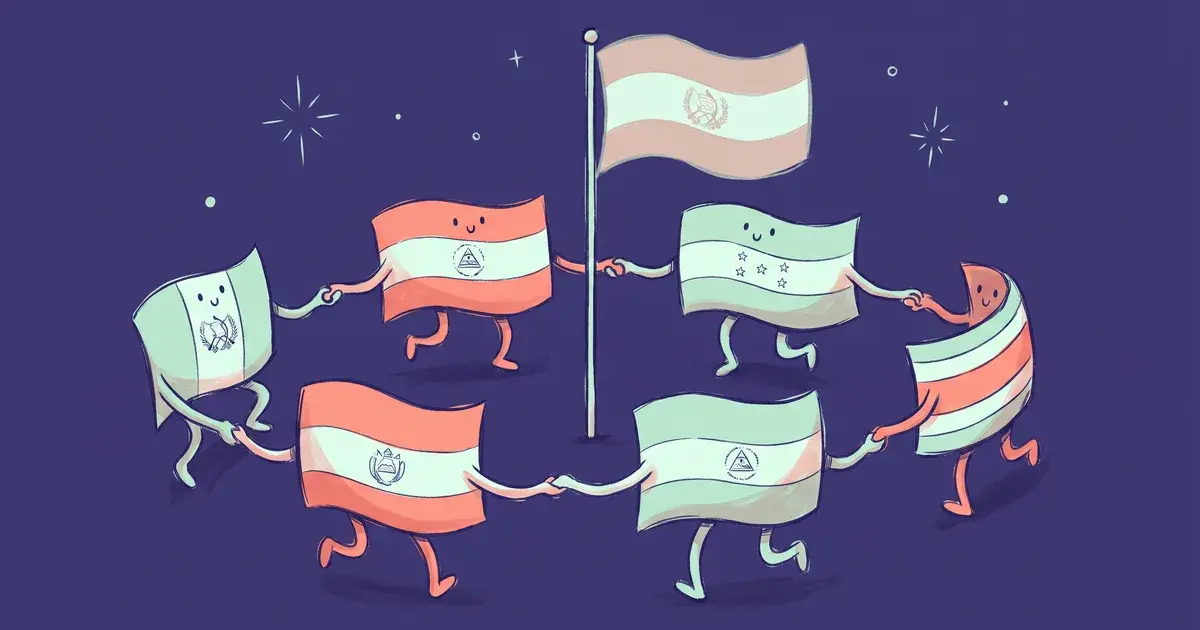
Line up the flags of Guatemala, Honduras, El Salvador, Nicaragua and Costa Rica and you'll see a family resemblance. Blue, white, blue. Two of them carry five volcanoes. One carries five stars. The resemblance has a paper trail, and it leads back to a country that stopped existing in 1841.
That country was the Federal Republic of Central America. It lasted less than twenty years. Its flag has outlived it by more than 180, and it keeps pulling its former members back after each one wanders off.
A country born in a single decree
Central America's independence came in stages. Colonial leaders declared independence from Spain on 15 September 1821, and a few months later a junta voted to join the First Mexican Empire. That union fell apart when Emperor Iturbide abdicated, and on 1 July 1823 a Central American congress declared the region free of Mexico too.
Seven weeks later, the same body wrote down what the new country would look like. The decree of the National Constituent Assembly of 21 August 1823 is short and precise. The flag gets three horizontal stripes, blue at top and bottom, white in the middle. The coat of arms is an equilateral triangle. Inside it sit:
- a range of five volcanoes on land washed by two seas
- a rainbow arching over them
- a liberty cap beneath the rainbow, throwing out rays of light
Around the triangle, in gold letters, runs the name "Provincias Unidas del Centro de América". Merchant ships skipped the coat of arms and carried the words "Dios, Unión, Libertad" in silver on the white stripe instead.
Five volcanoes for five provinces. Two seas for the two coasts. If you've ever wondered why a flag needs a geography lesson in the middle of it, this is the answer. The founders were describing the one thing all five members shared, the isthmus itself.
Where did the blue and white come from?
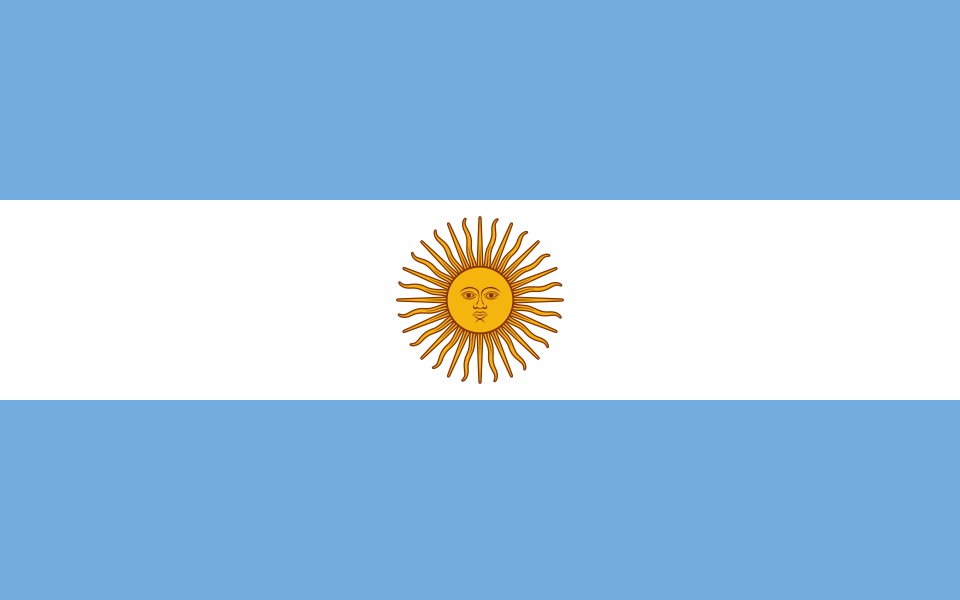
The decree doesn't say. The most repeated explanation points south. Wikipedia's article on the flag of Central America describes the triband as inspired by Argentina's flag, and Argentine sources tie the link to a privateer.
Hipólito Bouchard sailed under Argentine colours during the wars against Spain. According to the Argentine government's own biography of him, his ships attacked El Realejo, Nicaragua's main Pacific port, where they seized two Spanish vessels and destroyed two more. Treat the flag connection as tradition rather than record. No clause in the 1823 decree mentions Buenos Aires, and the theory rests on popular accounts.
 ArgentinaView flag →
What the record does show is that the colours stuck. The constitution followed on 22 November 1824. Then came the fighting.
The federation falls, the flag stays
The republic spent most of its short life at war with itself. There was a civil war from 1827 to 1829 and another from 1838 to 1840. The states won. Most had walked out by 1839, and El Salvador's declaration of independence in January 1841 closed the books.
The federation's best-known defender was Francisco Morazán, its president through most of the 1830s. He didn't give up. In 1842 he landed in Costa Rica, took San José, and started recruiting troops to rebuild the union. Costa Ricans didn't want it. An uprising broke out, and Morazán was executed by firing squad in San José on 15 September 1842, the twenty-first anniversary of independence.
So by the mid-1840s you had five small republics, no federation and one shared flag. Each one now had to decide what to do with it.
Costa Rica takes the first exit
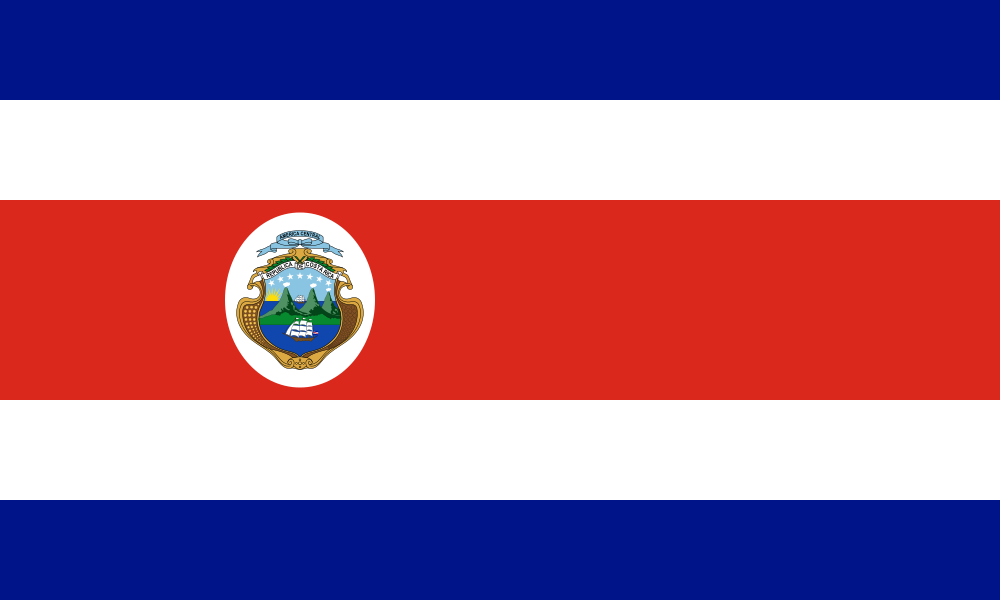
Costa Rica went furthest. On 29 September 1848, under President José María Castro Madriz, the country adopted a new design. The usual credit goes to his wife, Pacífica Fernández Oreamuno, an admirer of France, where revolution broke out that same year. She suggested adding red.
The result keeps the federal blue and white but splits them with a red band through the middle. Flags of the World records that the red stripe is twice the width of each of the other four. The current pattern dates from a decree of 27 November 1906.
 Costa RicaView flag →
Costa Rica never came back to the plain triband. Of the five, it's the only one that left the 1823 pattern and stayed out. The blue and white are still there, though. You're looking at a federal flag with a French red stripe pushed through it.
El Salvador's 47 years under stars and stripes
If Costa Rica's detour was a small one, El Salvador's was a sharp turn. In 1865 the country adopted a flag that looked like it came from Washington.
A decree of 14 February 1865, approved by President Francisco Dueñas on 28 April, created a flag with nine alternating blue and white stripes and a red canton. The canton held one white star for each department. As the country added departments, it added stars, reaching fourteen from 1875.
Picture it on a pole next to the United States flag. Same layout, different colours in the stripes, the stars clustered in the corner. The likeness was obvious, and according to the same source it's what led to the design's replacement.
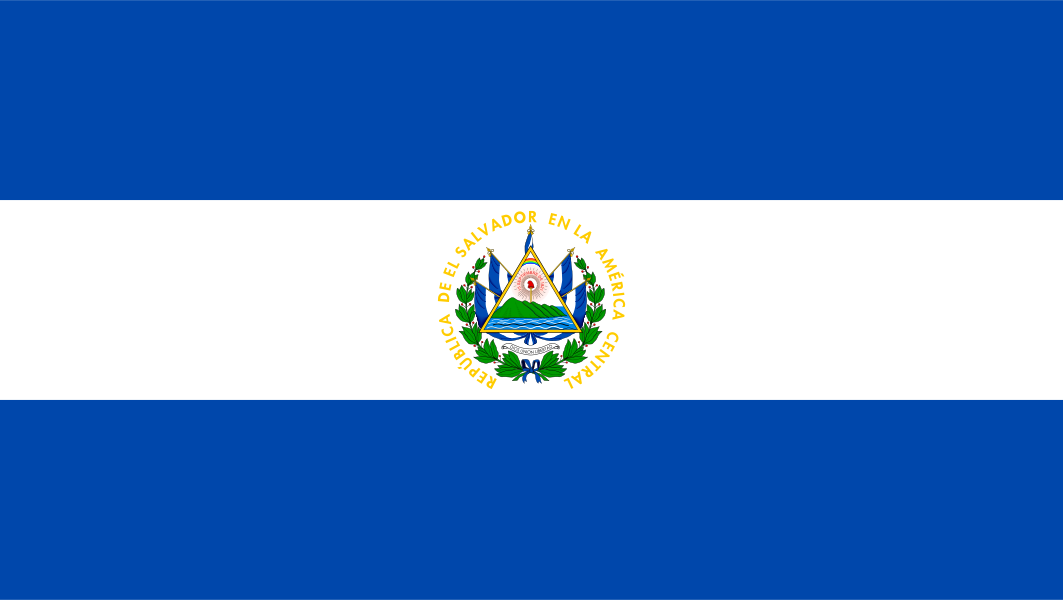
On 17 May 1912 the Legislative Assembly brought back the blue-white-blue, and the flag was first raised at the Campo de Marte in San Salvador on 15 September 1912, Independence Day. Its coat of arms showed five volcanoes, the same count as the federal one. The current rules sit in Decree 115, the Law on National Symbols of 14 September 1972, which specifies two blue stripes around a white one, all three of equal width.
 El SalvadorView flag →
For almost half a century El Salvador's flag counted its own departments. The 1912 flag stopped counting the country's parts and pointed back to the region it once belonged to.
Guatemala turns its stripes on their side
Guatemala had its own wandering years. Under General Mariano Paredes, a decree of 14 March 1851 added red and yellow, the colours of Spain, to the blue and white. Rafael Carrera's government reworked the design again about seven years later, with a coat of arms showing three volcanoes, a sun and two flags.
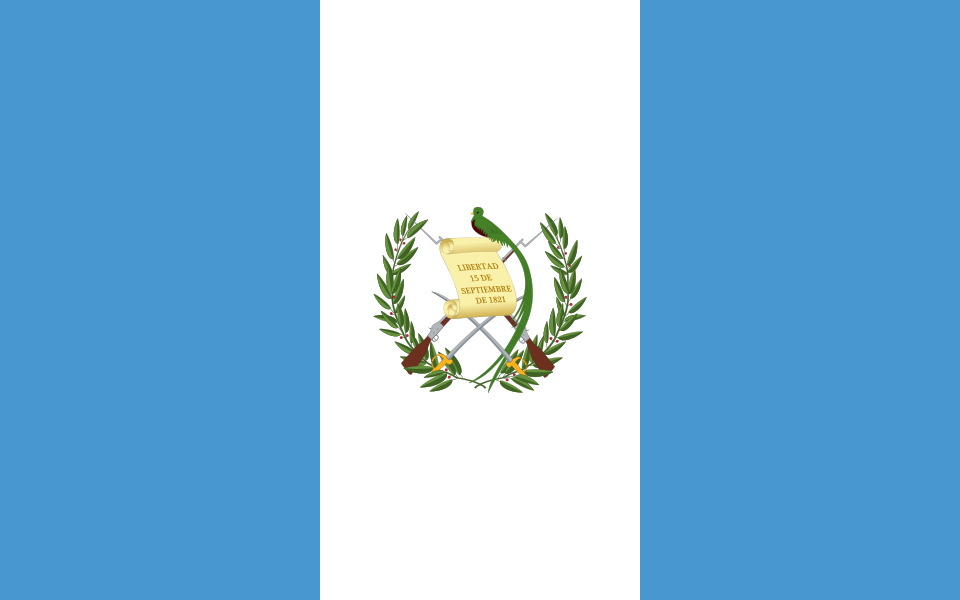
The break came in 1871. On 17 August, provisional president Miguel García Granados signed decree number 12 on national symbols. It restored the blue and white of 1823 but turned the stripes vertical. The new coat of arms put a quetzal at its heart, which the decree described as a symbol of the nation's independence and autonomy.
 GuatemalaView flag →
The vertical stripes are the giveaway. Guatemala wanted the federal colours back without looking like everyone else. The current rules date from 1997, and since 1961 Guatemalans have marked 17 August as Flag Day.
Honduras counts to five
Honduras took the opposite approach to El Salvador. Instead of counting its own pieces, it counted the federation's.
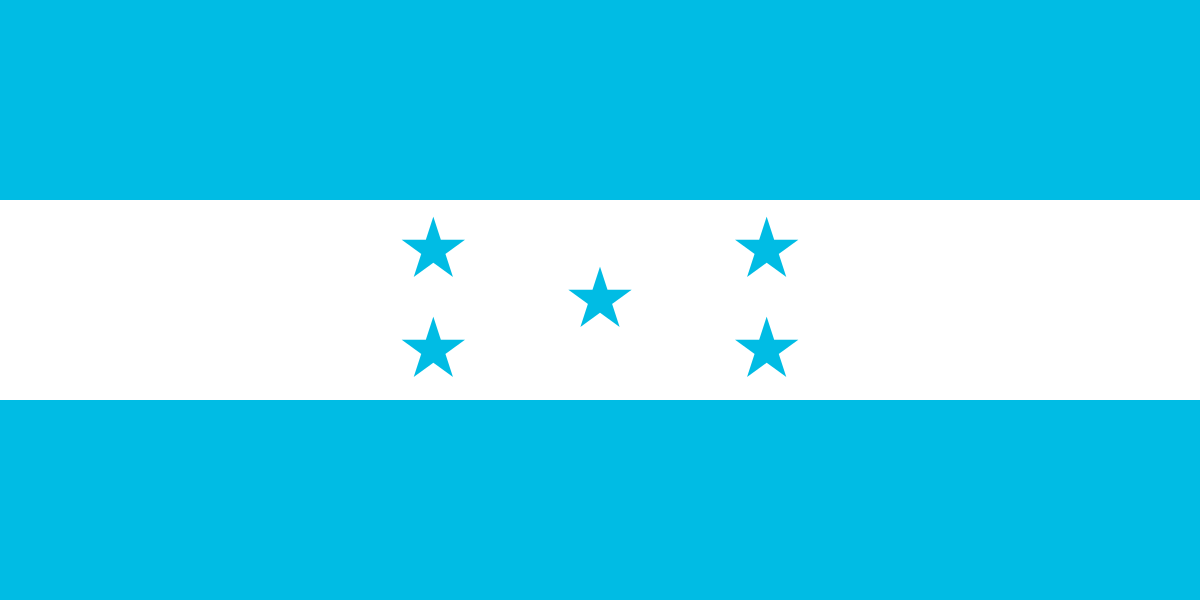
Decree 7 of 16 February 1866 created a national flag with five blue stars on the white stripe. A decree of 18 January 1949 confirmed the design and fixed the stars in their current layout, four in a rectangle with one in the middle. Each star stands for one of the five former members, with Honduras at the centre, and together they express the hope that the nations will unite again.
 HondurasView flag →
Read that again. A union that had been dead for 25 years when the decree was signed got a permanent place on a national flag.
Even the shade of blue has turned political. After Xiomara Castro took office in January 2022, the government started flying a turquoise version, following a recommendation from the national university about the flag's original colour. It didn't last. On 25 January 2026, Congress restored navy blue at the opening of its first session of the year. La Prensa notes the argument over which blue the constitution intends hasn't been settled.
Nicaragua keeps the whole triangle
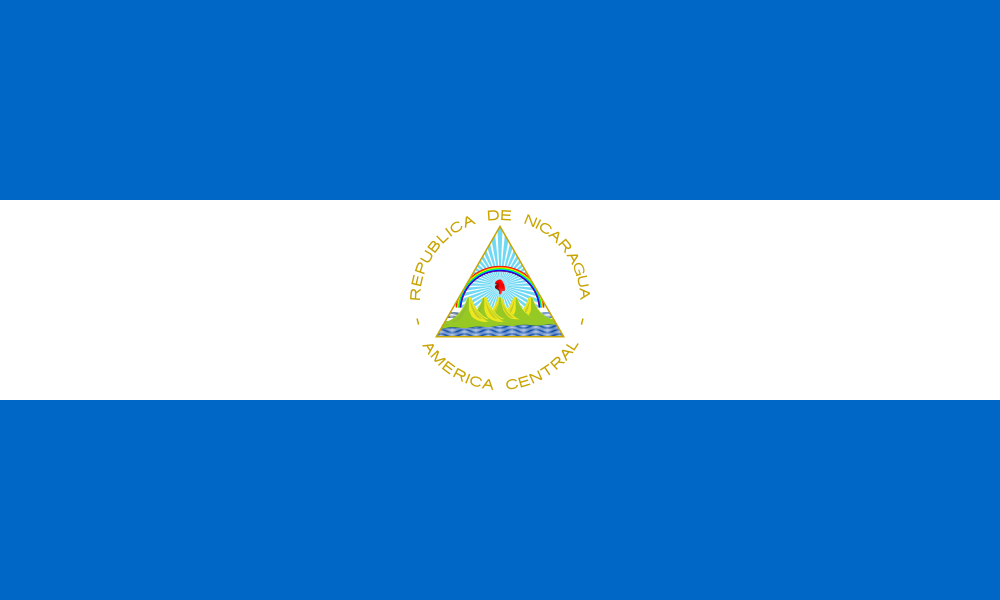
Of the five, Nicaragua's flag stays closest to the 1823 text. Its current form dates from a decree of 4 September 1908, and the Law on the Characteristics and Use of the Patriotic Symbols, published on 27 August 1971, still governs it.
Put Nicaragua's coat of arms beside the 1823 decree and you'll find the same checklist. Triangle. Five volcanoes. Rainbow. Liberty cap. The five volcanoes still stand for the five Central American countries, not for any five Nicaraguan peaks. The legend around the triangle reads "República de Nicaragua, América Central", a national name with a regional address attached.
 NicaraguaView flag →
That rainbow also hands Nicaragua a bit of trivia. Because it includes a purple band, Nicaragua's flag is one of the few national flags with purple in it.
Why the stripes keep coming back
Count the score. Guatemala left in 1851 and returned in 1871, sideways. El Salvador left in 1865 and returned in 1912. Honduras and Nicaragua never strayed far. Only Costa Rica broke away for good, and even it kept the blue and white.
None of these countries has rejoined a federation. Morazán died trying. What they did instead was keep the federation where it costs nothing to keep, on cloth. The five volcanoes in El Salvador's and Nicaragua's arms and the five stars on Honduras's white stripe all point back to the same decree of 21 August 1823.
Next time you see the Honduran or Nicaraguan flag at a football match or an embassy, look past the national emblem. You're looking at the flag of a country that was gone by 1841, still flown by four of the five states that took it apart.
Julio Song
Writer
Julio is a staff writer at FlagDB. He studied Mathematics at the University of Madrid and has a passion for vexillology.
More from Julio Song →