The Flag of Saint Vincent and the Grenadines
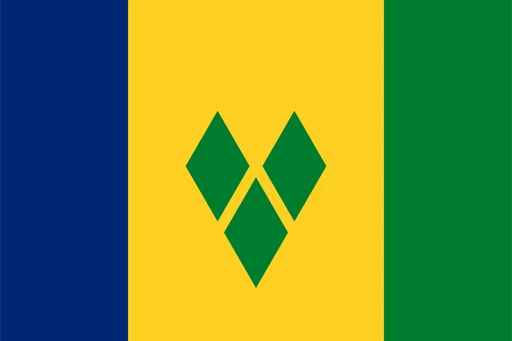
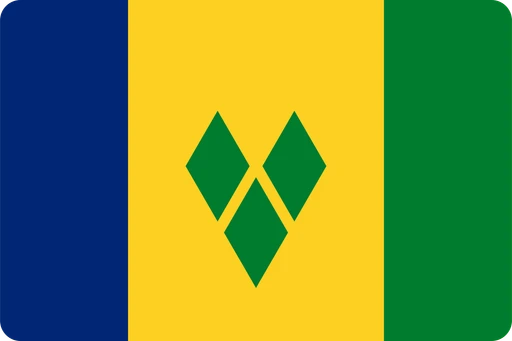
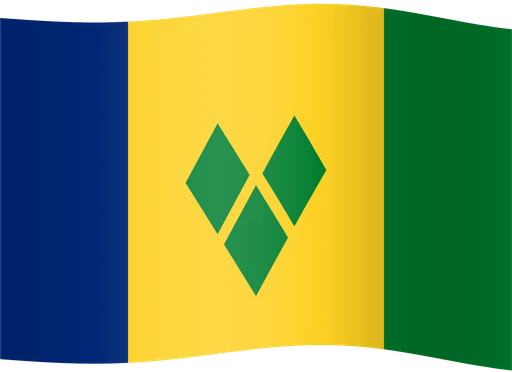
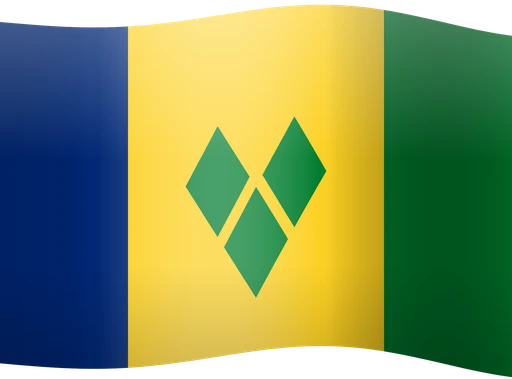
The flag of Saint Vincent and the Grenadines has three vertical bands of blue, gold, and green, with the gold band twice the width of the other two. Three green diamonds sit in the middle of the gold band, arranged in a V for the Grenadine Islands. Blue is for the sky and sea, gold for the warmth of the people and their bright future, and green for the vegetation of the islands.
The flag of Saint Vincent and the Grenadines is unusually easy to read: three vertical bands, one much wider than the others, and three diamonds arranged in the shape of the country's initial.
Two flags in six years
The current flag was adopted on October 21, 1985. Before independence, the country flew a blue ensign with the Union Jack and the colonial coat of arms.
Independence came in 1979, and with it a first national flag: horizontal bands of blue, yellow, and green with a breadfruit leaf emblem. That design lasted only until 1985, when it was replaced by the current one. The change was less about aesthetics than about putting some distance between the new country and its colonial past.
Blue, gold, green, and three diamonds
The three vertical bands are blue, gold, and green. Blue is the sky and the sea around the islands. Gold is for the warmth of the people and for the Grenadine sands. Green is the vegetation and the agricultural land.
At the center of the gold band, three green diamonds sit in a V. The letter is for Saint Vincent. The diamonds are known as "the gems of the Antilles", a phrase applied both to the islands and to the people on them, and the arrangement is what keeps the flag from being confused with anything else in the region.
Usage
The flag is used by the government, at sea, and by the military. It flies on government buildings and at official ceremonies, and protocol requires it to be flown above other flags when they are displayed together. Civil and state versions differ slightly in proportion but keep the same design.
It is everywhere on Independence Day, and it appears in parades and public events through the year. Among Vincentians abroad it works as a marker of where they are from.
Similar flags or influences
Saint Vincent and the Grenadines shares with its neighbors a taste for strong colors standing in for natural features, a habit that comes partly from shared geography and partly from shared colonial history. What sets this flag apart is the diamond arrangement, which has no close parallel among nearby countries.
References
Government of Saint Vincent and the Grenadines. Link
North American Vexillological Association. Link
Common questions
- What do the green diamonds on the Saint Vincent and the Grenadines flag stand for?
- The three diamonds form a 'V' for Saint Vincent. They are known as 'the gems of the Antilles', a reference to the islands themselves and to the people who live on them.
- Why was the Saint Vincent and the Grenadines flag changed in 1985?
- The 1979 design was revised in 1985 to move further away from colonial imagery and give the new country a flag that read as its own.
Featured in these articles
Download this flag
Free in 12 styles, from 32px icons up to 2000px, as SVG, PNG, WebP and JPG.