The Flag That Wasn't Allowed to Change: How Belarus Brought Back Stalin's Design, and Why It Started a Revolution
Julio Song · · 10 min read
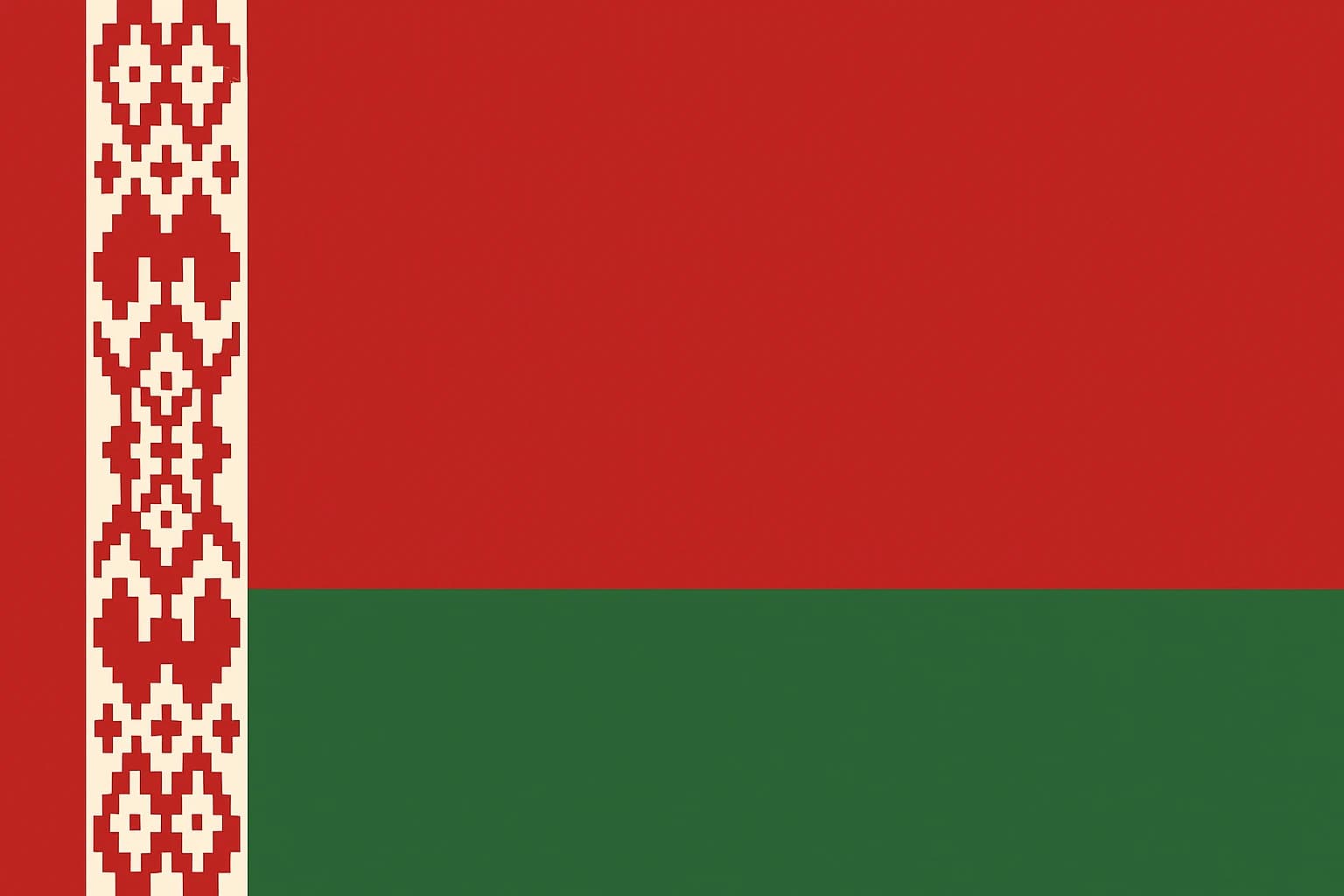
Belarus is the only country in the world that held a democratic vote to erase its own democracy's symbol. In 1995, four years after the Soviet Union collapsed and nations across Eastern Europe were racing to shed communist imagery, Belarusians went to the polls and voted, under deeply disputed conditions, to bring back a flag descended from a Joseph Stalin-era redesign. Everyone else was reaching forward. Belarus reached backward.
Two flags are now locked in a contest that shows no sign of ending. One is the Soviet-derived green-and-red banner that flies over government buildings in Minsk. The other is the white-red-white triband that protesters held aloft in 2020 as riot police closed in with rubber bullets and stun grenades. How did a piece of cloth become the most dangerous thing you could carry in Belarus?
A nation born twice: Belarus's two flags and what they each represent
The white-red-white flag has roots that reach back to 1918, when the short-lived Belarusian People's Republic declared independence during the chaos of World War I and the Russian Revolution. That republic lasted only months before being swallowed by the Bolsheviks, but its flag survived in memory. It was a straightforward national tricolor, white-red-white, predating Soviet rule by decades. Its meaning was simple: Belarus exists as a nation, separate from Russia.
The Soviet Belarusian SSR flag tells a different story. Stalin's 1951 redesign added a distinctive red-and-white ornamental stripe to a standard Soviet red field. That stripe borrowed from the rushnyk, a traditional Belarusian embroidered cloth. It was a cynical nod to Belarusian folk culture, designed to give the republic a thin veneer of national identity while keeping it firmly inside the Soviet system.
Then came 1991. On August 19, the Supreme Soviet of Belarus adopted the white-red-white flag. It was the same day hardliners launched the Moscow coup against Gorbachev. The timing cemented the white-red-white banner's association with freedom from Soviet rule. For a brief, heady period, it flew as the symbol of a newly independent Belarus.
The split runs by generation. For older Belarusians shaped by decades of Soviet life, the green-and-red banner means stability and a familiar identity. It is the flag that hung in their schools and workplaces. For younger citizens and the urban intelligentsia, the white-red-white is the flag of a country that was taken from them. The disagreement is not about design. It is about what Belarus is and who gets to decide.
The rushnyk stripe: the most unusual border on any national flag
Nothing else in world vexillology looks quite like the rushnyk stripe. A rushnyk is a traditional Belarusian embroidered ritual cloth. Families use it at weddings, funerals, and Orthodox ceremonies. Grandmothers embroider them by hand. The geometric red-and-white patterns carry cultural weight that goes far beyond decoration. They're intimate, domestic objects tied to the rhythms of birth, marriage, and death.
Soviet designers in 1951, working under Stalin's directive to give each SSR a superficially national character, took the rushnyk motif and embedded a stylized version as a vertical stripe down the left side of the Belarusian SSR flag. Folk art became propaganda, and a symbol of hearth and home was pressed into service for a totalitarian state.
Compare it to other unusual national flag motifs around the world. Nepal has its double-pennon shape, the only non-rectangular national flag.
Bhutan has its dragon. Cambodia features Angkor Wat.
But the rushnyk stripe is unique because it is a textile pattern, a domestic and feminine symbol, placed on a state banner. There's a visual tension between the intimate and the authoritarian that no other flag replicates.
When Lukashenko's 1995 referendum reinstated the Soviet-era flag, two changes were made: the hammer and sickle came off, and the stripe was flipped to mirror its original orientation. Restored flags are constructed rather than recovered. Someone sat in a room and decided which parts of the Soviet past to keep and which to leave out.
The rushnyk stripe now does double cultural work. Lukashenko's state claims it as proof of authentic Belarusian heritage. Pro-democracy protesters embroider and wear rushnyk patterns as a form of resistance, insisting that the folk tradition belongs to the people, not the government. The same symbol, pulled in opposite directions.
The 1995 referendum: how Lukashenko used a vote to bury a symbol
Alexander Lukashenko won Belarus's first presidential election in July 1994. He was a collective farm director and anti-corruption parliamentarian running on a populist, pro-Russia platform. He won with genuine popular support. What came next was anything but democratic.
Lukashenko moved fast to consolidate power through a series of referendums. The May 1995 vote was a neat piece of political engineering. It bundled four questions together: economic integration with Russia, official status for the Russian language, presidential power to dissolve parliament, and the restoration of Soviet-era state symbols. Voters couldn't pick and choose. You wanted closer ties with Russia? You also voted for the old flag. The questions were designed to travel as a package.
International observers from the OSCE documented serious procedural violations. The Belarusian parliament attempted to declare the referendum invalid. Eighteen opposition MPs staged a hunger strike inside parliament. Lukashenko responded by dissolving parliament and having them physically removed. A constitutional crisis, triggered in part by a flag.
The strategic logic was clear. By framing the white-red-white flag as a symbol of Nazi collaboration (some Belarusian collaborators did use it during the 1941-1944 German occupation, though the flag predates this by more than twenty years), Lukashenko poisoned the well of national identity. He made patriotism synonymous with loyalty to Soviet continuity. If you loved Belarus, you loved the green-and-red flag. If you carried the white-red-white, you were, by this logic, a fascist.
The 1995 vote set the template for everything that followed: referendums staged as theater, historical trauma put to work, and control of the symbols used to control the identity.
August 2020: when carrying a flag became an act of courage
On August 9, 2020, Lukashenko claimed 80% of the vote against opposition candidate Sviatlana Tsikhanouskaya. The results were almost universally condemned as fraudulent.
Hundreds of thousands of Belarusians came out into the streets of Minsk and other cities in the largest protests in the country's history, and the white-red-white flag was everywhere. Protesters draped it from apartment windows. They wore it as capes. They formed human chains holding it across Minsk's central boulevards. State television, meanwhile, showed only the official green-and-red flag, as if the protests were not happening. Two realities, defined by two flags, broadcasting simultaneously in the same city.
The state's response targeted the flag itself as a threat. Police singled out people carrying white-red-white flags for detention. Displaying it was treated as evidence of criminal intent. In the months that followed, Lukashenko's government moved to formally classify it as a "Nazi symbol" under Belarusian law.
Tsikhanouskaya and the opposition made a deliberate choice to lean into the flag as a unifying visual language. In a country where opposition parties had been suppressed for decades, the flag became the party. It was stateless, leaderless, required no infrastructure to deploy, and could not be arrested. You didn't need a membership card or a party headquarters. You needed a piece of white and red cloth.
The symbol crossed borders. The white-red-white flag was projected onto government buildings in Warsaw, Vilnius, and Berlin. The Belarusian diaspora carried it at embassies worldwide. A banned domestic symbol had become an internationally recognized distress signal.
The Nazi collaboration smear: how history gets weaponized in flag wars
The most serious charge against the flag has a factual basis. Some Belarusian nationalist collaborators did use the white-red-white flag during the Nazi occupation of 1941-1944, and Lukashenko's government has exploited that relentlessly. The context around it matters.
The white-red-white flag was created in 1918, more than two decades before World War II, by the Belarusian People's Republic as a national tricolor. Its wartime association with collaboration reflects the actions of specific political actors, not an inherent ideological meaning of the flag itself.
This pattern is not unique to Belarus. The French tricolor was used by the Vichy regime. The Norwegian flag flew under Quisling's collaborationist government. The Danish flag was used by Danish Nazi units. None of these flags are considered Nazi symbols today.
Historical misuse does not permanently define a flag's meaning, unless a government needs it to.
Following Belarus's role as a staging ground for Russia's February 2022 invasion of Ukraine, Lukashenko's government doubled down on the Nazi-symbol classification. The war in Ukraine gave him a new tool. All opposition was framed as treasonous Russophobia. The white-red-white banner's criminalization intensified between 2022 and 2026, with new prosecutions and harsher sentences for display.
The distortion is deliberate and works as propaganda. Historical accuracy is not the aim. Permanent contamination of the opposition's most recognizable visual asset is.
Two flags, one people: the identity crisis at the heart of modern Belarus
Belarus may be the only country in the world with two simultaneously active, competing national flags. One flown by a government, one carried by its exiled opposition and imprisoned citizens. As of mid-2026, there is no resolution in sight.
Sviatlana Tsikhanouskaya's Coordination Council, operating from Vilnius, Lithuania, uses the white-red-white flag in all official capacities. Two different entities claim to represent Belarus internationally, under two different flags. The European Union, the United States, and the United Kingdom have not formally recognized Tsikhanouskaya's government but maintain close relations with it. Some official European buildings have flown the white-red-white flag in solidarity, without it constituting formal diplomatic recognition. It's an ambiguous space, and flag politics is often about ambiguity.
This split reveals something uncomfortable about Belarusian national identity. Unlike Ukraine, where the 2014 Euromaidan produced a broadly shared national symbol consensus, Belarus remains genuinely divided.
A significant part of the population, particularly rural and older voters, genuinely identifies with the Soviet-derived flag and the stability it stands for. That is lived experience rather than brainwashing. For a lot of Belarusians the 1990s meant economic collapse and uncertainty, and the green-and-red flag marks the end of that.
Which leaves the question that will define the country's future. If Lukashenko's government ever falls, which flag flies over Minsk, and can a country reconcile two such bitterly opposed symbols of itself?
A piece of cloth, a piece of freedom
Belarus voted, imperfectly and under coercion, to go backward, and in doing so it produced a live case study in how flags work as instruments of political control rather than as national decoration. The rushnyk stripe came out of centuries of folk tradition, was co-opted by Stalin, modified by Lukashenko, and taken back by grandmothers embroidering at protest lines. No other national flag motif has had a run like that.
The white-red-white flag has become more meaningful because it was banned, which is a lesson authoritarian governments keep failing to learn.
As of June 2026 nothing is resolved. Belarusians still risk imprisonment for displaying a piece of cloth, which is a useful corrective for anyone who thinks the study of flags is a genteel hobby.
Julio Song
Writer
Julio is a staff writer at FlagDB. He studied Mathematics at the University of Madrid and has a passion for vexillology.
More from Julio Song →