The Flag of Lithuania
Republic of Lithuania
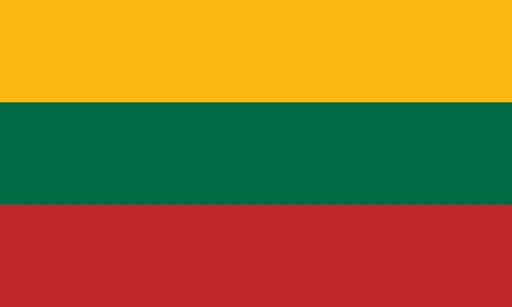
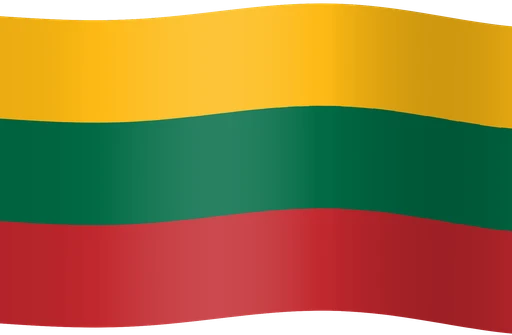
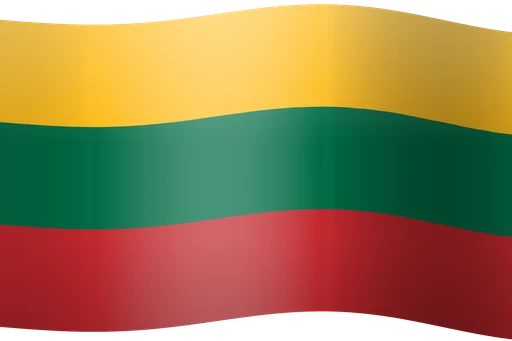
The flag of Lithuania is a horizontal tricolor of yellow, green, and red from the top down. Yellow represents the sun and prosperity, green the forests and the countryside, and red the courage and the blood shed for independence.
Lithuania's flag is a horizontal tricolor of yellow, green, and red, and for most of the twentieth century it was illegal to fly it. Banned for close to fifty years under Soviet rule, it came back into the open in 1988, a year before nearly two million people carried these colors and their Latvian and Estonian equivalents in a human chain across all three countries.
Banned in 1940, raised again in 1988
Lithuania's tricolor was officially adopted on August 1, 1922, following the country's declaration of independence in 1918 after World War I and the collapse of the Russian Empire. It didn't last long in public life. Soviet occupation in 1940 banned the tricolor entirely, replacing it with a Soviet-style flag featuring a hammer and sickle. Displaying the original flag became a criminal offense, punishable by imprisonment or deportation to Siberia.
The ban did not work especially well. Lithuanians kept flags in private homes, hidden in attics and behind walls. Underground publications, known as samizdat, reproduced the design. Diaspora communities in the United States and Germany flew it openly, a reminder that Lithuania still existed as a nation even after its statehood had been erased from the map.
By the late 1980s, Mikhail Gorbachev's glasnost policies had cracked open a narrow window, and the Lithuanian resistance movement Sąjūdis climbed through it. On October 7, 1988, the tricolor was publicly raised over Gediminas Tower in Vilnius for the first time in nearly five decades. Thousands watched. Many wept. That moment is widely considered a turning point on the road back to independence, which was formally re-declared on March 11, 1990. The flag's legal restoration came first, before the declaration itself.
Yellow, green, and red
Three equal horizontal bands make up the flag: yellow on top, green in the middle, red on the bottom. The precise shades are defined by the Law on the National Flag of the Republic of Lithuania, most recently refined in 2004 to ensure consistency across print and digital media.
Yellow, or auksinė, represents Lithuania's golden agricultural fields, the sun, and prosperity. There's also a connection to amber, the fossilized resin for which the Baltic coast is known; Lithuania has sometimes been called "the land of amber." Green, žalia, stands for the country's forests and the renewal of life, which is less abstract than it sounds: Lithuania is one of the most forested nations in Europe, with roughly a third of its land under woodland. Red, raudona, is for the blood shed for the nation and the courage of Lithuanian warriors, from medieval battles against the Teutonic Knights to twentieth-century resistance fighters.
Unusually for a European flag, these colors don't come out of a coat of arms tradition. They emerged from Lithuanian folk art, woven sashes (juostos), and embroidery patterns. No coat of arms or other emblem appears on the civil flag.
How the tricolor was chosen in 1918
When Lithuania declared independence on February 16, 1918, it had no established national flag. A new nation needed a new symbol, and designing one from scratch turned out to be a spirited debate. A commission was formed, and Jonas Basanavičius, the patriarch of the Lithuanian national revival, played a central role in shaping the discussion.
Early proposals leaned on the heraldic tradition of the Grand Duchy of Lithuania, particularly the Vytis, the armored knight on horseback that had represented Lithuanian power for centuries. But the commission ultimately chose a tricolor for its simplicity and modernity. The colors already had roots in folk textiles, which made the decision feel less like an invention and more like a recognition of something that had always been there. Proportions were set at 3:5, giving the flag a slightly wider appearance than many European tricolors. Placing yellow at the top was a deliberate choice: the sun rising above the landscape, rather than the more conventional arrangement of darker colors at the top. The tricolor was enshrined in law by the Constitution of Lithuania on August 1, 1922.
The Baltic Way
August 23, 1989 marked the 50th anniversary of the Molotov-Ribbentrop Pact, the secret agreement between Nazi Germany and the Soviet Union that had sealed the Baltic states' fate. To mark the occasion, approximately two million people formed a human chain stretching 675 kilometers through Estonia, Latvia, and Lithuania. They carried their national flags, including the Lithuanian tricolor, which had been publicly restored just months earlier but still carried the electric charge of the forbidden.
The images were broadcast globally. Grandmothers stood next to students, farmers next to professors, all holding up flags that their governments had tried to erase. The flags of all three Baltic nations appeared together, forging a visual solidarity that remains powerful to this day. For many participants, simply holding the tricolor openly was itself a radical act, an emotional one too. Some carried flags that had been hidden in their families for decades.
UNESCO now recognizes the Baltic Way as part of its Memory of the World Register, and flags carried during the demonstration are preserved as historical artifacts. The event attached the tricolor to nonviolent resistance as firmly as to nationhood.
Protocol and variants
Lithuanian law governs the flag's use in considerable detail. The Law on the National Flag specifies dimensions, occasions for display, and rules for mourning, including flying the flag at half-mast or fitting it with a black ribbon. Desecration of the flag is a criminal offense.
The state flag used by government institutions is identical in design to the civil flag. Lithuania doesn't maintain a separate civil ensign for maritime use that differs in color from the national flag, though a distinct naval ensign does exist: it features the Vytis in the upper hoist corner on a white field. The flag flies on all national holidays, including February 16 (Restoration of the State Day) and March 11 (Restoration of Independence Day). Flag-raising ceremonies on these occasions are major civic events, often attended by thousands. Lithuanians display their flag with genuine enthusiasm, draping it from balconies and windows. During the interwar period, a tricolor variant was used without precise color standardization. Modern digital and print standards now define the exact shades, eliminating the inconsistencies that once varied from one flag maker to the next.
The flag among its Baltic neighbors
Lithuania's tricolor belongs to a trio of Baltic state flags, alongside Latvia's dark red-white-dark red bicolor and Estonia's blue-black-white tricolor, that were all suppressed and restored during the same historical arc. Their stories are parallel but not identical, and seeing all three together instantly evokes the Baltic independence movements.
The Lithuanian flag is sometimes compared to Bolivia's and Ethiopia's tricolors due to similar color arrangements. The resemblance is purely coincidental: Lithuania's flag has no connection to the Pan-African color tradition, and its proportions and arrangement differ. One thing that sets Lithuania apart from many Central and Eastern European neighbors is the absence of blue, a relatively distinctive choice in the regional context. The historical Grand Duchy of Lithuania once stretched across enormous swaths of Eastern Europe, and its heraldic symbols, particularly the Vytis, continue to appear on the state coat of arms. The flag itself, however, remains deliberately non-heraldic.
The horizontal orientation puts Lithuania's tricolor in a different tradition from the vertical tricolors common in Western Europe, and in line with the Slavic and Baltic horizontal-stripe convention. Its palette of amber-yellow, forest-green and blood-red also sits outside both the blues and whites of Scandinavia and the reds and whites of its Slavic neighbors.
References
[1] Republic of Lithuania, Law on the National Flag of the Republic of Lithuania (official legislative text, available via e-seimas.lrs.lt)
[2] Senn, Alfred Erich. Lithuania Awakening. University of California Press, 1990. Covers the Sąjūdis movement and flag restoration in detail.
[3] Smith, Graham, et al. The Baltic States: The National Self-Determination of Estonia, Latvia and Lithuania. St. Martin's Press, 1994.
[4] UNESCO Memory of the World Register, Baltic Way entry (unesco.org)
[5] FOTW (Flags of the World), Lithuania entry (crwflags.com/fotw/flags/lt.html), a peer-reviewed vexillological reference.
[6] Misiunas, Romuald J., and Rein Taagepera. The Baltic States: Years of Dependence, 1940-1990. University of California Press, 1993.
[7] Rimša, Edmundas. Heraldry: Past to Present. Versus aureus, 2005. Covers Lithuanian state symbols including flag and coat of arms history.
[8] Kasparavičius, Algimantas. "The Historical Roots of the Lithuanian State Symbols." Lietuvos istorijos studijos, Vol. 5, 1997.
Common questions
- What do the colors of the Lithuanian flag mean?
- Yellow stands for sunshine and prosperity, green for the landscape and freedom, and red for courage and sacrifice.
- Why was the Lithuanian flag banned during the Soviet era?
- The Soviet Union banned the Lithuanian flag to suppress national symbols and impose their own, maintaining control during the occupation.
- What do the colors on the Lithuanian flag mean?
- Yellow represents the sun, the golden fields, and the amber Lithuania is known for. Green stands for the country's forests and the renewal of life. Red is for the blood shed fighting for independence and the courage of Lithuanian warriors.
Featured in these articles
Download this flag
Free in 12 styles, from 32px icons up to 2000px, as SVG, PNG, WebP and JPG.