The Flag of the Second Spanish Republic
Spanish Republic
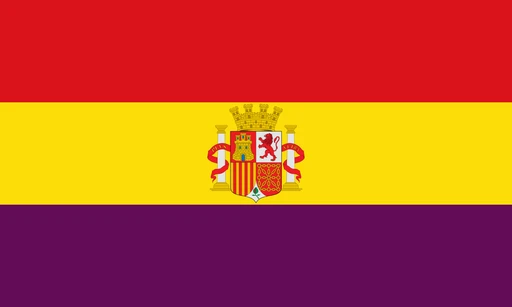
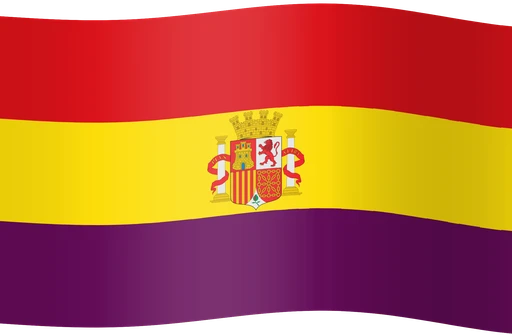
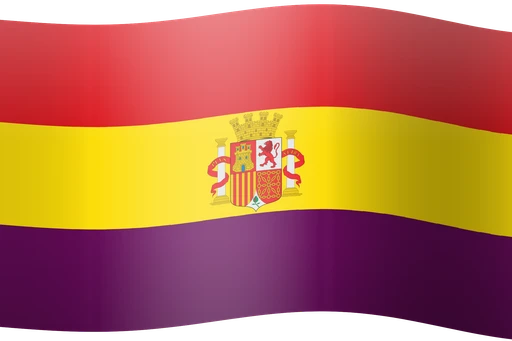
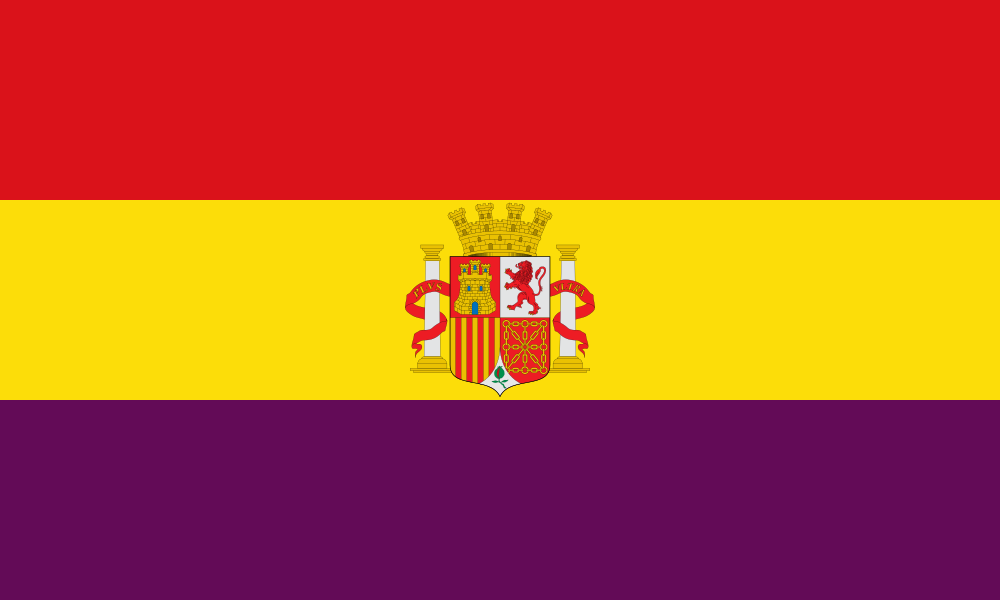
The flag of the Second Spanish Republic has three horizontal bands of equal width, red on top, yellow in the middle and dark purple at the bottom, with the coat of arms of the Republic in the centre of the yellow band. Red and yellow came from the flag Spain had flown since the 19th century. The purple was added for Castile, which the adopting decree calls "an illustrious region, the nerve of the nationality." The arms show Castile, León, Aragon, Navarre and Granada under a mural crown, between the Pillars of Hercules. A decree of 27 April 1931 adopted the flag. It flew until the Republic's defeat on 1 April 1939.
The flag of the Second Spanish Republic is the only national flag Spain has flown with purple in it. Three equal bands run across it: red, yellow and dark purple, with a coat of arms in the middle. It was official for eight years, from 1931 to 1939. The purple band was a tribute to Castile, and it rests on a piece of history that historians now doubt.
Three equal bands and a coin
The design is set out in article 2 of a decree dated 27 April 1931. Flags are to be "formed by three horizontal bands of equal width, the upper one red, the central one yellow and the lower one dark purple." That was a break in shape as well as colour. On the royal flag, the yellow band was twice the width of each red one.
The decree does not draw the coat of arms. It points to a coin. The arms are the ones "on the reverse of the five-peseta coins minted by the Provisional Government in 1869 and 1870." That shield has four quarters for Castile, León, Aragon and Navarre, with Granada at the base. A mural crown, shaped like a city wall, sits on top where the royal crown used to be. The Pillars of Hercules stand on either side, tied with a ribbon reading "Plus Ultra."
Merchant ships got a simpler version. Article 5 says their flags are the same "but without the shield."
You will not find proportions in the decree. It says only that flags keep "the same form and dimensions as those used until now." Flags of the World records a circular order of 6 May 1931 that set the flag for coastal fortresses and official buildings at 1.35 by 2.25 metres, which works out at 3:5. The image on this page follows that shape, and the colour values listed here are taken from that drawing.
Why purple?
The decree's preamble explains the third colour in one sentence. The old flag is folded away. "Of it the two colours are kept and a third is added, which tradition admits as the emblem of an illustrious region, the nerve of the nationality." The region is Castile.
The idea was already sixty years old. The historians José Luis González Fernández and Marie-Angèle Orobon trace it to the revolution of 1868. Early in 1869 a group of Madrid councillors, led by Fernández de los Ríos and Becerra, proposed replacing their gold medal of office with a silk sash. It would add to the national red and yellow "purple, the colour of the old banner of Castile." Liberals had tied purple to the comunero revolt of 1521 since the 1820s.
Was the banner of Castile purple? Margarita Márquez Padorno and Mirta Núñez Díaz-Balart have argued it either never existed or was red. The Flags of the World contributor Santiago Dotor adds an irony. The historical banner was a royal standard, an odd model for a republic.
None of that slowed the colour down. Orobon calls purple "the true chromatic identity of the Republic," and writes of a "morado-manía" in the newspapers that covered 14 April 1931.
Raised before it was legal
The tricolour spent decades as a party flag. From 1868 it belonged to the federal republicans. When the First Republic was proclaimed on 11 February 1873, it did not adopt it. Two days later, onlookers in Palma de Mallorca counted four different banners in the same celebration: one red and yellow, one red, one "red, yellow and purple," and one described only as "tricolour." The official flag of that republic stayed red and yellow. Under the dictatorship of Miguel Primo de Rivera in the 1920s, the tricolour became the flag of republicans of every kind.
Then came the municipal elections of 12 April 1931. In Éibar, an industrial town in the Basque Country, the new council met at six in the morning on 14 April. The minutes, quoted in Spain's official gazette, record what happened next. The mayor, Alejandro Tellería, and the councillors went out to the central balcony of the town hall and "proceeded to raise the flag of the Republic, which was greeted with cheers and loud applause." King Alfonso XIII left the country that day.
The Provisional Government caught up on 27 April. Its decree, signed by Niceto Alcalá-Zamora, admits as much. The people had already raised the flag "across the whole territory," and the government was sanctioning "a consummated fact." The tricolour, it says, "no longer denotes the hope of a party." The same decree sent the old regimental colours to museums. They were to be handed over "with the correctness, seriousness and respect they deserve," though without troops on parade.
The Constitution of 9 December 1931 settled the matter in its first article: "The flag of the Spanish Republic is red, yellow and purple."
Two flags, one war
The army officers who rose against the Republic in July 1936 did so under the three colours. That lasted six weeks. On 29 August 1936, in Burgos, Miguel Cabanellas signed Decree 77 as president of the Junta de Defensa Nacional. Its single article reads: "The bicolour flag, red and yellow, is restored as the flag of Spain." From then on, each side of the Civil War flew its own flag.
Republican army units carried a plain tricolour in proportions of 2:3. The International Brigades put a three-pointed red star on the yellow band. The Republic lost the war on 1 April 1939.
A flag without a state
The tricolour did not disappear in 1939. The Republican government in exile kept it, first in Paris, then in Mexico City from 1940 to 1946, then in Paris again until 1977. Mexico was among the countries that kept diplomatic relations with it after the Second World War.
Spain today flies the red and yellow flag. The tricolour has no official standing, but you will still see it at demonstrations, carried by trade unions, left-wing parties and people who want Spain to be a republic again.
References
[1] "Decreto del Gobierno Provisional de la República, de 27 de abril de 1931," Gaceta de Madrid, no. 118, 28 April 1931, pp. 359-360. https://www.boe.es/datos/pdfs/BOE/1931/118/A00359-00360.pdf
[2] "Constitución de la República Española," Gaceta de Madrid, extraordinary issue, 9 December 1931. https://www.boe.es/gazeta/dias/1931/12/09/pdfs/D00001-00014.pdf
[3] "Decreto núm. 77," Boletín Oficial de la Junta de Defensa Nacional de España, no. 14, 30 August 1936. https://www.boe.es/gazeta/dias/1936/08/30/pdfs/BJD-1936-14.pdf
[4] "Resolución de 7 de abril de 2025, de la Secretaría de Estado de Memoria Democrática, por la que se publica el Acuerdo de incoación del procedimiento de declaración de Lugar de Memoria Democrática de la Ciudad de Éibar," Boletín Oficial del Estado, no. 90, 14 April 2025. https://www.boe.es/boe/dias/2025/04/14/pdfs/BOE-A-2025-7569.pdf
[5] José Luis González Fernández and Marie-Angèle Orobon, "La Europa de los tres colores: banderas europeas en ruptura," Historia y comunicación social 28(1), 2023, pp. 21-30. https://dx.doi.org/10.5209/hics.85602
[6] "Second Spanish Republic (1931-1939)," Flags of the World. https://cdn.fotw.info/flags/es1931.html
[7] "Flag of the Second Spanish Republic," Wikipedia. https://en.wikipedia.org/wiki/Flag_of_the_Second_Spanish_Republic
[8] "Spanish Republican government in exile," Wikipedia. https://en.wikipedia.org/wiki/Spanish_Republican_government_in_exile
Common questions
- What does the flag of the Second Spanish Republic mean?
- The decree of 27 April 1931 gives the official reading. The flag stands for peace and for citizens working together under fair laws. Red and yellow were kept from the flag Spain adopted in the middle of the 19th century. The purple band was added as the emblem of "an illustrious region, the nerve of the nationality," meaning Castile. The decree says the three colours together sum up the harmony of a great Spain.
- Why is there purple on the Spanish Republican flag?
- Purple was meant to represent Castile. Nineteenth-century liberals believed the old banner of Castile, carried in the comunero revolt of 1521, had been purple. In 1869 a group of Madrid councillors proposed a sash adding purple to the national red and yellow for that reason. Historians Margarita Márquez Padorno and Mirta Núñez Díaz-Balart have argued the purple banner either never existed or was red.
- When was the Spanish Republican flag adopted?
- The Provisional Government adopted it by decree on 27 April 1931, thirteen days after the Republic was proclaimed on 14 April. The Gaceta de Madrid published the decree on 28 April 1931. The Constitution of 9 December 1931 confirmed it in article 1, which says: "The flag of the Spanish Republic is red, yellow and purple."
- How is the Republican flag different from the current flag of Spain?
- Spain's current flag has two red bands and a yellow band twice as wide between them. The Republican flag has three bands of equal width, and the bottom one is dark purple. The arms differ too. The Republican arms carry a mural crown instead of a royal crown, the pillars have no crowns, and there is no Bourbon shield in the middle.
- When did Spain stop using the Republican flag?
- It depended on which side of the Civil War you stood. The rebel Junta de Defensa Nacional restored the red and yellow flag by Decree 77, signed in Burgos on 29 August 1936. The Republic kept the tricolour until its defeat on 1 April 1939. The Republican government in exile went on using it until 1977.
- Did the Republican flag always have a coat of arms?
- No. The 1931 decree put the arms in the centre of the yellow band on the national flag and on navy flags. Merchant ships flew the same three bands without the arms. Republican army units in the Civil War also carried a plain tricolour, in proportions of 2:3. The International Brigades added a three-pointed red star to the yellow band.
Download this flag
Free in 12 styles, from 32px icons up to 2000px, as SVG, PNG, WebP and JPG.