The Flag of South Vietnam
Republic of Vietnam
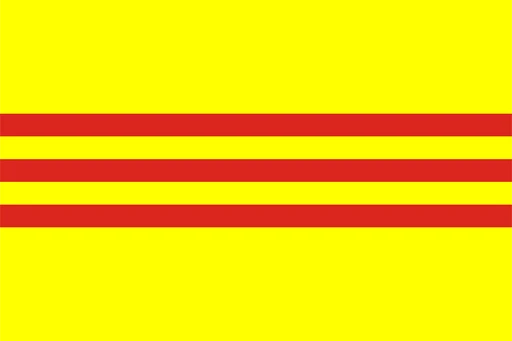
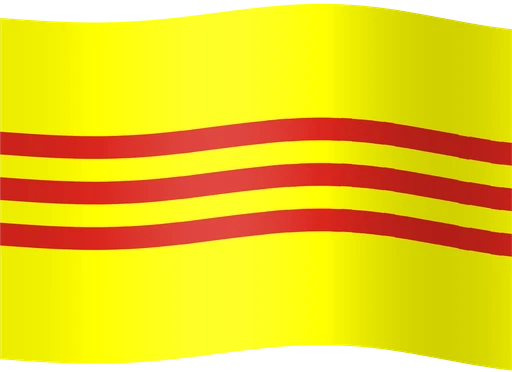
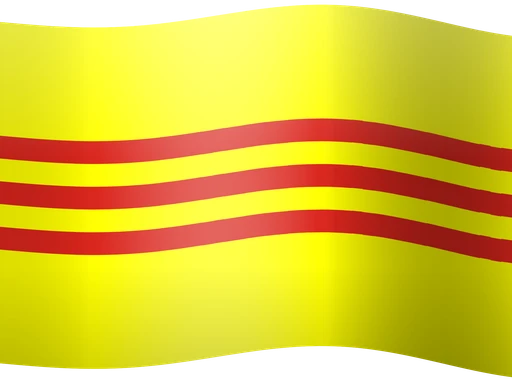
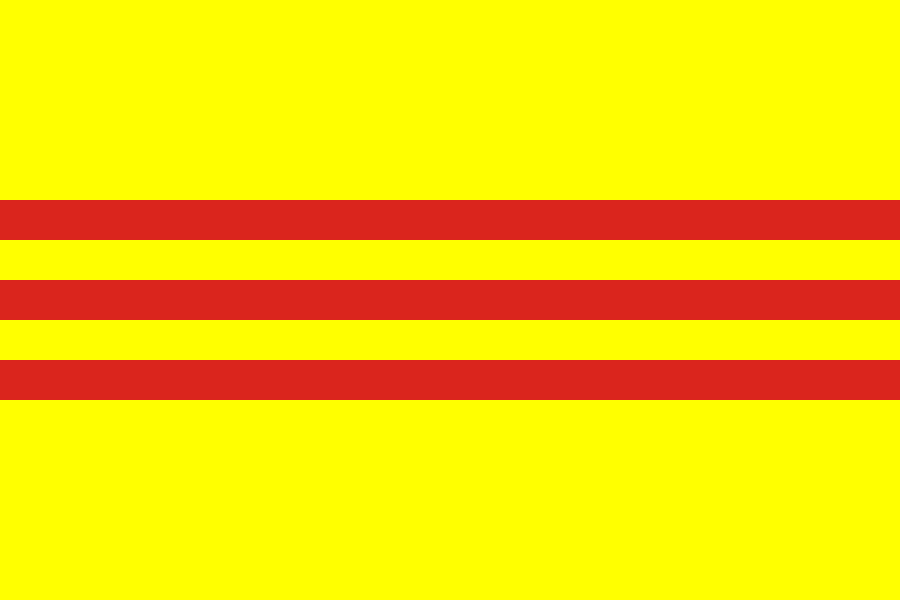
The flag of South Vietnam is a yellow field with three horizontal red stripes across the middle, in proportions of 2:3. The stripes and the two yellow gaps between them are all the same height. Yellow was the color of the Nguyễn emperors. The three stripes are most often read as the north, center and south of Vietnam. A second reading sees the Càn trigram, the sign for heaven. An ordinance of 2 June 1948 adopted the design. It served the State of Vietnam from 1949 and the Republic of Vietnam from 1955 until the fall of Saigon on 30 April 1975. Vietnamese communities abroad still fly it.
The flag of South Vietnam is a yellow rectangle with three red stripes across its middle. It flew over a state for 27 years, from 1948 to 1975. It has now spent longer than that as the flag of people who left. In Vietnam the state treats it as a sign of treason. In Virginia it is written into state law.
Yellow came first
Yellow was the color of the Nguyễn emperors, and several yellow flags came before this one.
The Nguyễn court flew the Long Tinh flag in its final years. It was yellow with one broad red stripe, modeled on the ribbon of the Order of the Dragon of Annam. In March 1945 Japan removed the French colonial authorities and proclaimed the Empire of Vietnam under Bảo Đại. From June to August of that year the empire used a yellow flag with a red Ly trigram: three stripes, the middle one broken. In June 1946 the French set up an autonomous republic in Cochinchina, the south. Its flag was yellow with three blue stripes.
So by 1948 a yellow field with horizontal stripes was a familiar idea. The three-stripe design itself was new. You will often read that Emperor Thành Thái decreed it in 1890. In December 2014 the researcher Phạm Quang Tuấn went looking for the evidence and published what he found in Văn Việt. A 2004 article by Nguyễn Đình Sài had cited the website of Ben Cahoon. Cahoon's site had cited Sài's article. Cahoon told Tuấn in May 2014 that he held no detailed records on Vietnamese flags. Tuấn found no picture of the three-stripe flag from before 1948. Two paintings from Thành Thái's reign show yellow flags, one with Chinese characters and one with a red border.
One ordinance, three bands
On 2 June 1948 Brigadier General Nguyễn Văn Xuân signed an ordinance as prime minister of the Provisional Central Government of Vietnam, a government formed in association with France. It was printed in the official gazette, the Công-báo Việt-Nam, on 4 June.
The text is short. "The national emblem is a flag of yellow background, the height of which is equal to two-thirds of its width. In the middle of the flag and along its entire width, there are three horizontal red bands." Each band has a height of one-fifteenth, and the bands are separated by a space of their own height.
That gives a 2:3 flag with five equal strips in the middle: red, yellow, red, yellow, red. English translations of the ordinance say one-fifteenth "of the width." The usual construction takes that as the flag's shorter side, so each strip is one-fifteenth of the height and the five together fill the middle third. The master image on this page follows that construction.
The ordinance, as quoted, names no shades. The image here uses #ffff00 for the yellow and #da251d for the red, the values in the public domain drawing it comes from.
It also assigns no meaning. The common reading is that the three bands stand for the north, the center and the south of Vietnam, the three regions the new government claimed to unite. A second reading sees the Càn trigram of three unbroken lines, the sign for heaven.
The flag was first raised on 5 June 1948 aboard the ship Dumont d'Urville off Hạ Long Bay, during the signing of the Hạ Long Bay agreements by Xuân and the French High Commissioner Émile Bollaert.
Who drew it?
No one is named in the ordinance, and three stories compete.
The best known comes from the historian Nguyễn Ngọc Huy, writing in 1988. He said the flag was drawn by the painter Lê Văn Đệ and chosen by Bảo Đại from many drawings shown to him at a meeting in Hong Kong in 1948. Lê Văn Đệ was born in Bến Tre province in 1906 and went to Paris on a scholarship in 1930 to study at the Beaux-Arts. He later founded the national fine arts school in Saigon, where he died in 1966.
A second account credits Tôn Thất Sa. A third credits a group led by Trần Văn Đôn and Lê Văn Kim. This page leaves the designer field empty for that reason.
Three governments, one flag
The Provisional Central Government lasted a year. In 1949 it gave way to the State of Vietnam, with Bảo Đại as head of state, and the flag stayed. In 1955 the State of Vietnam became the Republic of Vietnam, known abroad as South Vietnam. The flag stayed again.
The United States put it on a medal. President Lyndon Johnson established the Vietnam Service Medal by Executive Order 11231 on 8 July 1965, and the design of the flag was worked into it.
Saigon fell on 30 April 1975. The Republic of Vietnam ended that day, and so did the flag's life as a state symbol. The flag of the Provisional Revolutionary Government, red over blue with a yellow star, took its place in the south. Vietnam was reunified on 2 July 1976 under the red flag with the yellow star.
A second life abroad
Hundreds of thousands of Vietnamese resettled in the United States after 1975, and they took the yellow flag with them.
How much it mattered became clear in Westminster, California, in 1999. On 17 January Trần Văn Trường hung a photograph of Ho Chi Minh in Hi-Tek Video, his shop on Bolsa Avenue in Little Saigon. The next day he added the flag of the Socialist Republic of Vietnam. Protests ran until 11 March. About 15,000 people came to a vigil on the evening of 26 February, and police made 52 arrests over the course of the protests.
Recognition by American governments began in 2002. Virginia's statute, passed in 2004, is one sentence long. It recognizes "the flag of the former Republic of Vietnam, with three horizontal red stripes on a field of golden-yellow" as the Vietnamese-American Heritage Flag. On 27 June 2023 Representatives Michelle Steel and Luis Correa introduced House Resolution 560, which calls it the Vietnamese Heritage and Freedom Flag. Its preamble counts formal recognition by 20 states, 15 counties and 85 cities. The resolution was referred to committee.
The flag is recognized outside the United States too. In 2008 Canada's immigration minister, Jason Kenney, recognized it as a symbol of the Vietnamese-Canadian community. Australian city councils, among them Maribyrnong and Brimbank, have passed recognition motions since 2015.
There is no emoji for it. Flag emoji follow ISO country codes, and the code VN passed to the Socialist Republic of Vietnam in 1977. In 2025 the San Jose City Council voted unanimously to urge the Unicode Consortium to add one.
What Hanoi sees
Vietnam has no law that bans the flag by name. Radio Free Asia reports that the state treats it as a symbol of treason, that displaying it is considered subversive and that penalties run as far as prison. State media avoid showing it at all. In January 2022 Vietnam Television postponed its broadcast of a soccer match played in Australia because fans in the stadium were waving yellow flags.
The objection reaches abroad. In 2023 an Australian coin honoring Australians who fought in the Vietnam War carried the flag. Vietnam's deputy foreign ministry spokesperson, Pham Thu Hang, protested the release of items carrying "the flag of a regime which is no longer in existence."
Not every use abroad has been welcome to the diaspora either. Yellow flags appeared in the crowd at the attack on the US Capitol on 6 January 2021. Forty-five Vietnamese American figures condemned their use there.
References
[1] Ordinance of 2 June 1948 on the national flag, Công-báo Việt-Nam, first year, no. 1, 4 June 1948, p. 9.
[2] Code of Virginia § 2.2-3310.2, "Vietnamese-American Heritage Flag" (2004, c. 970). Virginia Legislative Information System. https://law.lis.virginia.gov/vacode/title2.2/chapter33/section2.2-3310.2/
[3] H. Res. 560, 118th Congress, "Recognizing the Vietnamese Heritage and Freedom Flag as the official symbol of the Vietnamese-American community in the United States," 27 June 2023. US Government Publishing Office. https://www.govinfo.gov/content/pkg/BILLS-118hres560ih/html/BILLS-118hres560ih.htm
[4] Executive Order 11231, "Establishing the Vietnam Service Medal," 8 July 1965. The American Presidency Project. https://www.presidency.ucsb.edu/documents/executive-order-11231-establishing-the-vietnam-service-medal
[5] Phạm Quang Tuấn, "Cờ vàng sọc đỏ có từ thời vua Thành Thái?," Văn Việt, 5 December 2014. https://vanviet.info/tu-lieu/co-vng-soc-do-c-tu-thoi-vua-thnh-thi/
[6] Nguyễn Đình Sài, "The National Flag of Viet Nam: Its Origin and Legitimacy," translated by Vũ Phương Uyên, 2004. https://flaggenlexikon.de/pix/TheNationalFlagofVN.pdf
[7] "EXPLAINED: Why does the South Vietnamese flag spark tension?," Radio Free Asia, 31 August 2024. https://www.rfa.org/english/news/vietnam/south-vietnam-flag-explained-08302024215421.html
[8] "Flag of South Vietnam," Wikipedia. https://en.wikipedia.org/wiki/Flag_of_South_Vietnam
[9] "Quốc kỳ Việt Nam Cộng hòa," Wikipedia (Vietnamese). https://vi.wikipedia.org/wiki/Qu%E1%BB%91c_k%E1%BB%B3_Vi%E1%BB%87t_Nam_C%E1%BB%99ng_h%C3%B2a
[10] "List of flags of Vietnam," Wikipedia. https://en.wikipedia.org/wiki/List_of_flags_of_Vietnam
[11] "Hi-Tek incident," Wikipedia. https://en.wikipedia.org/wiki/Hi-Tek_incident
[12] "Lê Văn Đệ," Wikipedia. https://en.wikipedia.org/wiki/L%C3%AA_V%C4%83n_%C4%90%E1%BB%87
Common questions
- What do the three red stripes on the South Vietnam flag mean?
- The usual reading is that the stripes stand for the three regions of Vietnam: north, center and south. A second reading treats them as the Càn trigram, three unbroken lines that stand for heaven. The yellow field was the color of the Nguyễn emperors. The 1948 ordinance, as it is quoted today, gives the measurements of the flag and assigns no meaning to any part of it.
- Who designed the flag of South Vietnam?
- The credit is disputed. The historian Nguyễn Ngọc Huy wrote in 1988 that the painter Lê Văn Đệ drew it and that former emperor Bảo Đại picked it from many drawings at a meeting in Hong Kong in 1948. Other accounts credit Tôn Thất Sa, or a group led by Trần Văn Đôn and Lê Văn Kim. The ordinance of 2 June 1948 names no designer.
- When was the South Vietnam flag used?
- It was adopted on 2 June 1948 by the Provisional Central Government of Vietnam. The State of Vietnam used it from 1949, and the Republic of Vietnam used it from 1955. It stopped being a state flag on 30 April 1975, when Saigon fell. The flag of the Provisional Revolutionary Government replaced it in the south until Vietnam was reunified on 2 July 1976.
- Is the South Vietnam flag older than 1948?
- No evidence supports that. A widely repeated claim says Emperor Thành Thái decreed the flag in 1890. In 2014 the researcher Phạm Quang Tuấn traced the claim to a 2004 article and a website that cited each other. He found no image of the three-stripe flag from before 1948. Earlier yellow flags existed, but they carried one red stripe or a broken trigram.
- Why do Vietnamese Americans still fly the South Vietnam flag?
- Many of them fled Vietnam after 1975, and the flag stands for the country they left and for opposition to communist rule. Virginia law has recognized it since 2004 as the Vietnamese-American Heritage Flag. A resolution introduced in the US House of Representatives in June 2023 counted formal recognition by 20 states, 15 counties and 85 cities.
- Is the South Vietnam flag banned in Vietnam?
- No law bans the flag by name. In practice the state treats it as a symbol of treason. Radio Free Asia reports that displaying it is considered subversive and brings penalties as severe as prison, and that state media avoid showing it. In January 2022 Vietnam Television postponed airing a soccer match played in Australia after fans waved the flag in the stadium.
Download this flag
Free in 12 styles, from 32px icons up to 2000px, as SVG, PNG, WebP and JPG.