The Flag of Saint Pierre and Miquelon
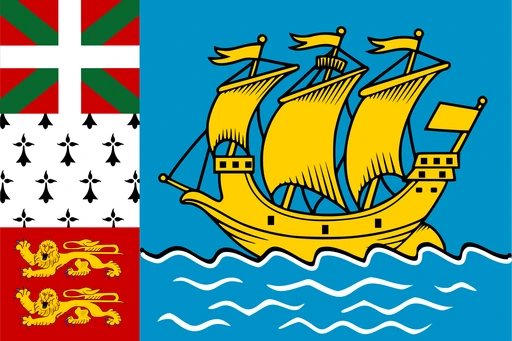
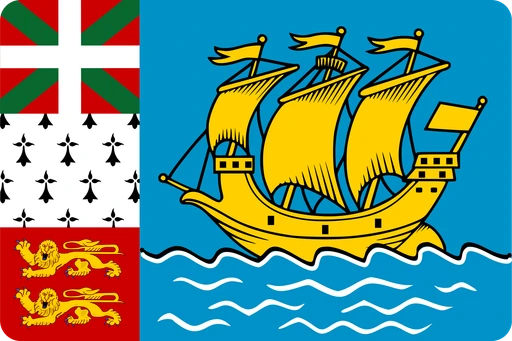
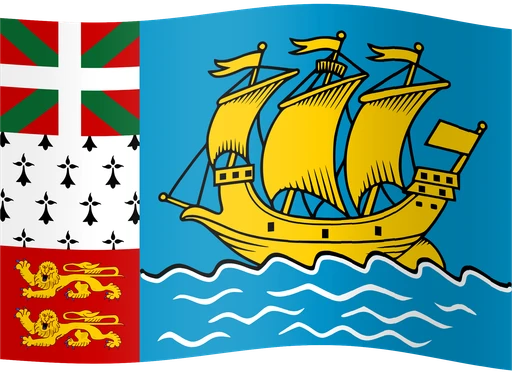
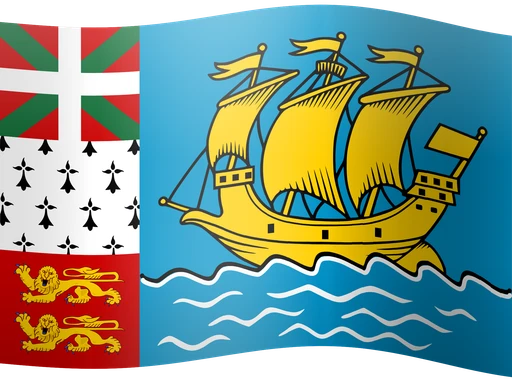
The flag of Saint Pierre and Miquelon has a blue field with a yellow ship on it, said to be the Grande Hermine, the vessel that brought Jacques Cartier to the islands in 1536. A yellow scroll above the ship carries the name of the islands. A cross made of one blue and one red stripe quarters the flag, and each quarter holds another flag: the Basque flag at the upper hoist, the Breton flag at the upper fly, Normandy at the lower hoist, and France at the lower fly. Between them they account for the main groups of settlers and the colonial history of the islands.
The flag of Saint Pierre and Miquelon belongs to a French overseas collectivity sitting off the eastern coast of Canada, and it borrows from the several places its settlers came from.
Adopted in 1982
Local authorities adopted the flag in 1982. Until then the islands used the French tricolor, in keeping with their status within the French Republic.
Europeans first explored the region in the early 16th century, and governance passed back and forth between France and Britain more than once. The 1982 design came out of a local wish to say something specific about the islands while staying French, and its adoption was a claim to cultural distinctiveness rather than to independence.
Cartier's ship and the settlers' flags
The main field is blue, with a yellow ship on it: La Grande Hermine, the vessel Jacques Cartier used on his 1535 expedition to the Gulf of Saint Lawrence. The blue stands for the Atlantic, which governs almost everything about life on the islands, and the ship for exploration, navigation, and the fishing industry that kept the place going for centuries.
Along the hoist runs a vertical stripe carrying the flags of the Basque Country, Brittany, and Normandy. These mark the origins of many of the islanders. The Basque flag acknowledges the Basque fishermen who worked these waters, while the Breton and Norman flags stand for settlers from those regions of France.
Where it flies
The flag is displayed on government buildings and flown at official events, usually alongside the flag of France. Protocol covers when it goes up, including public holidays and occasions tied to the islands' own identity, and it also appears at cultural and sporting events. Community groups and cultural organizations use it in their own activities.
For residents the flag is mostly a reminder of where the islands came from: European settlement on a North American shore, and a livelihood built on fishing and navigation.
Similar flags and influences
The obvious connections are to the Basque Country, Brittany, and Normandy, whose flags sit in the hoist stripe. Beyond that, French vexillological habits shape the design. A blue field standing for water is common in maritime flags, and the use of regional stripes fits a wider French pattern of marking local identities inside a single national frame.
References
[1] Government of Saint Pierre and Miquelon: History and Culture (https://www.collectivitesaintpierre.mi)
[2] FIAV: Saint Pierre and Miquelon Flag Information (https://flagspot.net/flags/pm.html)
Common questions
- What are the three flags in the corner of Saint Pierre and Miquelon's flag?
- The Basque flag at the upper hoist, the Breton flag at the upper fly, and the flag of Normandy at the lower hoist, with the French flag at the lower fly. Between them they account for the main groups of settlers who populated the islands.
- What is the ship on the Saint Pierre and Miquelon flag?
- The Grande Hermine, the vessel that brought Jacques Cartier to the islands in 1536. It is shown in yellow on the blue field, with a yellow scroll above carrying the islands' name. The ship stands for the French claims in the New World that followed Cartier's voyages.
- Is the Saint Pierre and Miquelon flag official?
- No. It was adopted unofficially in 1982 and has no official status, but it is used widely across the islands. The official flag remains the French tricolore, as with other French overseas collectivities.
- Why are Saint Pierre and Miquelon French?
- The islands have been under French control since 1763, apart from brief periods of British occupation, and are the last remaining part of the former colony of New France. They sit off the coast of Newfoundland, closer to Canada than to any other French territory.
Download this flag
Free in 12 styles, from 32px icons up to 2000px, as SVG, PNG, WebP and JPG.