The Flag of Panama
Republic of Panama
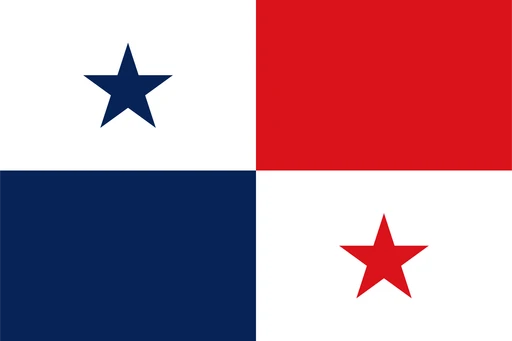
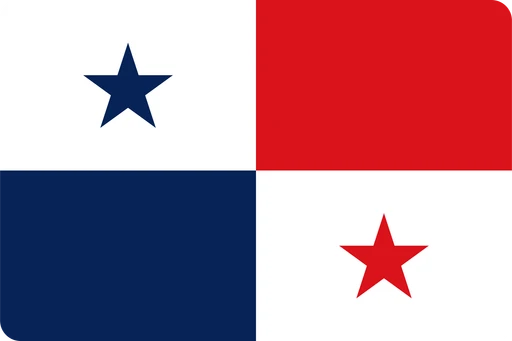
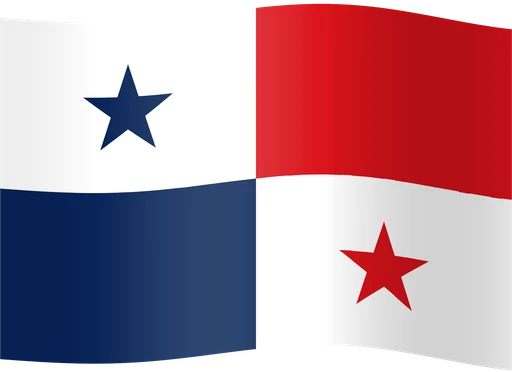
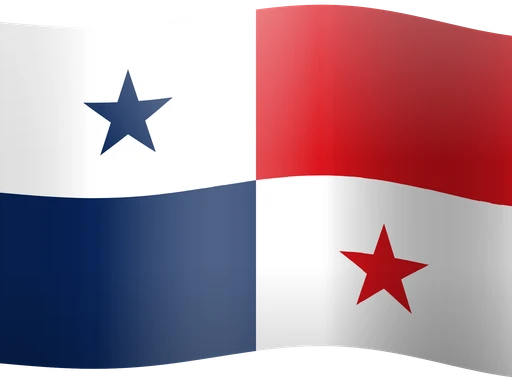
The flag of Panama is quartered. The upper hoist and lower fly quarters are white, each with a star in the center, blue in one and red in the other. The upper fly quarter is red and the lower hoist quarter is blue. White is peace, the blue star is purity and honesty, and the red star is authority and law.
The flag of Panama is a rectangle cut into four quarters: a blue star on white at the upper hoist, a red star on white at the lower fly, solid red at the upper fly, and solid blue at the lower hoist.
Independence from Colombia
The flag dates from 1903 and Panama's separation from Colombia. Manuel E. Amador, son of the country's first president, drew it, and María de la Ossa de Amador, his father's wife, sewed the first ones with the help of her sister-in-law and her niece. It was flown from November 3, 1903, the day of the separation. Other designs had been considered, and even the winning one was not final: the quarters were rearranged in December 1903, and it was in that form that the National Assembly adopted it provisionally by Law 64 of 1904. Definitive adoption came much later, by Law 48 of March 25, 1925, more than two decades after the flag was already in use.
Independence arrived while the Panama Canal was being built, which is the other half of the story. The canal is why a small new country carried strategic weight from the start.
Four quarters, two parties
White is peace. Red is the Liberal party and blue the Conservative party, the two forces that had defined Colombian and then Panamanian politics. Giving each a quarter of the flag, with white quarters between them, was the point of the design. The stars stand for the new republic and for the hope of a working relationship between the factions.
It is an unusual basis for a national flag: not a monarch, a religion, or a landscape, but a truce between two political parties.
Where it flies
The flag is flown on government buildings, at national celebrations, and abroad. Protocol covers its display and handling, and it is raised on Independence Day and at government and military ceremonies. There are variants for military use and for occasions where it appears beside the national coat of arms.
References
[1] Panama's National Institute of Culture (INAC)
[2] World Vexillological Research Institute
[3] Library of Congress: Historical Records on Panama
[4] Smithsonian Institution: Panama Canal and National Symbols
Common questions
- What do the colors and stars on Panama's flag mean?
- Red is the Liberal party, blue the Conservative party, and white is peace. The stars stand for the new republic and for the hope that the two factions would get along.
- Who created Panama's flag?
- Manuel E. Amador, son of Panama's first president Manuel Amador Guerrero, drew the design. María de la Ossa de Amador sewed the first flag.
Featured in these articles
Download this flag
Free in 12 styles, from 32px icons up to 2000px, as SVG, PNG, WebP and JPG.