The Flag of Nunavut
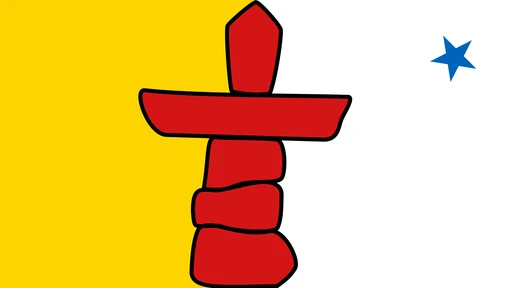
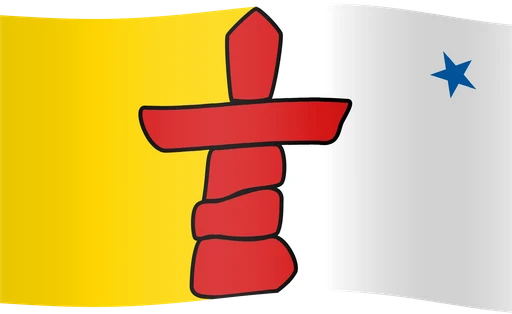
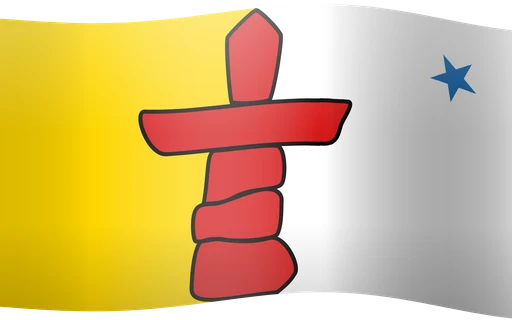
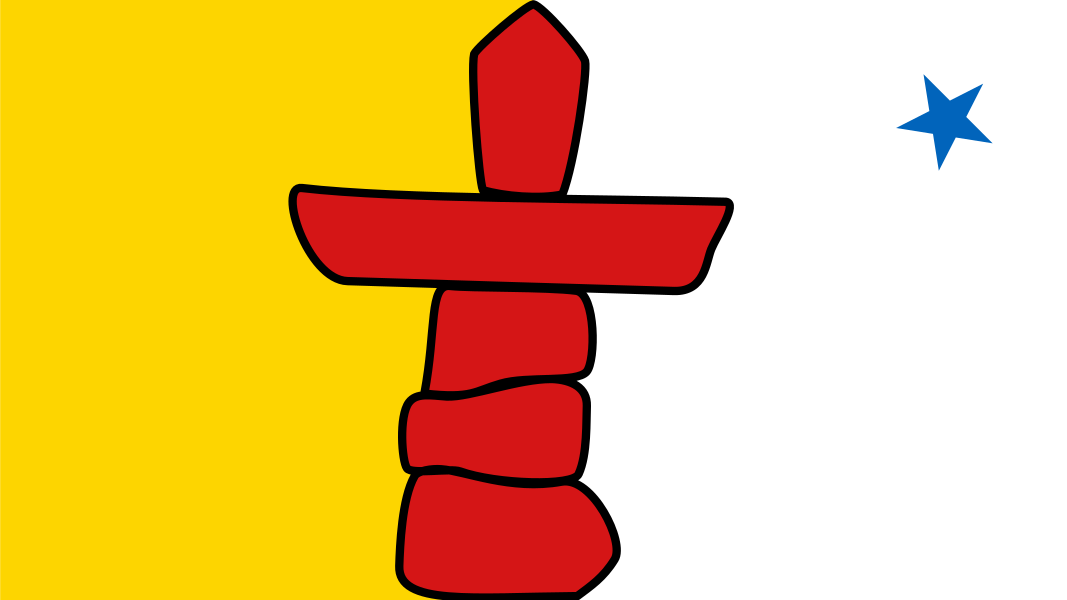
The flag of Nunavut is split down the middle, gold at the hoist and white at the fly, with a red inuksuk outlined in black standing on the dividing line and a blue star in the upper fly corner. The inuksuk is the stone marker Inuit build to guide people on the land and to mark sacred and special places. The star is the Niqirtsuituq, the North Star, a fixed point for navigation and a symbol of the leadership of community elders. Blue and gold stand for the riches of the land, sea and sky. Red refers to Canada.
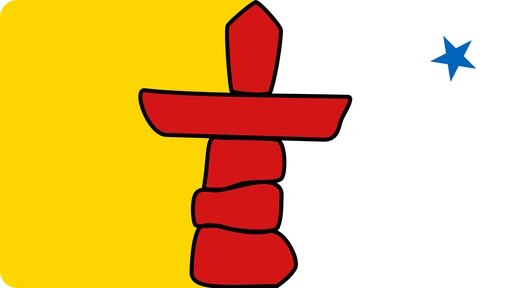
Nunavut's flag is half gold and half white. A red inuksuk outlined in black stands on the line where the two colours meet, and a blue star sits in the upper corner of the white half. It went up a pole for the first time on 1 April 1999, the day the territory itself came into being, after four years of meetings, a public contest and a lot of magic markers.
A stone marker and a star that stays put
The formal description sits in the Public Register of Arms, Flags and Badges of Canada, kept by the Governor General's office. The blazon reads: "Per pale Or and Argent overall an inuksuk Gules in sinister canton a mullet (niqirtsuituq) Azure." In plain English, that is a field divided down the middle into gold and white, a red inuksuk over the top of both, and a blue star in the upper corner away from the pole.
The same entry gives the meaning. Blue and gold stand for the riches of the land, sea and sky. Red refers to Canada. The inuksuk represents the stone monuments that guide people on the land and mark sacred and other special places. The star is the Niqirtsuituq, the North Star. It is the traditional guide for navigation, and it stands for the leadership of elders in the community.
Neither the register entry nor the territory's flag law quoted below gives measurements or colour codes. The flag is normally drawn nine units high and sixteen wide, and the image on this page follows that shape. The colour values listed here are taken from that drawing.
Four years, 800 entries and no winner
Nunavut means "our land" in Inuktitut. Parliament charged a body called the Nunavut Implementation Commission with designing the new territory's government. On 29 June 1995 the commission set up a Symbols Committee, chaired by Meeka Kilabuk of Iqaluit. The story of what followed comes from Robert Watt, the Chief Herald of Canada, who advised the commission and later described the work to a congress of flag scholars.
In November 1996 the commissioners decided two things. They wanted a coat of arms and a flag by official grant, with the same standing as Canada's other national, provincial and territorial symbols. They also wanted the public involved. In the spring of 1997 Kilabuk led Watt on a tour of Rankin Inlet, Baker Lake, Cape Dorset, Iqaluit and Pangnirtung to see the land and the art. A contest open to all of Canada ran from 15 May 1997 to 15 February 1998.
A selection committee of artists and elders met in Iqaluit from 6 to 10 April 1998 and went through 800 submissions. More than 500 of them were flag designs, most from people living in what became Nunavut. Many showed an inuksuk and the North Star. None was a clear winner, which surprised the committee. So its members picked ten front-runners and started refining the ideas themselves. Watt remembered the group testing colours with markers until someone had to open the door to clear the fumes. It was minus 15 degrees Celsius outside.
One entry shaped the layout. Watt wrote that a vertical design in white and gold, submitted by a seven-year-old, influenced the flag's structure.
Forty inuksuit
The committee's ideas went to Ottawa, where Debbie MacGarvie of the Canadian Heraldic Authority drew up five flag designs in May 1998. The commissioners met at Rankin Inlet on 25 June 1998 and made the final decision. They adjusted the colours. At the last moment they also swapped the positions of the two main colour blocks.
That July, Kilabuk and the Pangnirtung artist Andrew Qappik travelled to Ottawa to style the official version with Cathy Sabourin of the Heraldic Authority. Qappik drew more than 40 inuksuit before one was chosen. The Legislative Assembly of Nunavut names him as the flag's designer. Watt was firm that it "was not designed by one person, it was a group effort," and he thought that suited a culture that decides by consensus. He had been offered a vote on the committee and never used it. He wanted to be able to say the flag was made in Nunavut by its own people.
The commission approved the result in August 1998. The Governor General and Queen Elizabeth II accepted it in October.
The first chapter of Nunavut's statute book
The grant is dated 31 March 1999 and is recorded in volume III, page 293 of the register. The next day, in Iqaluit, the coat of arms was shown in public and the flag was flown for the first time. Nunavut had been the eastern part of the Northwest Territories until that morning.
The new Legislative Assembly confirmed the grant the same day. The Flag of Nunavut Act has a single section. It confirms the flag "as most graciously granted by His Excellency the Governor General of Canada, the Right Honourable Roméo LeBlanc, in his warrant of March 31, 1999." It is chapter 1 of the Statutes of Nunavut for 1999.
The flag that ended up in the garbage
The flag raised at the territory's first legislative session had a rough start. The session was held in the local high school. According to a CBC report summarised by Flags of the World, the flag was left behind afterwards and thrown out. A man named Brian Carey rescued it and took it to Saint John, New Brunswick. In May 2006 it was hanging in his art store, where an official from the Department of Canadian Heritage spotted it.
In Iqaluit the territorial flag has company. Flags of the World notes that every community in Nunavut has a flag of its own, and that they fly together in front of the Legislative Assembly.
References
[1] "Territory of Nunavut: Grant of Arms, Supporters and Flag, March 31, 1999, Vol. III, p. 293," Public Register of Arms, Flags and Badges of Canada, Governor General of Canada. https://www.gg.ca/en/heraldry/public-register/project/813
[2] "Flag of Nunavut Act," S.Nu. 1999, c.1, assented to April 1, 1999, Nunavut Legislation. https://nunavutlegislation.ca/en/file-download/download/public/869
[3] "The Flag of Nunavut," Legislative Assembly of Nunavut. https://assembly.nu.ca/node/138
[4] Robert Watt, "The Flag of Nunavut: Public Process and Cultural Considerations," Proceedings of the 18th International Congress of Vexillology. https://fiav.org/wp-content/uploads/2021/05/18-01Watt-TheFlagOfNunavut.pdf
[5] "Nunavut (NU) - Facts, Flags and Symbols," Government of Canada. https://www.canada.ca/en/immigration-refugees-citizenship/services/canadians/celebrate-being-canadian/teachers-corner/pin-symbol-province-territory/fact-sheet-nunavut.html
[6] "Nunavut (Canada)," Flags of the World. https://crwflags.com/fotw/flags/ca-nu.html
[7] "Flag of Nunavut," Wikipedia. https://en.wikipedia.org/wiki/Flag_of_Nunavut
Common questions
- What does the flag of Nunavut mean?
- The Governor General's register of arms and flags gives the official reading. Blue and gold stand for the riches of the land, sea and sky. Red refers to Canada. The inuksuk in the centre is the stone monument that guides people on the land and marks sacred and special places. The star is the Niqirtsuituq, the North Star, the traditional guide for navigation. It also stands for the leadership of elders in the community.
- Who designed the flag of Nunavut?
- The Legislative Assembly of Nunavut credits Andrew Qappik, an artist from Pangnirtung. The Chief Herald of Canada, Robert Watt, who advised on the project, called the flag a group effort. A selection committee of artists and elders developed the idea from public submissions, and the Nunavut Implementation Commission made the final decision. Qappik drew more than 40 versions of the inuksuk before the committee settled on one.
- When was the flag of Nunavut adopted?
- The flag dates from the birth of the territory. Governor General Roméo LeBlanc granted it in a warrant dated 31 March 1999. It was flown for the first time in Iqaluit on 1 April 1999, the day Nunavut separated from the Northwest Territories. The Legislative Assembly confirmed the grant the same day in the Flag of Nunavut Act, chapter 1 of the territory's statutes for 1999.
- What is the red figure on the flag of Nunavut?
- It is an inuksuk, a marker built from stacked stones. Inuit use inuksuit to guide travellers on the land and to mark sacred and special places. The official blazon calls it "an inuksuk Gules," which is heraldic language for a red inuksuk. Many of the public entries in the 1997 design contest featured one, and the selection committee kept it as the main emblem.
- Why is the flag of Nunavut gold and white?
- Blue and gold were the colours the Nunavut Implementation Commissioners preferred, and the official symbolism ties them to the riches of the land, sea and sky. The split field has a second source. Robert Watt recorded that a vertical design in white and gold, sent in by a seven-year-old, influenced the structure. The commissioners swapped the positions of the two colour blocks at their final meeting in June 1998.
Download this flag
Free in 12 styles, from 32px icons up to 2000px, as SVG, PNG, WebP and JPG.