The Northern Mariana Islands
Commonwealth of the Northern Mariana Islands
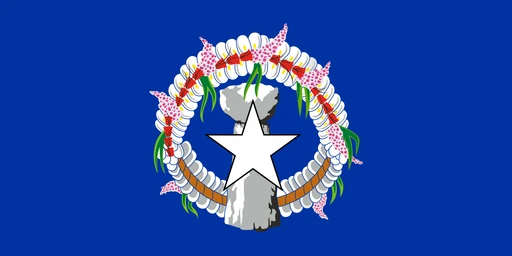
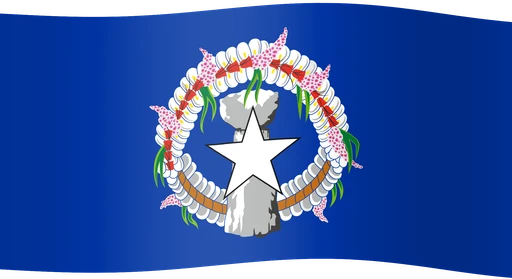
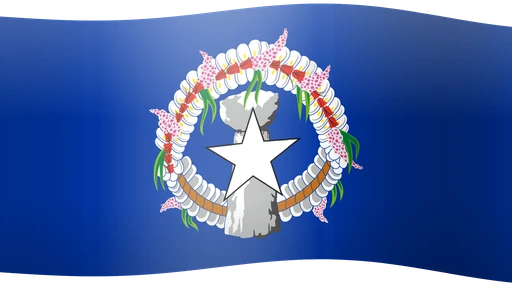
The flag of the Northern Mariana Islands is a blue field with a white star in the center, set on a gray latte stone, a Chamorro symbol, and ringed by a wreath of two native flowers. Blue is the Pacific Ocean, the star is the Commonwealth itself, the latte stone is Chamorro heritage, and the wreath of mwar (Marianas ginger) and plumeria is the natural world of the Marianas.
The flag of the Northern Mariana Islands carries more cultural freight than most U.S. territorial banners. It brings together the Chamorro and Carolinian peoples, who have lived on these Pacific islands for millennia. The current form dates from 1989, after several earlier designs: a blue field with a white star superimposed on a gray latte stone, the whole thing ringed by a Carolinian mwáár, or floral wreath. Between them, the elements cover colonization, indigenous heritage, and the islands' present relationship with the United States.
The latte stone at the center
The gray latte stone at the heart of the flag is the ancient stone pillar the Chamorro people used as building foundations, dating back to approximately 800 CE. If you've ever seen photos of the Marianas' archaeological sites, you'll recognize them instantly: mushroom-shaped columns carved from limestone and basalt, topped with hemispherical capstones. They're among the most recognizable archaeological features anywhere in the Pacific.
Putting the latte stone at the center of the flag was a deliberate assertion of indigenous roots. The islands' identity predates centuries of Spanish, German, Japanese, and American administration, and the stone says so. It is gray on the flag, matching the material the real pillars were cut from. Across both Guam and the CNMI the latte stone works as a general emblem of Chamorro heritage, but here it carries political weight as well.
The mwáár wreath and Carolinian identity
Surrounding the latte stone and star is a decorative wreath known as a mwáár, a traditional Carolinian head lei fashioned from flowers, shells, and other natural materials. The Carolinian people migrated to the Northern Marianas from the central Caroline Islands beginning in the 18th century, and today they are one of the two principal indigenous communities alongside the Chamorro.
Leaving the mwáár out would have produced a flag that spoke to only half the islands' indigenous population. In Carolinian tradition the mwáár is ceremonial rather than ornamental: you are given one at important gatherings, celebrations, and moments of recognition, and it stands for honor and respect. That dual heritage sets the CNMI flag apart from territorial and state flags built around one dominant cultural story. Both peoples can see themselves in it.
From Trust Territory to Commonwealth
After World War II, the Northern Mariana Islands became part of the Trust Territory of the Pacific Islands, administered by the United States under a United Nations mandate. While the Federated States of Micronesia, Palau, and the Marshall Islands eventually pursued free association or independence, the Northern Marianas chose a different path. In 1975, the islands' leaders signed the Covenant to Establish a Commonwealth in Political Union with the United States, creating a status that persists today.
The first official CNMI flag was adopted on July 4, 1976, timed to coincide with the U.S. Bicentennial. That original design was a blue field with a white star and latte stone, and no mwáár wreath. By 1985, growing recognition of Carolinian political and cultural presence led to a revision that added the wreath. The current design was finalized in 1989 with modifications to the wreath's proportions and detailing, then codified in CNMI law.
The white star itself is the Commonwealth's political union with the United States, a deliberate nod to the stars on the American flag. The move from a bare latte stone to the full composition tracks the CNMI's own shift from administered territory to self-governing commonwealth.
The blue field and the Pacific
The blue field is the Pacific Ocean, which shapes Marianas identity, economy, and daily life. Navigation, fishing, and ocean stewardship are not hobbies here.
The particular shade of blue links the CNMI flag visually to other Pacific Island flags: Palau's golden disk on blue, Micronesia's four white stars, the Marshall Islands' rising diagonal stripes. It also separates the flag from most U.S. state flags, which tend toward darker navy backgrounds or entirely different color schemes.
Where the flag appears
The flag flies alongside the U.S. flag at government buildings across Saipan, Tinian, and Rota, the three principal inhabited islands. It appears prominently during cultural festivals, particularly the annual Flame Tree Arts Festival and Liberation Day commemorations marking the end of Japanese occupation in 1944.
CNMI athletes carry it in international competitions where the islands compete separately from the United States, including the Pacific Games and certain Olympic qualification events. For a population of roughly 47,000 it does a lot of work, marking a distinct Pacific Islander identity within the American system, which is not something most U.S. state flags have to do.
The flag's design elements, particularly the latte stone, appear widely in local commercial branding, tattoos, and public art throughout the islands. Walk around Garapan on Saipan and you'll see latte stone motifs on storefronts, murals, and bumper stickers. The flag isn't something that only comes out on holidays.
A flag between two worlds
The CNMI flag has a tension common to territorial flags: it has to hold indigenous identity and an administrative relationship with a much larger power in the same frame. The white star that points to the U.S. connection sits literally on top of the latte stone of Chamorro heritage. Whether or not the designers intended anything by that arrangement, it is a difficult one to look at neutrally.
Guam's flag uses the seal-on-blue-field design common to U.S. territories. The CNMI flag is more distinctive and much less dependent on Western heraldic convention: no eagle, no shield, no Latin motto. During political debates about the Commonwealth's status, self-determination, and indigenous land rights, the flag has become a rallying point, and it is one of the more successful attempts among U.S. territories at a flag that addresses its own people rather than the administering power.
References
[1] Covenant to Establish a Commonwealth of the Northern Mariana Islands in Political Union with the United States of America (1975). Full text available via the U.S. Government Publishing Office.
[2] Constitution of the Commonwealth of the Northern Mariana Islands and CNMI Public Law establishing the official flag specifications.
[3] Don A. Farrell, History of the Mariana Islands to Partition (2011). Comprehensive regional history covering pre-colonial through modern periods.
[4] Flags of the World (FOTW), entry on the Northern Mariana Islands. Vexillological details and historical flag variants. https://www.fotw.info/flags/mp.html
[5] CNMI Division of Historic Preservation, records on latte stone archaeological sites and cultural heritage documentation.
[6] Smith, Whitney, Flags Through the Ages and Across the World (1975). Standard vexillology reference work.
[7] National Park Service, American Memorial Park, Saipan. Historical context on WWII and postwar administration of the Mariana Islands. https://www.nps.gov/amme/
[8] Pacific Islands Legal Information Institute (PacLII). CNMI statutory references for flag specifications and related legislation. https://www.paclii.org/
Common questions
- What is the latte stone on the Northern Mariana Islands flag?
- A traditional Chamorro pillar, shown in grey behind the white star. Latte stones once carried the foundations of buildings across the Marianas, and archaeological examples still stand. On the flag the stone represents Chamorro heritage and continuity with the islands' pre-colonial past.
- What is the wreath on the Northern Mariana Islands flag?
- A mwar, a traditional head garland woven from local flowers, here made of Marianas ginger and plumeria. It was added to the design to represent Carolinian culture alongside the Chamorro latte stone, so the flag speaks for both of the islands' main indigenous communities.
- When was the Northern Mariana Islands flag adopted?
- On 4 July 1976, following a design contest. The islands had just become a Commonwealth in political union with the United States, and wanted a symbol of their own that drew on local culture rather than American heraldry.
- What does the star on the Northern Mariana Islands flag represent?
- The Commonwealth itself. It sits white against the blue field, which stands for the Pacific Ocean. Together the star, the latte stone and the wreath place the Commonwealth's political identity on top of its indigenous one rather than in place of it.
Download this flag
Free in 12 styles, from 32px icons up to 2000px, as SVG, PNG, WebP and JPG.