The Flag of Montserrat
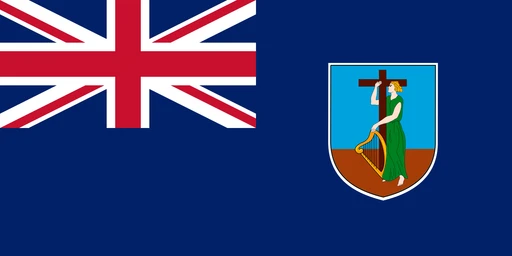
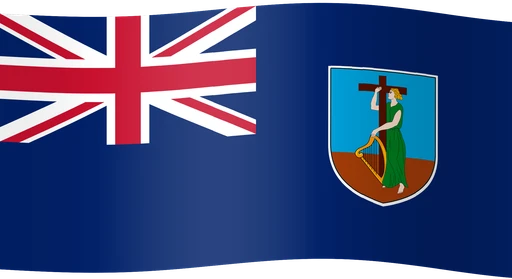
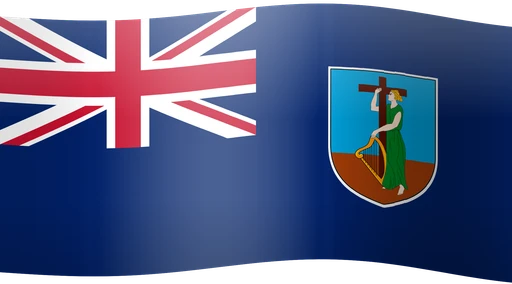
The flag of Montserrat is a British Blue Ensign: the Union Jack in the upper hoist corner and the Coat of Arms of Montserrat on the fly side. The shield shows a woman in a green dress holding a harp and a cross. She is Erin, the personification of Ireland, and she is there because of the island's Irish heritage.
Montserrat flies a British Blue Ensign: the Union Jack in the canton, the island's coat of arms on a deep blue field. What sets it apart from every other British Overseas Territory flag is the figure on that coat of arms, a woman in a green dress holding a golden harp.
From Irish settlement to overseas territory
The English colonized Montserrat in 1632, after Irish Catholics fleeing nearby islands had settled there. The island received its own shield on April 10, 1909, and for the next half century that shield served as a colonial badge on the Blue Ensign flown by government vessels while the Union Flag did the work on land.
Montserrat was administered as part of the Leeward Islands colony until that colony was wound up at the end of 1959, and it took the Blue Ensign with its own badge as its flag the following year, in 1960. It was also a province of the West Indies Federation, which lasted from 1958 to 1962. When the federation dissolved, the island chose to keep its close association with the United Kingdom, becoming a separate crown colony in 1962 and later a British Overseas Territory.
Erin, the harp, and the cross
The coat of arms is the part worth looking at. Erin, the personification of Ireland, appears as a woman in a green dress holding a golden harp, a standard element of Irish heraldry. She leans on a Celtic cross, a reference to the Roman Catholicism that Irish settlers and laborers brought with them.
The field behind the arms is a deep blue, usually read as the Atlantic that surrounds the island and as the sky above it. That reading is common to blue ensigns across the British territories, where the color also carries the sense of a shared colonial past.
Where the flag flies
The flag is used in official settings: government buildings, national events, ceremonies, and parades. Its largest outing is St Patrick's Day, which is a major cultural event on Montserrat because of the island's Irish connections, and it also appears at the Creole cultural festivals.
Protocol follows the pattern used across British territories. The flag is flown from sunrise to sunset on government premises and is never allowed to touch the ground. Local government bodies use few variants of it; the standard design covers both official and cultural use.
Among the other British Overseas Territories
Every British Overseas Territory flag carries the Union Jack, so the shared colonial history is visible at a glance. Montserrat's is the only one that puts Irish symbolism at the center, and it records a migration that shaped who lives on the island. A harp and a Celtic cross on a Caribbean territory's flag is not a combination you will find anywhere else.
References
[1] Government of Montserrat official sites: www.gov.ms
[2] World Vexillological Association: vexillology.org
[3] Historical archives of the British Overseas Territories
[4] Montserrat Cultural Heritage Foundation
Common questions
- What does the woman with the harp represent on the Montserrat flag?
- The woman is Erin, a symbol of Ireland, holding a golden harp. She is there because of Montserrat's Irish roots and the influence of its early Irish settlers.
- Why is the Union Jack on the Montserrat flag?
- The Union Jack marks Montserrat's status as a British Overseas Territory and its long ties to the United Kingdom.
- What does the blue color on the Montserrat flag mean?
- The blue is the Atlantic Ocean around Montserrat. On British territory flags it also reads as the shared colonial background those territories have in common.
Featured in these articles
Download this flag
Free in 12 styles, from 32px icons up to 2000px, as SVG, PNG, WebP and JPG.