The Flag of Montenegro
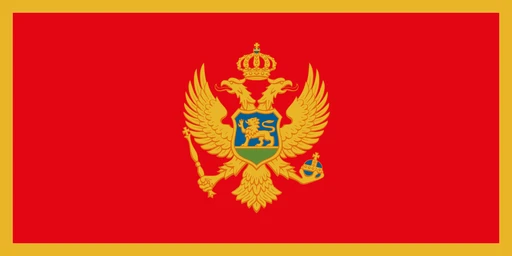
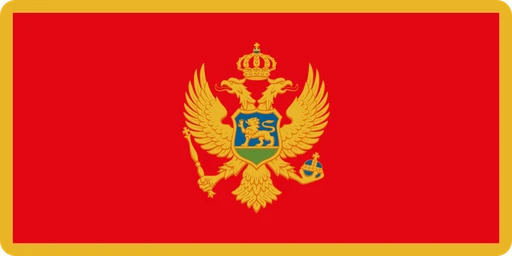
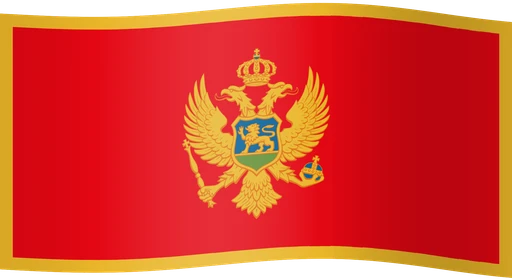
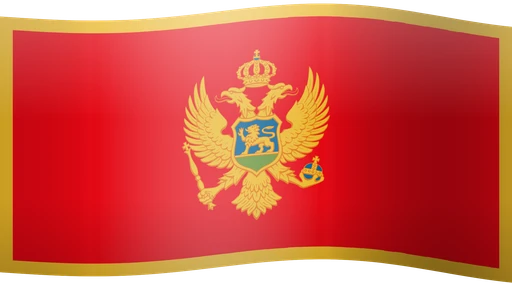
The flag of Montenegro is a red field with a gold border and the country's coat of arms at the centre. The arms show a golden double-headed eagle holding a golden scepter and orb, with a lion passant on a green field on the eagle's chest. The proportions are 1:2.
Montenegro's flag is one of the most visually striking in Europe: a golden-bordered crimson field carrying a full-colour coat of arms that reads like an illustrated history lesson. This is no simple tricolour. It's a rare example of a modern national flag that leans fully into heraldic complexity, with a double-headed golden eagle, a lion passant, and a jewelled mantle all packed into the centre. Officially adopted on 13 July 2004, a date that carries enormous weight in Montenegrin history, the flag traces its roots through centuries of Ottoman resistance, the rule of the Petrović-Njegoš dynasty, and a Yugoslav era that nearly wiped it out entirely.
A date that does double duty
Montenegro didn't pick 13 July 2004 at random. That's Statehood Day, the anniversary of the 1878 Congress of Berlin, where the great powers of Europe formally recognised Montenegro as an independent state. Adopting the flag on that date tied the new symbol directly to one of the proudest moments in the nation's past.
The timing was part of a bigger project. After decades inside socialist Yugoslavia, where distinctive national symbols were played down or suppressed, Montenegro was rebuilding a sense of its own identity. Restoring the red-and-gold flag was a piece of that cultural revival.
When Montenegro declared full independence from the State Union of Serbia and Montenegro in June 2006, the 2004 flag gained full international standing as the banner of a sovereign country. Its legal foundation is the Law on the State Symbols of Montenegro (Zakon o državnim simbolima Crne Gore), which spells out the exact colours, proportions, and placement of the coat of arms. The aspect ratio is 1:2, lining it up neatly with many other European national flags.
Red, gold, and centuries of resistance
That blood-red field isn't a modern styling choice. It comes straight from the battle standards of the Petrović-Njegoš dynasty, the prince-bishops who led Montenegro's long fight against the Ottoman Empire. Red was the colour they carried into the mountains.
The gold border framing the whole thing does real work too. Golden borders appeared on royal and ecclesiastical standards across Balkan heraldry, signalling sovereignty and prestige. Put red and gold together and you get the royal standard of King Nikola I, Montenegro's last king, who reigned from 1910 until the country was folded into Yugoslavia in 1918.
Then the palette vanished for a while. Through the Yugoslav period from 1945 to 1992, Montenegro flew a version of the Yugoslav tricolour, blue-white-red with a red star, and the old red and gold sat on the shelf for close to half a century. Bringing them back after independence was a deliberate reconnection with the pre-Yugoslav national identity, a statement about where Montenegro saw its story beginning.
For anyone reproducing the flag officially, the specifications are precise: the red is Pantone 192C and the gold is Pantone 116C, keeping the colours consistent wherever the flag appears.
An eagle, a lion, and a jewelled mantle
Sitting at the centre is Montenegro's coat of arms, one of the most detailed and layered emblems on any national flag in the world. There's a lot going on, and every piece means something.
The double-headed golden eagle is the part your eye lands on first. It's a symbol shared with the Byzantine Empire and later the Russian Romanov dynasty, and it announces Montenegro's ties to Orthodox Christianity along with its self-image as a defender of Slavic and Christian civilisation against Ottoman expansion. In the eagle's right talon is a sceptre; in its left, a blue orb. Both are classic emblems of sovereignty and temporal power, borrowed directly from the visual language of European monarchies.
On the eagle's chest rests a shield showing a golden lion passant on a blue background. This "lion of Montenegro" carries its own history. Some historians trace it to the heraldry of the Balšić dynasty of the 14th and 15th centuries, while others connect it to the lion of St. Mark and the Venetian influence that spread along the Adriatic coast.
A golden crown sits above the eagle, a nod to the royal status King Nikola I proclaimed in 1910. Wrapping the whole composition is a green mantle trimmed with ermine, a detail you'd expect on a royal coat of arms far more than a national flag. It gives the emblem a regal, almost theatrical grandeur. The design was tidied up for greater heraldic precision when it was codified in the 2004 law, with artist Risto Stijović credited for the modern rendering.
Six centuries from prince-bishops to a republic
The oldest Montenegrin battle standards were religious banners, not heraldic ones. Carried by the Orthodox church-state under the vladika, the prince-bishops, they showed crosses and saints rather than eagles.
Things grew grander over time. The Petrović-Njegoš dynasty formalised a red and gold standard through the 18th and 19th centuries as Montenegro increasingly presented itself as a princely and then royal court. King Nikola I's royal standard after 1910 is the clearest ancestor of today's flag: a red field bearing the dynastic coat of arms. You can see the modern flag's DNA in it immediately.
That thread got cut after the First World War. Absorbed into the Kingdom of Serbs, Croats and Slovenes, and later Yugoslavia, Montenegro lost its separate flag as a state symbol. Under the Socialist Federal Republic of Yugoslavia from 1945 to 1992, it flew a blue-white-red tricolour with a communist red star, in step with the other Yugoslav republics.
Even after Yugoslavia broke apart, the old design didn't come back right away. Between 1992 and 2004, during the Serbia and Montenegro federation, Montenegro used a plain red-blue-white tricolour. Only in 2004 did the historic red-and-gold return. That makes the current flag less an invention than a restoration, a deliberate act of reclaiming national identity.
Protocol, variants, and the flag in daily life
The national flag flies year-round on government buildings, courts, and embassies, and gets special prominence on 13 July for Statehood Day and 21 May for Independence Day, which marks the 2006 referendum result.
A few variants exist for specific uses. There's a civil ensign for civilian vessels and a naval ensign that positions the coat of arms differently to fit maritime vexillological conventions. The presidential standard drops the gold border and places the coat of arms on a plain field, a subtle change that signals executive authority.
Montenegrin law lays out strict rules for handling, displaying, and retiring the flag, including bans on commercial misuse, though enforcement tends to be light compared to somewhere like the United States. Beyond the country's borders, the flag turns up prominently in diaspora communities in Serbia, the US, and Germany, where it works as a strong identity marker. Sport has boosted its recognition too. Montenegro punches well above its weight in football and water polo, and the flag rides along on that success.
Neighbours, rivals, and kindred eagles
That double-headed eagle puts Montenegro in an interesting visual family. Albania carries a black double-headed eagle on red, Russia a red one on gold, and all three share a Byzantine heraldic inheritance. Serbia's flag and coat of arms feature a double-headed eagle too, reflecting the shared Orthodox and dynastic heritage of the Western Balkans, yet Montenegro's gold-on-red looks nothing like Serbia's red-on-blue-white-red tricolour.
Set Montenegro's elaborate heraldry against the cleaner tricolours of Croatia, Bosnia, and Slovenia and you see how differently post-Yugoslav states approached visual nation-branding. Vexillologists tend to flag Montenegro as an outlier in the global push toward simple, easily reproducible designs. It's proudly, defiantly complex.
People have compared it to the flags of certain Spanish regions and to Liechtenstein for its use of a full coat of arms, but Montenegro's is arguably the most intricate state flag in the Balkans. The Russian imperial influence, that Romanov double-headed eagle, reflects a real historical alliance between Montenegro and the Russian Empire, built on 18th-century diplomacy and a shared Orthodox faith.
References
[1] Government of Montenegro, Official State Symbols portal, Law on State Symbols of Montenegro (Zakon o državnim simbolima Crne Gore), 2004 (www.gov.me)
[2] Flag Institute (UK), Montenegro flag profile and vexillological analysis (www.flaginstitute.org)
[3] Flags of the World (FOTW), Montenegro entry, including historical variants and civil/naval ensigns (www.crwflags.com/fotw)
[4] Roberts, Elizabeth. Realm of the Black Mountain: A History of Montenegro. Cornell University Press, 2007
[5] Congress of Berlin (1878), primary records via the Avalon Project, Yale Law School (avalon.law.yale.edu)
[6] CIA World Factbook, Montenegro entry, flag description and national symbols (www.cia.gov/the-world-factbook)
[7] Smith, Whitney. Flags Through the Ages and Across the World. McGraw-Hill, 1975
Common questions
- What does the double-headed eagle on Montenegro's flag mean?
- It is a traditional symbol of the Petrović-Njegoš dynasty, which ruled Montenegro for over two centuries. The golden eagle holds a scepter and orb, and carries a lion passant on a green field on its chest. The design harks back to the royal standards of the Kingdom of Montenegro between 1910 and 1918.
- When did Montenegro adopt its current flag?
- On 13 July 2004, during the push for independence from the State Union of Serbia and Montenegro. Montenegro formally declared independence in June 2006, so the flag preceded the state it now represents by about two years.
- Why did Montenegro bring back its royal symbols?
- The 2004 flag was part of a wider effort to restore pre-Yugoslav symbols and assert an identity distinct from Serbia. Reaching back to the Kingdom of Montenegro rather than designing something new was itself the argument: it claimed continuity with a period of independent statehood.
- What are the proportions of Montenegro's flag?
- 1:2, making it noticeably longer than most European national flags, which tend towards 2:3. The gold border runs around all four edges, and the coat of arms sits centred in the red field.
Featured in these articles
Download this flag
Free in 12 styles, from 32px icons up to 2000px, as SVG, PNG, WebP and JPG.