The Flag of Kurdistan
Kurdistan Region
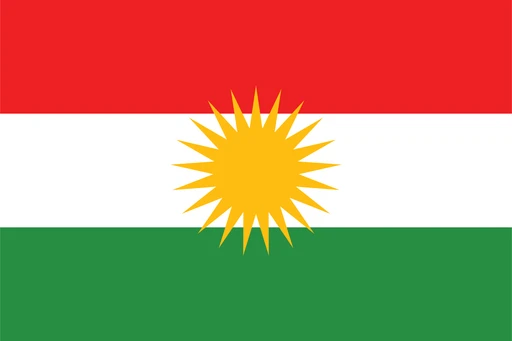
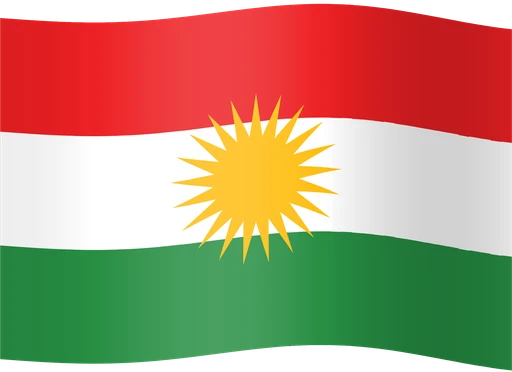
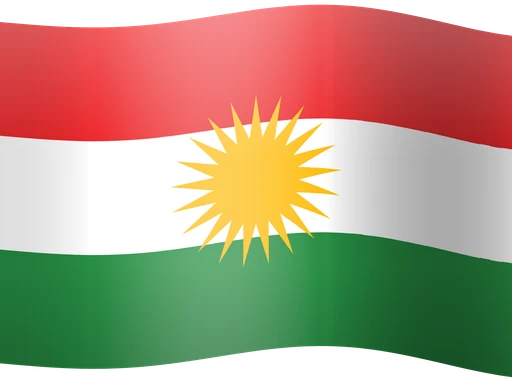
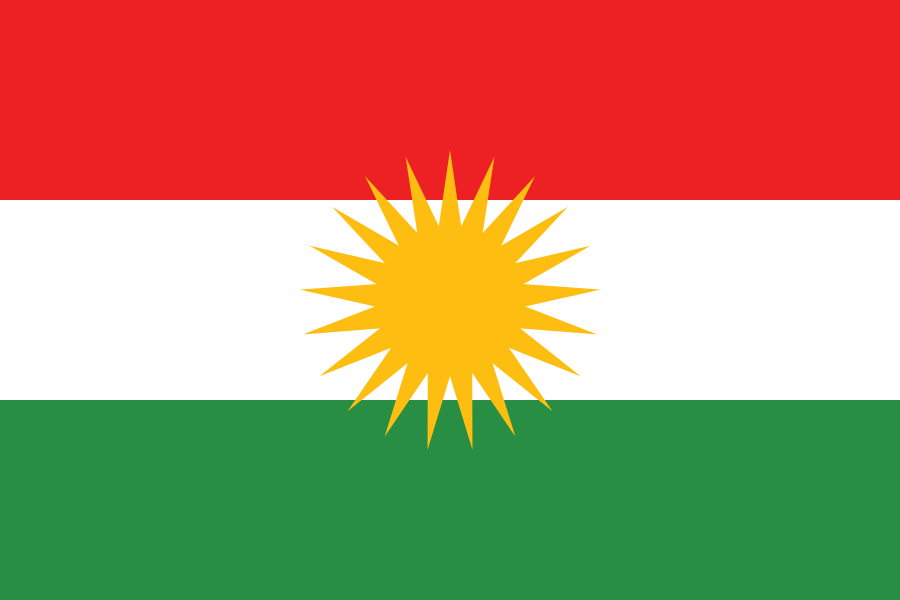
The flag of Kurdistan has three horizontal bands of red, white and green, with a golden sun of 21 rays at its centre. The flag is two units high and three long. The sun reaches out of the white band into the red and the green, and its topmost ray points straight up. Red is read as the blood of those who died in the Kurdish struggle, white as peace and equality, and green as the land of Kurdistan. The 21 rays carry a number held sacred in Yazidism, Yarsanism and Alevism, where it stands for rebirth. Kurds call the flag Ala Rengîn, "the colourful flag."
The flag of Kurdistan is a red, white and green tricolour with a golden sun in the middle. It is the official flag of the Kurdistan Region of Iraq, and Kurds in Iran, Turkey, Syria and the diaspora fly it too. The design is about a century old. The exact drawing is younger. Two Kurdish scholars fixed the size of the sun, the number of its rays and the shades of the colours in 1998, and the Kurdistan Parliament made the result law a year later.
A sun with 21 rays
The standard drawing comes from a short document that Bijan Eliasi prepared in 1998, with Mehrdad Izady as historical consultant. The Kurdish Institute of Paris published it. It sets out the rules you need to draw the flag.
The flag has three horizontal bands: red on top, white in the middle, green below. Its width is two-thirds of its length. A golden sun sits at the exact centre. It has 21 rays, "equal in size and shape," and the vertical line through the middle of the flag passes through the tip of the topmost ray. Flags of the World adds the measurements. On a flag 2 units high and 3 long, the sun is 1 unit across with its rays and 0.5 without them. That makes the sun wider than the white band, so its rays cross into the red and the green.
Kurdistanica, the site where the authors posted the specification, gives the colours as Pantone 032C for the red, 116C for the yellow and 355C for the green. Sources do not agree on every shade. Flags of the World records the green as Pantone 354 in one report and as 7732c in the 2023 edition of the Album des Pavillons. The hex values listed on this page come from the drawing shown here.
Why 21? The specification says the number holds "a primary importance" in the Yazdani religious tradition of the Kurds. Izady told Rudaw that it signifies rebirth in Yarsanism, Alevism and Yezidism.
The usual reading of the colours is short. Red is the blood of those who died in the Kurdish struggle. White is peace and equality. Green is the land, its mountains and waters.
Three flags that came before the law
The sources differ on who made the first one. Kurdistanica credits the founders of the Society for the Uplift of Kurdistan, who wanted a flag for Kurds seeking independence from the Ottoman Empire. Eliasi's text credits the leaders of Xoybûn. Both say it was presented to delegates at the Paris Peace Conference, which wrote a plan for Kurdish independence into the Treaty of Sèvres in 1920.
In 1927 the Xoybûn movement, whose name means "independence," used it to announce a Kurdish government in exile. The Republic of Ararat flew it until 1930.
Then it moved east. On 17 December 1945 the flag was raised over the government office in Mahabad, in Iran. The Republic of Kurdistan was declared there on 22 January 1946, and its president, Qazi Muhammad, named the tricolour the flag of Kurdistan. The republic was short-lived. Days before it fell, Qazi Muhammad handed the flag to Mustafa Barzani, who had come to Mahabad from Iraq.
Standardised in 1998, with an argument about the sun
After the 1991 uprising, Kurds in Iraq ran their own affairs under a no-fly zone, and the Kurdistan Regional Government was formed in 1992. The "sunny flag" was in wide use, but nobody had set a standard for it.
Izady, Eliasi and their colleague Dilan Roshani set out to fix that. Rudaw reports that the work ended a decade-long effort, and that they consulted the Flag Institute in Britain along the way.
The institute had notes. It thought the sun was too large and had too many rays, and it suggested the rays stay inside the white band. Izady refused on both points. A sun touching all three bands was historically accurate, he said, and the 21 rays had a meaning that a simpler count would lose.
The colours had a logic too. Izady avoided the shades used by the states that govern parts of Kurdistan, and took his red, white and green from the flag regulations of Hungary and Italy. He still sees the sun drawn wrong. The top ray, he told Rudaw, should point straight up.
The Kurdistan Parliament made it law. According to the Presidency of the Parliament, the Law on the Flag of Kurdistan Region – Iraq, Law No. 14, passed at the sitting of 11 November 1999.
Flown beside the Iraqi flag, and sometimes instead of it
The flag has caused trouble with Baghdad more than once.
At the end of August 2006 Massoud Barzani, president of the region, issued decree number 60. It ordered the Kurdistan flag onto all government offices in the region and told offices flying the Iraqi flag to replace it. Kurds tied the Iraqi flag of the day to Saddam Hussein's Baath party. Prime Minister Nuri al-Maliki answered on 3 September: "The present Iraqi flag should be hoisted on every inch of Iraqi soil until the parliament takes a decision about it."
Iraq removed the Baathist symbols from its flag in 2008, and the Kurdistan Region began flying the two flags together. Shafaq News reported in 2022 that the region raises its flag alongside the Iraqi flag at official departments and events.
Kirkuk was harder. In March 2017 the provincial council of the disputed, oil-rich city voted to raise the Kurdistan flag next to the Iraqi one on public buildings. Arab and Turkmen members opposed the vote. On 1 April 2017 Iraq's parliament, with 186 of its 328 members present, voted that only the Iraqi flag should fly on Kirkuk's buildings. Kurdish members walked out before the vote.
Flag Day falls on 17 December
The anniversary of the Mahabad flag-raising is now Kurdistan Flag Day. The Presidency of the Kurdistan Parliament says a resolution passed on 19 June 2004 set 17 December as both Flag Day and Mother's Day. Kurdistan24 has reported the year as 2009.
The day looks the same across the region. People raise the flag while the anthem plays, and many wear traditional Kurdish dress. Schools and universities hold music and dance events. In 2017, three months after 93 percent of voters backed independence in a referendum, a large flag went up over the citadel of Erbil, and the families of fallen Peshmerga raised another in front of the parliament.
Kurds in Europe, North America and Australia mark the day as well. For Kurds in Iran, 17 December is also Peshmerga Day.
References
[1] "Parliament's Presidency conveys best wishes on Kurdistan Flag Day and Mother's Day," Kurdistan Parliament, 17 December 2022. https://www.parliament.krd/english/parliament-business/latest-news/posts/2022/december/parliaments-presidency-conveys-best-wishes-on-kurdistan-flag-day-and-mothers-day/
[2] B. A. Eliasi, "The National Flag of Kurdistan," Kurdish Institute of Paris, 1998. https://www.institutkurde.org/en/kurdorama/the_national_flag_of_kurdistan.php
[3] "Flag of Kurdistan," Kurdistanica. https://kurdistanica.com/289/flag-of-kurdistan/
[4] Chris Johannes, "Years before independence talk someone had foresight to standardize the Kurdish flag," Rudaw, 21 July 2017. https://www.rudaw.net/english/kurdistan/210720171
[5] "Kurdistan," Flags of the World. https://crwflags.com/fotw/flags/krd.html
[6] "Iraq PM rebukes Kurds over flag," Al Jazeera, 3 September 2006. https://www.aljazeera.com/news/2006/9/3/iraq-pm-rebukes-kurds-over-flag
[7] "Iraq's parliament bans Kurdish flag in Kirkuk," Al Jazeera, 1 April 2017. https://www.aljazeera.com/news/2017/4/1/iraqs-parliament-bans-kurdish-flag-in-kirkuk
[8] Sangar Ali, "WATCH: People celebrate National Flag Day in Kurdistan," Kurdistan24, 17 December 2017. https://www.kurdistan24.net/en/story/373677/slug
[9] "Leader Barzani: Kurdish flag is a symbol of sacrifice, peace, and coexistence," Shafaq News, 17 December 2022. https://shafaq.com/en/Kurdistan/Leader-Barzani-Kurdish-flag-is-a-symbol-of-sacrifice-peace-and-coexistence
[10] "Flag of Kurdistan," Wikipedia. https://en.wikipedia.org/wiki/Flag_of_Kurdistan
Common questions
- What does the flag of Kurdistan mean?
- Red stands for the blood of those who died in the Kurdish struggle for freedom. White stands for peace and equality. Green stands for the land, the mountains and waters of Kurdistan. The golden sun at the centre is an old emblem in Kurdish culture, and Mehrdad Izady, who standardised the flag, described its beams as shining into the future. The sun has 21 rays, a number tied to rebirth in Yazidism, Yarsanism and Alevism.
- Why does the sun on the Kurdistan flag have 21 rays?
- The number 21 is sacred in Yazidism, Yarsanism and Alevism, religious traditions with deep roots among Kurds, where it signifies rebirth. When the flag was standardised in 1998, the Flag Institute in Britain suggested fewer rays to make the flag easier to reproduce. Mehrdad Izady kept all 21. The rays are equal in size and shape, and the topmost one points straight up.
- Who designed the flag of Kurdistan?
- No single designer is known. The Society for the Rise of Kurdistan introduced the sun flag around 1920. The version flown today was standardised in 1998 by the historian Mehrdad Izady, who handled the history and the look, and Bijan Eliasi, who handled the technical drawing. They consulted the Flag Institute in Britain. The Kurdistan Parliament adopted their specification in 1999.
- When was the flag of Kurdistan adopted?
- The Kurdistan Parliament passed the Law on the Flag of Kurdistan Region – Iraq, Law No. 14, at its sitting of 11 November 1999. The design is much older. It was introduced around 1920, flown by the Republic of Ararat from 1927 to 1930, and raised in Mahabad on 17 December 1945, shortly before the Republic of Kurdistan was declared there.
- When is Kurdistan Flag Day?
- Kurdistan Flag Day is 17 December. The date marks the raising of the flag in Mahabad in 1945, weeks before the Republic of Kurdistan was declared. The Presidency of the Kurdistan Parliament says a resolution of 19 June 2004 set the date. Some news reports give 2009 instead. People mark the day by raising the flag, playing the anthem and wearing Kurdish dress.
- Is the flag of Kurdistan the same flag Kurds use in Syria?
- No. The sun flag is official in the Kurdistan Region of Iraq and is flown by Kurds in Iran, Turkey, Syria and abroad. The Kurdish-led administration in north and east Syria also uses a tricolour of its own, adopted around 2012. Mehrdad Izady, who standardised the sun flag, told Rudaw in 2017 that this saddened him: "National flags are there to unify a nation not divide them."
Download this flag
Free in 12 styles, from 32px icons up to 2000px, as SVG, PNG, WebP and JPG.