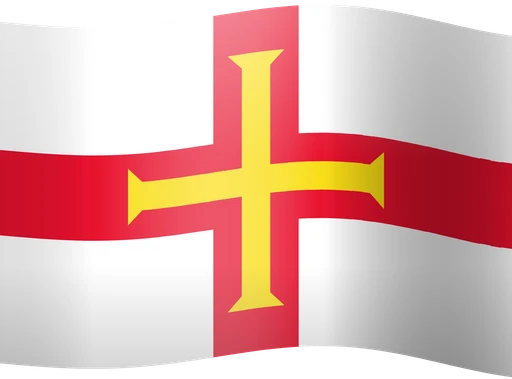
The Flag of Guernsey
Bailiwick of Guernsey
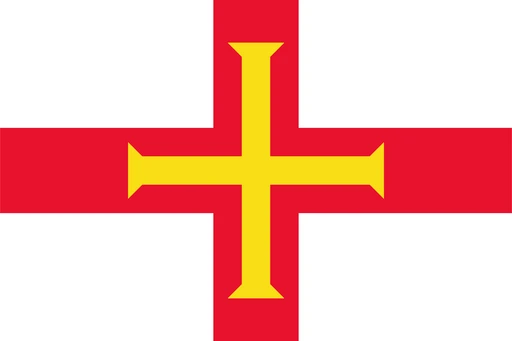
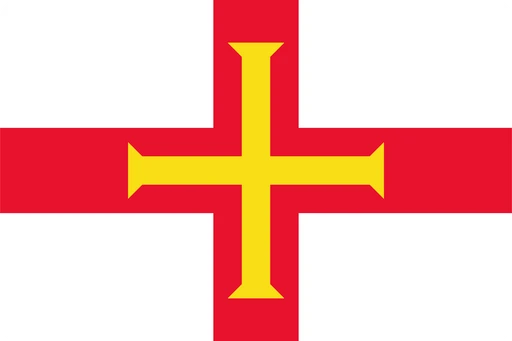
The flag of Guernsey is a white field with a red St George's Cross reaching the edges, and a gold Norman cross laid over the center of it. The gold cross is what separates Guernsey's flag from England's, and it points to the island's Norman rather than English roots.
Guernsey's flag is a red cross of St George with a golden Norman cross laid over its center, and it is one of the few flags anywhere that asserts its allegiance to the British Crown flows from Normandy rather than from England. Guernsey is a Crown Dependency: it owes loyalty to the monarch but is not part of the United Kingdom, and the flag was designed to make that distinction visible.
Why Guernsey needed its own flag
For centuries Guernsey flew the plain red cross of St George, identical to England's flag. That worked well enough while the islands were a quiet corner of the Crown's dominions, but by the twentieth century it was a practical problem. At sporting events, official meetings, and maritime encounters, nobody could tell the two apart, and the confusion blurred a constitutional line the islanders cared about.
By the 1980s the push for a distinct flag had momentum. Guernsey wasn't English, and it wasn't British in the way Scotland or Wales is British. Its relationship with the Crown predates England's own national identity and runs through the Duchy of Normandy rather than any act of Parliament.
In 1985 the Privy Council approved the addition of a golden cross, taken from the historic arms of the Duchy of Normandy, placed centrally over the red St George's Cross. The island's authorities worked with heraldic advisors on the design. Laying William the Conqueror's cross on top of England's national symbol was a constitutional argument, not a cosmetic tweak: Guernsey's loyalty runs to the Crown through Normandy, not through Westminster.
The dual-cross composition is close to unique. Flags commonly carry a single cross, or a cross with a charge in the canton, but building one nation's cross directly on another's is very rare. The 1985 date makes this one of the most recently formalized flags in the British Isles, carrying thoroughly medieval symbolism.
The Norman inheritance
Guernsey was Norman before England was. The Channel Islands became part of the Duchy of Normandy in 933, more than a century before William crossed the English Channel to claim the English throne at Hastings in 1066. When the French Crown seized mainland Normandy from King John in 1204, the Channel Islands faced a choice: follow the duchy back into French hands, or remain loyal to the English Crown. They chose the Crown, but on their own terms, retaining Norman customary law, their own courts, and a fierce sense of separate identity that persists today.
The golden cross on the flag references the Normandy ducal standard, a golden cross on a red and gold field, reputedly carried by William himself at the Battle of Hastings. That connection is reinforced by Guernsey's coat of arms, which bears two gold leopards (lions passant guardant) on red, the arms of the Duchy of Normandy. These same leopards appear across Channel Islands heraldry, a family resemblance that links Guernsey, Jersey, and their smaller neighbors to a shared Norman past.
In a sense, the concept behind Guernsey's flag is older than England's own use of the St. George's Cross, which wasn't widely adopted as an English national symbol until the late medieval period. Guernsey's Norman identity was already centuries old by then.
The flag carries more recent emotional weight, too. During the German Occupation of 1940 to 1945, the only time British soil fell under enemy control, the flying of the Guernsey flag was suppressed. Its return on Liberation Day, 9 May 1945, became one of the most emotionally charged moments in the island's modern history.
Gold, red, and white
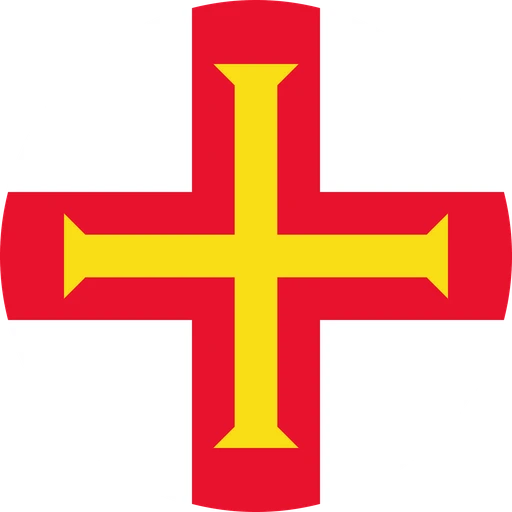
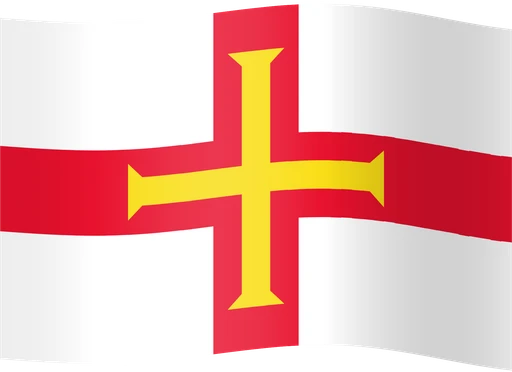
A white field bearing a red St George's Cross, with the golden cross of Normandy centered over the intersection. The golden element is a cross pattée, sometimes called a cross formée, its arms flaring slightly wider at the tips. The shape belongs to crusading imagery and medieval heraldic convention.
Red and gold, which heralds call gules and or, are the traditional colors of Normandy. White, or argent, gives the field and the contrast. The layering mirrors the political arrangement: Normandy sits at the heart of England's symbol rather than beneath it or beside it.
Jersey's flag shares the red cross on white but solves the problem differently, placing a yellow Plantagenet crown and the island's coat of arms in the upper hoist triangle. Alderney uses an entirely different design. Guernsey's answer is the cleanest of the three: no text, shields, or crowns, and legible at a distance, which matters for a community that has always made its living from the sea.
Protocol and constitutional status
Guernsey's constitutional position baffles most people who meet it for the first time. The island is a Crown Dependency, loyal to the monarch personally but not part of the United Kingdom. It was never in the European Union either, and kept a separate customs relationship long before Brexit. Its flag is not incorporated into the Union Jack, which surprises people and is a fair measure of how separate the island's status is.
The flag flies on all official Guernsey government buildings and serves as both the civil and state flag of the Bailiwick. At international sporting events, Guernsey competes under its own banner. The island fields its own team at the Commonwealth Games and the Island Games, marching behind the red, white, and gold rather than the Union Jack.
That said, the Union Jack isn't absent from the island. It may be flown on specific royal occasions, and the two flags coexist comfortably, reflecting a dual loyalty to Norman heritage and British Crown that islanders see no contradiction in. Guernsey-registered vessels carry the flag at sea, and the island's coat of arms appears on official documents and seals.
Liberation Day, celebrated every 9 May, is when the flag takes on its deepest emotional resonance. The annual commemoration of the end of the German Occupation sees the Guernsey flag raised across the island in a ceremony that blends relief, pride, and remembrance.
Guernsey among the Channel Island flags
Guernsey and Jersey solved the same problem in different ways. Both start from the red cross of St George on white; Guernsey adds a golden cross, Jersey a crowned shield in the upper hoist.
The flag of Normandy itself, two gold leopards on red, survives in Guernsey's coat of arms rather than its flag. England's St George's Cross remains visible and unaltered beneath the golden addition, so the differentiation never amounts to rejection.
The cross pattée connects Guernsey to a wider tradition. The same shape appears in the flag of Georgia, in the insignia of the Knights Templar, and in various crusading orders, which puts that small golden cross in a lineage nearly a thousand years old. The Isle of Man, another Crown Dependency, went a completely different way with its triskelion, three armored legs on red. Every Crown Dependency has had to answer the question of how to look distinct while remaining loyal, and no two answered it alike.
Vexillologists often cite Guernsey as a textbook case of "differencing," the heraldic practice of modifying a shared base design to create a distinct identity.
References
[1] States of Guernsey Official Government Website (gov.gg), official flag specifications and usage guidelines.
[2] Privy Council Order 1985, the formal instrument establishing the distinctive Guernsey flag with the golden cross of William the Conqueror.
[3] Flag Institute (UK), vexillological records and analysis of British Isles flags, including Channel Islands variants (flaginstitute.org).
[4] Victor Coysh, Bailiwick of Guernsey: A History, historical context on Norman heritage and constitutional status.
[5] Guernsey Museums & Galleries, archival material on the German Occupation period and Liberation Day flag symbolism.
[6] Flags of the World (FOTW) database (crwflags.com), technical specifications and comparative flag analysis for the Channel Islands.
[7] The Law Officers of the Crown, Guernsey, for constitutional relationship with the British Crown and flag protocol.
[8] The Flag Bulletin, Journal of the Flag Research Center, scholarly vexillological analysis of differencing in British Isles flags.
Common questions
- What's the story behind the yellow cross on the Guernsey flag?
- The yellow cross comes from the banner of Duke William of Normandy, who is said to have carried it at the Battle of Hastings in 1066. It marks Guernsey's Norman roots and separates the flag from every other St George's Cross.
- When did Guernsey officially adopt its flag?
- Guernsey adopted its flag in 1985, to mark an identity distinct from England's.
- When did Guernsey get its own flag?
- Guernsey got its official flag in 1985 when the Privy Council approved it. Before that, the island just used a plain red cross on white, the same as England's St. George's Cross. That caused a lot of confusion at sports events and official stuff, so they added the golden Norman cross to make it distinctly Guernsey's.
Download this flag
Free in 12 styles, from 32px icons up to 2000px, as SVG, PNG, WebP and JPG.