The Flag of Guadeloupe
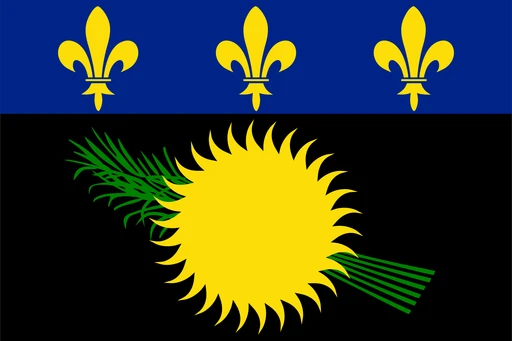
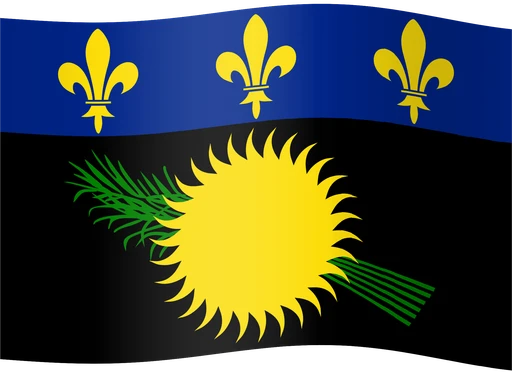
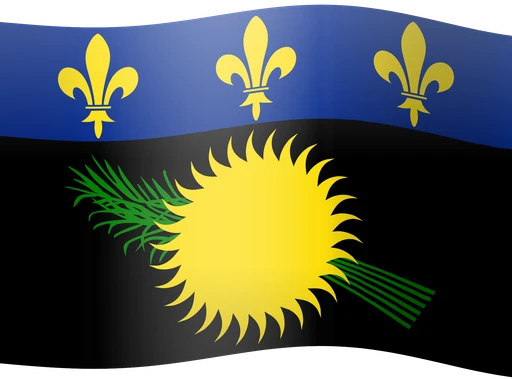
Guadeloupe has no official flag of its own. The French tricolor of blue, white, and red is what flies in official settings. The flag most commonly associated with the island is unofficial: a black field carrying a gold radiating sun above a bundle of green sugar cane, with a blue band across the top bearing three gold fleurs-de-lis. A version with a red field instead of black is also sold. Its elements refer to the sugar economy, the tropical climate, and the island's former place in the French royal domain.
Guadeloupe has no official flag recognized by the French state, and three different designs have grown up in the space that leaves. The best known is a black flag with a golden sun rising over sugar cane, assembled out of colonial-era coats of arms. The regional council has its own institutional banner. The independence movement has a third. None of them is official, and the disagreement between them is the interesting part.
Why Guadeloupe has no official flag
Guadeloupe is constitutionally part of France. As an overseas department and region (DOM-ROM), its official flag is the tricolor: blue, white, and red, the same one that flies over the Élysée Palace. The arrangement dates to 1946, when Guadeloupe was departmentalized under a law championed by the poet-politician Aimé Césaire, who represented neighboring Martinique. In December 2003 voters were asked whether to merge the departmental and regional councils into a single collectivity and said no, which left the two-council structure in place. Saint-Martin and Saint-Barthélemy, voting separately on the same day, chose to leave Guadeloupe altogether.
The result is a Caribbean archipelago with its own Creole language, its own cooking, and its own musical forms in gwo ka and zouk, sharing an official flag with metropolitan Paris. The tricolor says nothing about Guadeloupe specifically, and for many Guadeloupeans that silence is the problem.
The French state has adopted none of the alternatives, and that vacuum tracks an unresolved argument about autonomy, independence, and what it means to be French and Guadeloupean at once.
The sun and sugar cane flag
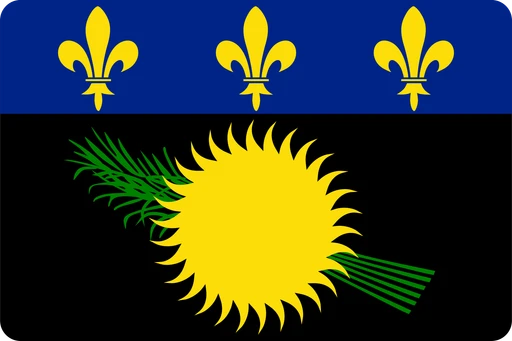
The flag sold in every airport shop and flown at plenty of carnivals is a black field with a blue band across the top. On the black is a golden sun, drawn with straight rays, rising over a bundle of green sugar cane. On the blue band are three gold fleurs-de-lis. A version with a red field instead of a black one exists and is sold alongside it, and neither has ever been standardized by anyone.
The parts are borrowed. The design is stitched together from the old arms of Basse-Terre and Pointe-à-Pitre, the two main towns, which is why it looks like heraldry rather than like a flag. The sugar cane is the colonial economy that built the island. The sun is the climate. The fleurs-de-lis mark Guadeloupe's attachment to the French royal domain.
That last element is why the flag is contested rather than simply popular. The fleur-de-lis is the emblem of the monarchy that ran Guadeloupe as a slave colony, and it was the mark branded with a hot iron onto the shoulders of recaptured runaways. Flying it as a symbol of Guadeloupean identity strikes a great many Guadeloupeans as the wrong way round. It is also, for what it is worth, the version that appears in the Unicode emoji for Guadeloupe, which has given it a reach nobody voted for.
The independence flag
The flag that does carry a political argument is a different object entirely: three horizontal bands of red, yellow and green with a star. It was proposed in 1977 by Sonny Rupaire, a poet and militant, for the Union Populaire pour la Libération de la Guadeloupe. The colours are pan-African, chosen in homage to Ethiopia, the state that kept its sovereignty through the European carve-up of Africa, and they assert the African origins of most Guadeloupeans.
It is the banner of demonstrations, of the trade unions UGTG and LKP, and of the Guadeloupean football team. Athletes have carried it too: Teddy Riner and Yannick Borel both used it around the 2024 Paris Olympics. Its resemblance to the flag of Suriname has caused the occasional diplomatic irritation.
The regional council emblem
The Conseil Régional de Guadeloupe flies a white banner with its own emblem in the middle: a square split between blue above and green below, with a blue and white seagull and a yellow rising sun between them. Blue is the sky and the sea, green is the vegetation. It is clean, modern, and restrained, closer to a corporate logo than a banner, which is exactly what it is.
The emblem appears on government buildings, official documents, and regional communications, and it is what you see at bureaucratic events and EU functions. Guadeloupe is an outermost region of the European Union, so the EU's circle of gold stars on blue often flies alongside the French tricolor and the regional emblem, three overlapping political identities on one flagpole line.
Next to the other two, the regional emblem is deliberately neutral. It identifies without provoking, and whether that counts as a strength depends on where you stand.
Sugar, slavery, and the tricolor
France colonized Guadeloupe in 1635, and within decades the island was one of the great sugar producers, built on the labor of enslaved Africans. The plantation economy shaped the demographics, the culture, and the language, and the damage it did has not gone away.
Then came 1794. In the upheaval of the French Revolution, the National Convention abolished slavery across the French colonies. The commissioner Victor Hugues arrived in Guadeloupe with the decree and the tricolor, and for a short period that flag meant liberation. Formerly enslaved people fought under it to repel a British invasion.
Napoleon shattered that identification in 1802 when he sent troops to reinstate slavery. The resistance that followed produced one of Guadeloupe's greatest heroes: Louis Delgrès, a mixed-race military officer who led a doomed stand against the French forces. When defeat became inevitable, Delgrès and his followers chose death over re-enslavement, detonating their own powder magazine at the Habitation d'Anglemont on May 28, 1802. His proclamation to the people of Guadeloupe, beginning with the words "To the entire universe, the last cry of innocence and despair," remains one of the most powerful documents in Caribbean history.
After that the tricolor could never be a simple symbol of freedom in Guadeloupe. The 20th-century departmentalization debate added another layer. Aimé Césaire, whose négritude movement shaped Antillean identity from Martinique, backed departmentalization as a path to equality rather than assimilation, but equality under the tricolor came with strings. The pan-African independence flag is the counter-argument: our colors, our symbols, our story without Paris in the middle of it. That the popular flag sold in the shops carries the fleur-de-lis of the slaveholding monarchy is the argument's unresolved half.
Neighbors and contrasts
Guadeloupe is not alone in this. Martinique had the same problem for decades and settled it in February 2023, when its assembly voted to adopt the red, green and black flag of the anticolonial movement and retire the argument over the old snake flag. Guadeloupe has held no equivalent vote, so its flags remain in a vexillological limbo that fully independent neighbors do not share. Haiti, Jamaica, and Barbados each have a national flag with the weight of sovereignty behind it.
The Garveyite red, black, and green scheme shaped independence movements across the Caribbean, and Guadeloupe's independence flag follows the related Ethiopian palette of red, yellow and green rather than the Garveyite one. The most widely sold Guadeloupean flag sits outside that tradition entirely, which is the whole of the disagreement in one sentence.
At Caribbean sporting events the distinction becomes visible: Guadeloupe competes under its own banner in regional competitions, not the tricolor. Saint-Martin and Saint-Barthélemy, which split from Guadeloupe's departmental structure in 2007 to become separate collectivities, have since developed flag identities of their own.
An unresolved question
During Carnival in Pointe-à-Pitre the flags are everywhere: draped over floats, painted on faces, sewn into costumes. They turn up at gwo ka drum circles and political rallies alike, though which one you see depends on the occasion. During the 2021 unrest, when protests over COVID-19 vaccine mandates merged with long-standing frustrations about inequality and the cost of living, it was the red, yellow and green independence flag that was carried through the streets, and coverage in Reuters and Le Monde showed it alongside burning barricades.
For some Guadeloupeans, adopting an official flag would be a step toward greater autonomy or independence. For others it risks a symbolic break from France that could put concrete things at risk: EU citizenship, French social services, structural funds.
The diaspora keeps the question alive. Guadeloupeans in metropolitan France, concentrated around Paris, put these flags in apartment windows, at community events, and on social media, in places where they sit directly against the tricolor every day.
There is no tidy answer here, and there is unlikely to be one until the political question underneath it is settled.
References
[1] Conseil Régional de Guadeloupe, official website. cr-guadeloupe.fr. Institutional emblem and regional governance context.
[2] Flags of the World (FOTW), Guadeloupe entry. fotw.info. The leading vexillological reference database for flag variants and descriptions.
[3] Dubois, Laurent. A Colony of Citizens: Revolution and Slave Emancipation in the French Caribbean, 1787-1804. University of North Carolina Press, 2004. Essential for the history of Louis Delgrès and the 1802 resistance.
[4] Césaire, Aimé. Discourse on Colonialism. Monthly Review Press, 1972 (orig. 1950). Foundational text for understanding Antillean identity politics and the négritude movement.
[5] Dorigny, Marcel (ed.). The Abolitions of Slavery: From L.F. Sonthonax to Victor Schoelcher, 1793-1794-1848. UNESCO Publishing, 2003. For context on the 1794 abolition and its aftermath.
[6] Smith, Whitney. Flag Lore of All Nations. Millbrook Press, 2001. General vexillological context for Caribbean flags.
[7] European Commission, Outermost Regions profile for Guadeloupe. ec.europa.eu/regional_policy. For EU status and institutional flag usage.
[8] Reuters / Le Monde coverage of 2021 Guadeloupe protests. For contemporary documentation of the unofficial flag's role in political demonstrations.
Common questions
- What does the sun on the Guadeloupe flag represent?
- The sun stands for life, energy, and the island's tropical climate.
- Why does the Guadeloupe flag include sugarcane stalks?
- Sugar cane was the basis of the island's colonial economy and is still part of its agriculture. The flag shows the sun rising over a bundle of it.
- What does the fleur-de-lis mean on the Guadeloupe flag?
- There are three of them, in gold on the blue band across the top, and they mark Guadeloupe's attachment to the French royal domain. They are also the reason the flag is disputed. The fleur-de-lis was the mark branded onto recaptured runaway slaves, so for many Guadeloupeans it is not a neutral piece of history.
- Does Guadeloupe have an official flag?
- No. Officially, Guadeloupe uses France's tricolor since it's an overseas department of France. Several unofficial flags circulate instead: the black flag with the sun and sugar cane, the regional council's white banner with its seagull-and-sun emblem, and the independence movement's red, yellow and green flag with a star.
- Why does Guadeloupe have its own flag when it's part of France?
- The French tricolor doesn't say anything about Guadeloupe's Creole culture, language, or unique history, and several designs have filled that gap without anyone making them official. The one flown as a statement about French rule is the independence flag proposed in 1977 by the poet Sonny Rupaire for the UPLG, in the pan-African red, yellow and green as a nod to Ethiopia. Athletes including Teddy Riner have carried it. It shows the tension of being both French and Guadeloupean.
Featured in these articles
Download this flag
Free in 12 styles, from 32px icons up to 2000px, as SVG, PNG, WebP and JPG.